Seller Beware: There’s one small change in the new Tennessee foreclosure laws that you need to know

The practice of law is “form” driven. That means that, once a lawyer drafts a really good document, she tends to go back to that document the next time that same issue comes up.

This is particularly true with foreclosures in Tennessee.

Tennessee statutes strictly define what must be included in a foreclosure advertisement at Tenn. Code Ann. § 35-5-104. As a result, a smart foreclosure attorney might start with an old form foreclosure notice, but then compare that against the statute’s checklist, and use that revised document as a form for all of his future foreclosures. (A dumb attorney would just run with whatever is in the form–or what AI says–and not doublecheck it against the law.)

With a little bit of detail work on the front end, a savvy lawyer has a form document that will guide him for years…until the law changes.


This week, I and the Tennessee Bankers Association taught a class for the Knoxville Bar Association called “Modernization of Tennessee’s Foreclosure Laws“, which tracked the foreclosure law changes that went into effect on July 1, 2025.

The TL;DR version is that the newspaper publications have been reduced from 3 times to 2 times and, now, foreclosing parties must post the notice with a “third-party internet posting company.” See Tenn. Code Ann. § 35-5-101.


If you are updating your form, however, you need to dig in on that other statute. There’s a discrete change in the sale notice requirements.

It’s at Tenn. Code Ann. § 35-5-104(a)(7), which adds that the sale notice “shall…[i]dentify the website of the third-party internet posting company that posts an advertisement pursuant to § 35-5-101(a)(2).”


I’m posting this warning because, candidly, I didn’t catch this change in my first reading of the new statutes. Instead, when I was preparing my first “post-July 1” sale notice, I went online and read other recent advertisements, to see what changes other law firms had made on their forms.

In doing that, I noticed this text in many of them: As of July 1, 2025, notices pursuant to Tennessee Code Annotated § 35-5-101 et seq. are posted online at https://foreclosuretennessee.com by a third-party internet posting company.

That’s weird, I thought. Why are they saying that? That’s when I dug in on § 35-4-104 and found that little change.


Non-judicial foreclosures in Tennessee are tricky. You have to comply with both the letter of the statute exactly and with the terms of the relevant lien instrument. In short, you have to be awesome at paperwork.

Big-picture compliance with the changes in Tenn. Code Ann. § 35-5-101 is easy. This post is a reminder that there’s a very little change in Tenn. Code Ann. § 35-104 that could have a big impact on your sale.

On Law Firm Names and Branding

What’s in a name?

There’s a scene in Season 6 of Mad Men that considers this question.

After the merger of “Sterling Cooper Draper Pryce” with their rival, “Cutler Gleason and Chaough,” the partners meet to decide on a name going forward. The secretaries are confused: the official name is “SCDP-CGC,” but many are answering the phones with “Sterling Cooper Draper Pryce Cutler Gleason and Chaough.”

Both are mouthfuls. Every alternative considered is offensive to the partners in different ways. Some don’t like the order of the names. Some don’t like that the deceased partners remain in the title. Some partners don’t like that their own name (or initial) isn’t on the list. Some are just awkward and impossible to say. Every solution is worse than the one before.

In the end, they decide on “Sterling Cooper & Partners,” which is perceived as the least offensive choice (well, except to “Sterling” and “Cooper”).


This reminded me of law firm names.

Law firms have been, generally, named after a few of the lawyers in the firm. Maybe they are the founders and first partners. Maybe they are the rainmakers. Maybe adding a last name to the list is way to recruit the next generation of leaders.

Even though the rules of professional conduct no longer require law firms to use lawyers’ last names, law firm names are still, typically, just a list of last names. And, yes, it can be a mouthful, when it exceeds 3 or 4 names. When I’m typing it out for a letter, all I think about is the back office drama that went into the 7th partner getting his or her name added and how, maybe, that partner is going to fight whoever tries to be the 8th name. When a partner has a hard to pronounce name (like “Chaough”), I wonder if that was a mark against his or her partnership candidacy.

Over the past few decades, as partner ranks have grown, law firms have started to get inventive. In some cases, no matter how many actual partners there are, the firm simply has 2 or 3 partner names listed, following the Mad Men concept of annoying most of the partners equally.

Some mega firms go even more scaled back, using branding that highlights only 1 or 2 names. Sure, lots of people know “Skadden Arps,” but did you know it’s actually “Skadden, Arps, Slate, Meagher & Flom LLP” and that none of Skadden or Arps or any of them are still at the firm?

Having said that, though, if you are reading this blog, you’ve probably heard of Skadden Arps, right? That’s good branding. If you call and ask for Mr. Skadden (or even Mr. Flom), they aren’t there anymore. But, you can be sure that whoever takes your call is going to be very well educated, have great credentials, and will be very expensive and litigious. That’s the “Skadden Arps” way.

I get it. Sometimes, a random assortment of last names has meaning in the market. When you’re a brand name with market cachet, you tend to want to keep that name.


There has been chatter over the past 4 months about the potential demise of Neal & Harwell, PLC, a Nashville litigation law firm that’s been around for more than 50 years. It has been historically regarded as a premier litigation firm in Nashville, based, largely, on the reputation of Mr. Neal and Mr. Harwell. At first, it was second-hand and unsubstantiated whispers, then, about a month later, founding partner Mr. Harwell left for a new firm, and then, over the following weeks, lawyers slowly started leaving for other firms.

Today, the Nashville Post reported that 20 of the remaining Neal & Harwell lawyers will join Womble Bond Dickinson (US) LLP. Womble Bond Dickinson was founded in 1876 in London and has 37 offices all over the world. The picture in the Post’s article is of Womble’s Nashville office managing partner, who has a “202” area code and who is based in both Washington DC and in Nashville.

I don’t know much about Womble Bond, but I remember that it’s one of those big law firms trying to get in on Nashville. I’m sure it’s a great move for all involved, and we’ll be seeing Womble Bond lawyers on the court dockets soon.


I may be biased, but I’ve never liked the long list of last names as a corporate name. Sure, sometimes there’s value (see above), but, sometimes, it’s just about ego, tradition, and lack of creativity. Not to mention that it’s a practice that favors old white guys.

We’ve seen lots of lawyers jumping firms over the past few years, which has included a number of named partners (who are discretely removed from the name), but I can’t remember a founding captain of a firm switching firms and leaving his name behind. Has that ever happened?

Notwithstanding my general dislike of last names as law firm names, I’ve been secretly hoping that one or many of the lawyers at the old firm would decide to simply keep the name and continue practicing as “Neal & Harwell, PLC” for years to come. It’s a brand built with 50 years of effort from many lawyers–and not just Mr. Neal and Mr. Harwell. Lots of unnamed partners have carried that flag for decades, and, just because they weren’t in the name, it doesn’t mean that they didn’t help build up that name.

Did they shut it down when Jim Neal (a huge legal figure) passed away? (No) Are there lawyers all over the country who think of great litigators in Nashville, have no idea about any of this, and will simply tell their Tennessee clients to call the “Neal & Harwell” firm? (Surely)

None of this is my business, and I don’t even know if keeping the old name was possible. (Maybe the Tennessee Rules of Professional Conduct prohibit it.) As somebody who left a firm and has suffered through many e-mail iterations over the last 5 years, maybe I’m just biased about keeping the old name and prefer to avoid the hassle.

But I would have considered it. That name meant something. RIP, Neal & Harwell. You were always a pain in the neck to have litigation cases against, and I respected you and your attorneys.

Five Years and 807 Files Later

In the nearly 5 years after leaving my old law firm, I’ve opened 807 new matters.

That is a lot of files.

In fact, it’s so many that I was reluctant to mention it. For many lawyers, opening a lot of files is a negative thing, an indication that you run a high volume, “small” matter firm. The true honor, some would argue, is working on a very small number of very large, complex cases.

I won’t debate the different philosophies. After taking a leap of faith and leaving a big law firm to start a brand new, solo-focused firm, I’m just grateful that there have been at least 807 times that a client has said “I need David Anthony’s help on this” and called me.

And, sure, I’ve handled a lot of small files, like the dozens of times I’ve sent a demand letter and nothing else. Many have been big: File No. 797 was to foreclose on a notable Nashville commercial property valued at $120 million. File Nos. 227 to 274 were when a big bank client found out I had left and told my old firm to send me every open case I had touched while working there.


In retrospect, I should have left earlier. Some of my hesitation was, candidly, fear. Fear of whether I needed to be at a big firm to be taken seriously. Of whether I needed all the bells and whistles of a big firm. Whether clients would trust me if I started my own firm. Whether my phone would ring.

I was way off, but I’ve got mouths to feed and needed to be careful. You never know what the future holds. Some lawyers leave a big firm with a few boxes of files, but no plan on how to get more.

When younger lawyers ask me for advice, I tell them that there are things you can do early in your career that prepare you for long term success. That client development and professional development go hand-in-hand. Being a very good lawyer is the baseline expectation, but what really builds a career is the ability to connect with your clients, to understand their business and needs, to inspire trust, and to care enough to deserve that trust.

I tell clients too often: “You don’t have to worry about this any more. Your problems are now my problems.” That is absolutely not the most healthy approach to work/life balance (see the part in that post about my late night ER visit). Having said that, your clients can tell if you are just pushing paper around to satisfy your law firm’s billable hour requirements.

You have to practice law with a purpose. Be the attorney who goes the extra mile, who communicates more, and who makes the client look good. Impress the clients when you send the simple demand letter, and then they’ll call you on the big foreclosure.

Lawyer (and lawyer business coach) Lee Rosen has a great post about this, “Associates: You are Going to Leave.” In short, prepare to leave, long before you would ever leave.


After I left the old firm, I never looked back. I never needed to. I was lucky, but I also think we can create our own luck, with preparation and being bold when presented with opportunities.

Around this time of year, I always promise that I’ll share stories and advice about starting your own firm. I invariably get busy with work and then don’t post as much as I intended (this post was actually scheduled for about 2 weeks ago, when I opened File No. 800).

Oh well, maybe this year will be different. A disclaimer: While writing this, my paralegal opened File No. 808, and a client emailed me File Nos. 809 and 810.

Get Your Foreclosures Started Now: New Tenn. Code Ann. § 35-5-101 takes effect in Two Weeks

The Tennessee Legislature has made some significant changes to the foreclosure process in Tennessee, and those changes to Tenn. Code Ann. § 35-5-101 take effect on July 1, 2025.

This post is not to summarize the changes. (I’ll do that at this Tennessee Bar Association CLE, Upcoming Changes to Tennessee Foreclosure Law, alongside the Tennessee Bankers Association.)

The point of this post is more urgent.

By my analysis, the new statute doesn’t apply to foreclosures initiated before July 1 and, for those of you who aren’t ready or willing to learn a new law, I tell you this: Issue your foreclosure sale notices now.

Here’s my analysis. Tenn. Code Ann. § 1-3-101 says “[t]he repeal of a statute does not affect any right which accrued, any duty imposed, any penalty incurred, nor any proceeding commenced, under or by virtue of the statute repealed.”

The Tennessee Supreme Court has considered a similar question and wrote “[t]hough ‘procedural’ changes in the law generally apply retrospectively to causes of action arising before such changes become law,… where the pending action has gone beyond the procedural stage to which the amendment pertains, an amendment will not apply.” See Smallwood v. Mann, 205 S.W.3d 358, 365 (Tenn. 2006).

In short, even though procedural legislation generally applies retroactively, this general concept doesn’t apply when the case has progressed beyond the procedural stage impacted by the new law.

By my own analysis (disclaimer: I could be wrong), if a foreclosure was already in its publication stage before July 1, 2025, the new law doesn’t apply.

After more than 25 years, I’ve practiced through many changes in the law. In that time, I’ve learned that there are always growing pains, confusion, and a little bit of chaos in the days, weeks, and months after a big change.

What I’m saying is: Call your bankers and ask them if you have any foreclosures on their desks.

Law Firms: To avoid Malpractice Claims, Remember that Tennessee Judgments Expire in Ten Years

Tennessee judgments expire after ten years.

As a creditor lawyer, one of my greatest fears is that one of the many judgments that I’ve taken over the past 10 years is set to expire and I have forgotten about it.

It is so easy to renew judgments under Tenn. R. Civ. P. 69.04, but it’s also easy to forget about those old files. If a law firm forgets, it could get sued for malpractice. It’s a big deal.

Earlier this week, the Tennessee Court of Appeals touched on this issue. See John Doe Corp. v. Kennerly, Montgomery & Finley, P.C., E2023-00236-COA-R3-CV (Tenn. Ct. App. May 28, 2024).

In the case, after the 10 year period expired on an old judgment, the judgment creditor client sued its former lawyers, alleging that the law firm “had failed to inform Plaintiff that the judgment would expire after ten years or that it needed to seek to extend the judgment prior to its expiration.”

The trial court dismissed the claims against the law firm, because the client failed to have filed the lawsuit within the one-year attorney malpractice statute of limitations. The opinion doesn’t really focus on the renewal issue; the real analysis is on issues of recusal and the different standards under Tenn. R. Civ. P. 59.04 and 60.02.


But, back to creditor rights. Is this is victory for the law firm? Not really, because lawyers don’t like being sued for malpractice in the first place.

Since starting my firm nearly 4 years ago, I’ve opened 639 new cases. Before that, I handled a similarly busy caseload at my old firm. In the past 10 years, I’ve taken 100s of judgments.

It would be a cold comfort to me to know that, if my client sues me for malpractice, I could possibly defend the case on a technicality.

Having said that, how can lawyers mitigate that risk? The answer is in a Court of Appeals decision I wrote about in 2019. There, the malpractice claims turned on whether the law firm warned the client, at any point, that the judgment needed to be renewed in ten years. Because the law firm had previously warned the client about the 10 year expiration, the client had knowledge of the possible malpractice claims that accrued at the time of non-renewal (and not a later date).

Look at the text of the John Doe case: the client alleged that the law firm “had failed to inform Plaintiff that the judgment would expire after ten years or that it needed to seek to extend the judgment prior to its expiration.”

If you’re like me, a busy lawyer with many judgments, remember my advice from 2019: “A good practice is to make sure that the client understands that it has a responsibility in ten years to notify you that it wants you to take this action.”

In a perfect world, my advice is to calendar judgments and simply avoid this issue altogether.

A separate safeguard could be, in that initial congratulatory email, sending a copy of the judgment to the client, to always include text that clearly discusses the validity and expiration of the Judgment in terms that the client can understand.

Smaller Law 101: Advice from Taylor Swift about Bad Client Intake

When I think about my least favorite cases, it’s generally because the client is terrible in some crucial way.

I remember the day I got my own all-time least favorite case. It was about 20 years ago, and my day started with a simple matter in Williamson County General Sessions Court. While I was waiting for my case, there was a dramatic hearing on the docket right before mine.

A contractor had filed a pro se collection lawsuit, and, during the trial, the contractor came with a wild energy, ready to fight. He got into an argument with the lawyer on the other side, threatened the homeowners, had no documents to support his case, and ended the trial by yelling at the Judge (who had ruled against him and told him to hire a lawyer and appeal it, if he thought the decision was wrong).

As the contractor stormed out of the courtroom, yelling at everybody, I remember thinking “I would hate to be that guy’s lawyer.”

In the two hours that it took for me to get lunch and make it back to my office in Nashville, my boss had a new case for me. Yes, it was that guy. He had told his cousin about how he had gotten screwed over by a biased judge and needed a lawyer for the appeal in Circuit Court. The cousin–a client of my firm–recommended my boss, who handed the file directly to me.

I told my boss what I saw in court that day and begged him not to take the case.

I’ll spare you all the details, but that client never got less angry and more reasonable. He was mad at me for asking for paperwork and proof. He didn’t understand why we needed evidence. He was mad at the bills we sent him. He refused to participate in any meaningful aspect of the process. He hated me and questioned everything I said to him about the case. Settlement was never an option. We were going to fight this to the end. My boss took a “hands off” approach.

In the end, he showed up for the trial in Circuit Court, but it was only slightly less wild than the first trial. We lost spectacularly, and my memories of that trial are as vivid to me as my memories of my wedding day and the births of my children.


I tend to think about that case during the holiday season, because, after that trial, I went directly to a real estate agent’s elaborate holiday party in a 6,000 square foot model home in Brentwood (this was the good times, pre-Great Recession). I drowned my PTSD in eggnog.

I was reminded of it all, when I saw Matt Margolis‘ tweet about how better the practice of law can be when you get to choose your clients. Matt recently started his own law firm, Margolis PLLC.

That may be the greatest benefit of running your own firm. At my old firm, you got handed cases, whether you wanted them or not. Some clients are unreasonable. Some have bad claims. Some can’t afford a lawyer. In a big firm, often you don’t always have a choice. It’s too bad, though, because taking on bad cases or bad clients is an easy way to create unhappy lawyers.

Don’t get me wrong: In your own firm, you will absolutely take on bad cases and bad clients, but it’s different when it’s your own choice. At worst, it’s a lesson you (hopefully) learn from. Having recently closed the last of what I referred to as “The Sinister Seven,” I can assure you that it’s a learning process (ask me about the sequel, “The Terrible Two”). Taylor Swift and I both can benefit from some honest self-reflection.

After three plus years of running my own firm, you would be shocked at how picky I have become (I call it The Client Decision Tree, and I’ll do a full post on that soon). Some lawyers see those initial client calls like a job interview, and I do too: But it’s usually me doing the vetting.

I refer out about three times as many cases than I accept, and it’s been a revelation. Some clients simply make things more difficult, and that can impact your entire practice.


To this day, my engagement letters say “the attorney-client relationship is one of mutual trust and confidence,” and it’s not just filler to distract the client from the hourly rate and retainer. If I get a sense from a potential client that she doesn’t respect my role, the legal process, or trust me (i.e. listen to me), that client never gets an engagement letter.

Life is too short and reputations are too fragile to do work for clients who aren’t a good fit with my firm. Say yes to too many bad clients, and you’ll find you have less time, patience, and space for the awesome clients.

Nashville Has a Bankruptcy Lawyer Problem

There are hardly any bankruptcy lawyers in Nashville under the age of 40.

With three law schools in the Middle Tennessee area, you’d think there’d be more than enough lawyers in Nashville to satisfy any and every conceivable legal need. 

If so, you’d be wrong. In my recent experience, Nashville is an under-lawyered city, if you judge from the number of new calls I get (across the legal spectrum) and, as result, the difficulty I have finding a lawyer to refer these callers to.

(As an aside, it might just be that the clients are calling their old lawyers at their new firms and are stunned by the new hourly rates.)

Having said that, I’m really concerned about the lack of young bankruptcy attorneys.

I wrote about this 2020–“The Bankruptcies are Coming, but Where are the Bankruptcy Attorneys“–and my bold March 2020 and April 2020 prediction about the looming wave of bankruptcy filings was totally wrong. In fact, the opposite was true: Bankruptcy filings in Middle Tennessee hit a historic low mark during that time.

As the country braces itself for an economic dip and you hear about law firm layoffs, I repeat my old advice: Learn Bankruptcy.

A bankruptcy practice is one of the best kept secrets in the profession. It’s all based on the Bankruptcy Code, which you can read cover-to-cover in an afternoon. It’s a small, collegial and sophisticated bar (the fact that it’s so small tends to prevent the shenanigans lawyers pull in the broader legal universe).

Plus, starting in a bankruptcy practice exposes you to nearly every legal issue imaginable, since so many state and federal law issues end up in bankruptcy court. Many complex transaction lawyers cut their teeth doing 363 sales in bankruptcy court.

During the last recession, Nashville was lucky and recovered quickly, with real estate prices rising, corporate growth, and a robust commercial lending base in the immediate years after the downturn. 

The downside of that is that we’ve lost a generation of bankruptcy lawyers to corporate, commercial lending, and other (more sexy) practice areas. Today, in the year 2023, the lawyers who file debtor bankruptcies are largely the same ones who were filing those cases fifteen years ago. You can count the firms who file small/medium corporate chapter 11 cases on one hand.

I expect to see more national and local bankruptcy filings in 2024. If you’re a law student or recent grad trying to differentiate yourself from the pack, learning a little bit about bankruptcy law may be a smart move.

Smaller Law: You Don’t Answer Your Own Phones, Do You?

Last year, I was making small talk with a Medium Firm lawyer at a fancy lawyer dinner, and I was complaining about all the phone calls.

The conversation hit an abrupt stop….

Him: Wait a second. You don’t answer your own phone calls, do you?

Me, after an awkward 5 second pause: HA! No way, of course not, are you kidding? (said, literally, while my phone was vibrating in my pocket with a new call)


One of my favorite parts of having my own firm also relates to the least fun part of it: I make every administrative decision and also pay for every decision.

When the cost of every subscription, new technology, and sponsorship comes directly out of your own pocket, you develop a critical eye when making decisions.

With every one, I always ask: Will this help me serve my clients and/or make their experience working with me better? If yes, I then ask: Is it absolutely necessary?


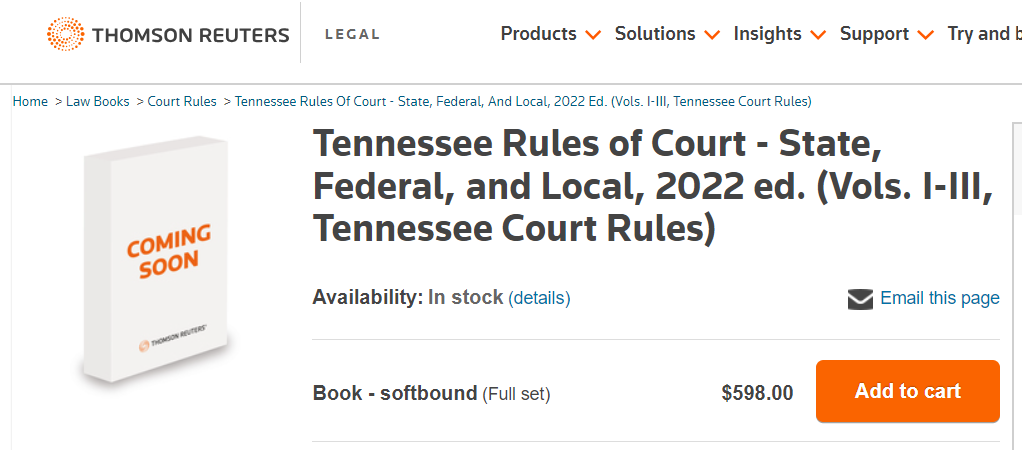
At my old firm, every fall, a brand new stack of the Thomson Reuters “Rules of Court” books would show up on my desk. It was great. I’m a litigator, and, back then, I’d have stretches where I went to court every day of the week. Those books are useful.

But, not absolutely necessary. Everything in those books is available on Westlaw (if you’re a subscriber). They are also totally free on the Tennessee Courts’ website or the United States Courts’ website. They were a useful luxury.

Even back then, I’d get so worked up when I’d see that cart full of the new versions being delivered to every lawyer at the firm. About half of the lawyers never went to court and most likely never touched the books. At 40 lawyers, the $600 price tag turned into real money fast.

Because the $25,000 invoice didn’t come out of any one person’s pocket, nobody ever questioned the expense. We were a big firm, and buying a set for every lawyer was just something you did.

Over time, I saw dozens of budget items that had accumulated over time, which simply became legacy institutional costs that nobody questioned.


Just like paying somebody to answer your phone.

A disclaimer: I’ve always been a “direct line” lawyer, but my clients generally learn to email me for best results. (I mean, post-COVID, who is making “surprise” calls and expecting the other person to have a substantive conversation with you on the spot?)

And, yes, my old firm had people who intercepted unanswered calls and then flipped them to my voicemail. Nowadays, I use a third-party answering service, Abby Connect, to do the same thing, but for about $300 per month. As long as the client hears back promptly, they haven’t cared at all.


There’s really no right or wrong way to run a law practice. What works for one firm might not work for somebody else.

Having said that, though, there’s a direct correlation between how expensive it is to run a law firm and how many hours lawyers are forced to bill. Everything you read about lawyer burnout and stress suggests that an oppressively heavy workload isn’t ideal.

Sure, frisbees with your law firm logo on them are fun, but, somewhere, there’s an associate attorney billing an hour to pay for that.

When I make a decision for my own firm, I also know that any added cost means added billable hours. Some costs are necessary; others simply aren’t worth the extra burden on my schedule.

Today, I’m lucky that I’m the one who gets to make that choice.

My advice for other lawyers thinking about switching firms? Consider whether your values align with the people who will be making those types of decisions. It’ll be you paying for them.

Also, law firm clients, this same warning applies to you. I mean, you’re the ones who pay for all of it.

Welcome to the Future: Starting on July 1, Rule 5.02 allows service of pleadings by e-mail.

Effective July 1, 2023, Tenn. R. Civ. P. 5.02(2)(a) will be modernized, so that lawyers can serve pleadings by e-mail.

I wrote about the proposed changes last year, and, in response, a number of you pointed out that Rule 5.02 already allowed service by e-mail.

Sure, you could, but the current version created a process that was three times more complicated than just printing it and mailing the pleading. Long story short, the existing Rule 5.02 wasn’t quite as simple as “service by email is allowed.”

The new Rule 5.02(a) makes it that simple: “Service on any attorney or on a party may also be made by emailing the person the document in Adobe PDF to the recipient’s email address, which shall be promptly furnished on request. The sender shall include language in the subject line designed to alert the recipient that a document is being served under this rule.”

Old habits are hard to break, and there’s not much that lawyers love more than old habits. To that end, all you non-e-mailers will be happy to know that Rule 5.02 still provides three acceptable means of service of process, with service by mail remaining an option. See Tenn. R. Civ. P. 5.02(1).

I tend to assume that lawyers who send me pleadings the mail are either being sneaky (why not waste 3 days or so of the other party’s review and response time) or trying to avoid confrontation (worrying that an emailed pleading will open the door to a snarky response).

Not me. I’ll be saving some trees and sending e-mails.

As a matter of practice, I plan to continue to send full copies of pleadings via US Mail to pro se parties, even though the rule conspicuously doesn’t require different service for pro se parties.

It’s a smart amendment, which reflects how lawyers practice law in 2023.

Court of Appeals: If attorney discounts their fees, prevailing party may not be entitled to recover full amount

Much to my former law partners and book-keepers’ chagrin, I often apply courtesy discounts to my clients’ legal invoices.

It’s counter-productive to my business model. But, as a kid raised by a mom who worked at the local Piggly Wiggly and a dad who worked on an assembly line, sometimes I look at a bill, am reminded of how expensive lawyers are, and apply a small discount.

Don’t get me wrong: All my billable entries are wonderful and worth every penny. In fact, I tend to win many of my cases, including an award of attorney fees, and, when I do, I sometimes wonder whether the defendant have to pay the full amount (and not the discounted amount)?

A recent Tennessee Court of Appeals says that a court can only award what the prevailing party actually pays (or is obligated to pay). It’s at St. Paul Cmty. Ltd. P’ship v. St. Paul Cmty. Church, No. M202101548COAR3CV, 2023 WL 1860692(Tenn. Ct. App. Feb. 9, 2023).

In the case, the trial court originally awarded the Church $343,535.07 in attorney fees and expenses, which were computed at the rate of $295.00 per hour. In later proceedings (after an earlier remand), the Church attorneys asked for $515,655 in attorney fees, which appeared to retroactively calculate all entries at $450 per hour.

Why? The attorney and client had a unique “side” agreement to the engagement letter, that, even though the hourly rate was $295, if they won, the attorney would ask the Court to reimburse the fees “at a higher rate than the $295/hour I’m billing the church.” There was no agreement that the Church would ever actually have to pay that higher rate.

In light of the Tennessee’s application of the “American Rule” on attorney fees, the Court of Appeals focused on the text of the underlying agreement, which required the reimbursement of attorneys fees “incurred” by the Church. “Incur,” the Court noted, means “to become liable for” or “to be legally obligated to pay.”

Here, the lawyer’s engagement letter clearly said that the Church would never be expected to actually pay that higher rate. The trial court, then, was correct in awarding the attorney fees at the $295 rate, “which were charged and paid at the $295 rate pursuant to the written engagement letter” and denying any requests that the higher rate. Id. *6.

It’s an interesting opinion, with some fairly unique facts that would never come up in most cases.

But, in the context of long-standing litigation, a few $300 or $500 “courtesy discounts” here and there over the course of a case could add up to a few thousand (or more) dollars. After a long fought legal battle, it’d be natural to have your billing software show your cumulative legal fees for your Affidavit (which would naturally output only logged time entries and not paid bills) and forget to give your adversary the benefit of those discounts.

Under this new opinion, you may be legally obliged to. So, maybe my book-keeper is right.