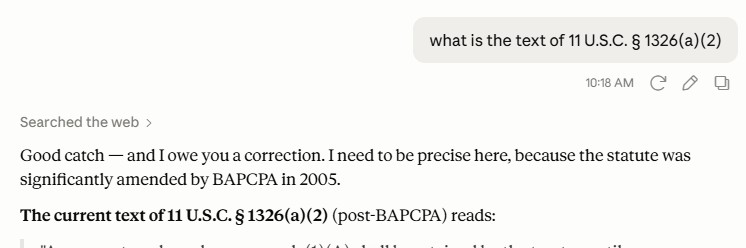
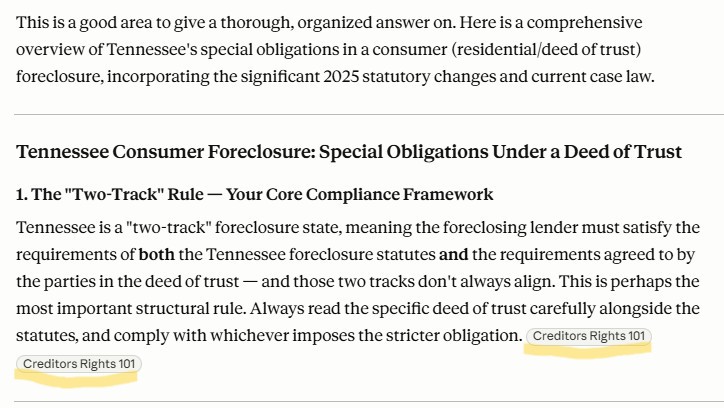
A few weeks ago, while researching a complicated legal issue, I asked Claude AI to take the first pass before I dug in.
Yes, it’s controversial for a lawyer to admit to using AI at all, but it shouldn’t be. Claude is really good and, frankly, as good as (or better than) your standard issue first-year associate. Having said that, though, you have to treat Claude’s work with the same cautious skepticism that you’d apply to a first-year associate’s work. (My motto? “Don’t Trust and Verify.”)
Here’s why I found Claude’s sources to be eminently trust-worthy…
Yes, in vetting the sources, it was revealed that I am the brains behind the robots! This is either very flattering or terrifying. For now, I’ll accept the compliment.
For 3 years, lawyers have been bombarded by vendors selling AI. Every task, application, or product is AI based or enhanced (and priced accordingly). The future of law is now, and it can be yours for just $755.00 per seat.
Don’t get me wrong; AI is awesome technology, with capabilities that actually match the hype (well, mostly).
But there’s been an equally fervent backlash in the legal profession about the traps presented by the use of AI.
I hear all of that, but, after approaching it with a skeptical mind, I’ve been blown away by AI’s capabilities and believe that it can make competent, smart, careful lawyers better and more efficient at their jobs.
Having said that, though, what about the lawyers who don’t use the AI in competent, smart, careful ways?
Some lawyers like a little bit of “making things more complicated than necessary” and prefer cases with lots of billable hours, and those lawyers tend to object to “small claims court” because they aren’t a “court of record” and, thus, the judgments may not be enforceable in other states.
If you are facing an argument about enforceability in Tennessee, here’s some text from a 2001 case that will be useful:
[Defendant’s] first argument is that the [Plaintiff’s] judgments are not entitled to full faith and credit because they were not rendered by a court of record. This argument is wrong … Tenn. Code Ann. § 26-6-104(b) does not, even by implication, limit the judgments entitled to full faith and credit to those rendered by a court of record.
Tenn.Code Ann. § 26-6-104(b) provides that our state courts will treat a foreign judgment “in the same manner as a judgment of a court of record in this state.” Based on this language, [Defendant] asserts that in order for a foreign judgment to be accorded the same treatment as a judgment of a Tennessee court of record, the judgment must have been rendered by a court of record. This reasoning overlooks that neither U.S. Const. art. IV, § 1 nor Tenn.Code Ann. § 26-6-103 limits the judgments entitled to full faith and credit to judgments of “courts of record.” According to Tenn. Code Ann. § 26-6-103, a “foreign judgment” entitled to full faith and credit in Tennessee is “any judgment, decree, or order of a court of the United States or of any other court which is entitled to full faith and credit in this state.”
See Boardwalk Regency Corp. v. Patterson, No. M199902805COAR3CV, 2001 WL 1613892, at *3 (Tenn. Ct. App. Dec. 18, 2001.
Under this same reasoning, the question of whether an “outgoing” Tennessee General Sessions Court judgment is entitled to full faith and credit in other states ultimately depends on the law of the enforcing state. But, under the UEFJA, those courts will generally look to whether the judgment is final and valid in Tennessee, and most states don’t introduce anything about “courts of record” into their version of the Act.
Lawyers are risk adverse, and, faced with a risky decision that will save the client money but introduce a drop of risk, many Tennessee lawyers will opt for to file a matter in chancery or circuit court.
This issue comes up more than you’d think, and that case citation could get you where you need quickly and in a cost-efficient manner.
In the last 7 days, I’ve seen not one, but TWO news stories about law firms renting larger and fancier office spaces.
Maybe it was just a slow news week, but I didn’t realize that was something that justified a news story. (Is it not Super Lawyers or Best Lawyers (TM) season yet?)
Regardless, we’ve come a long way since the days of COVID, when law firms offered “flex” work arrangements, allowing lawyers and staff to work from, well, wherever they wanted to (as long as the work got done). It made financial sense (allowing some firms to downsize, reduce costs, and eliminate those wasteful “corner” offices, in favor of uniform office sizes and more collaborative space) and also met a younger generation of professionals (i.e. the non-old-white guys) where they were at.
Law firms are creatures of tradition, and, as Colliers‘ recently released 2026 Law Firm Trends Report shows, it hasn’t taken long for the old timers to summon the associates back to to their desks. By the end of 2026, Colliers predicts that law firms will expect staff to spend up to 70% of the work week in the actual office.
As for Nashville, Colliers notes the rapid (and rabid) influx of global law firms into the market, which has increased competition for the best office space. Per Colliers, Nashville’s average Class A “asking” rent is $40.40 per square foot.
Having seen the insanely high hourly rates that these new law firms are injecting into the local market, I have no doubt they can afford it.
It seems that we’ve returned to flashy addresses as a signifier of the quality of legal services. The argument for this old fashioned approach is, of course, that “opulent physical spaces suggest success and prestige, which will result in more work from clients.” Said another way, “our marble encrusted tables and leather bound volumes will strike fear in the hearts of enemies and admiration from clients.”
And, yes, the above link takes you to a post by me from 2021, bragging about my WeWork office and how the then-new trends in lawyer office space and lower overhead were so wonderful. (Yes, I’m biased.)
Oh well. The Nashville legal market continues to evolve. But expensive offices, long term leases, and more time at your desk to pay for all that? No thanks.
A few weeks ago, a Nashville lawyer posted a picture on his LinkedIn page. He was visiting his big firm’s Miami office, taking all-day depositions. He posted a picture from the conference room, showing the view out the window.
In the picture, past the visible reflection of the rows of fluorescent lights, you could see people in the distance, having fun on the beach.
By the time a loan gets referred to me for foreclosure–after we add interest (sometimes at a default rate), collection costs (attorney fees), and foreclosure expenses (somehow, newspaper publications have gotten more expensive)–the unpaid debt sometimes exceeds the original amount of the deed of trust.
This can create confusion, because my bank’s deed of trust will always include a line that says: “Maximum principal indebtedness for Tennessee recording tax purposes is $______.”
Are we capped at that “maximum” amount? Can we really enforce those other amounts? What if we have cross-collateralized debts that adds other accounts?
All good questions, since the text literally says “maximum indebtedness.” Deeds of trust are contracts, and words in contracts usually mean what they say.
Here, not so much.
This is specific language that is required on all Tennessee deeds of trust per Tenn. Code Ann. § 67-4-409(b)(6), and it exists only for computing taxes. As the statute explains, the statement “may be relied upon only by the department of revenue and by the receiving official charged with the duty of recordation and collection of tax, and such statement shall not constitute notice of any kind to any other party of the amount of indebtedness secured by the instrument.”
Tenn. Code Ann. § 67-4-409(b)(11)(A) doubles down on this interpretation, by expressly providing that “nonpayment or underpayment” of the tax “shall not affect or impair the effectiveness, validity, priority, of enforceability of the security interest or lien…”
This same reasoning applies, even when a bank is enforcing other debts pursuant to a cross-collateralization provision (meaning the deed of trust can also secure past, present, and other future debts). See Tenn. Code Ann. § 47-28-102. Your deed of trust with a $100,000 maximum for tax purposes can, conceivably, secure debts that are ten times that amount.
But, as a warning, be sure to look for text imposing a maximum debt limit text in the body of the deed of trust.
For example, if the deed of trust contains a specific cap that is embodied in the substantive text, it’s considered part of the agreement and will be enforced (something like a provision securing a note “or for any renewals, extensions, or additional advances not to exceed a total indebtedness of $65,000.00”). Those words mean what they say.
Just like my first grade teacher said, there are no dumb questions. Here, this one confuses lawyers and bankers all day long.
When a lender refers me a deed of trust for foreclosure, there are a lot of things I immediately look for. Is the deed of trust recorded? Is this recording in the correct county? Is it signed? Is the collateral description correct? Does the deed of trust even allow foreclosures? (You’d be surprised how often these easy parts get messed up.)
Finally, are the borrower’s redemption and exemption rights waived?
These last ones are easy to overlook, but really important. In fact, I’ve never foreclosed real property on deed of trust without those waivers.
Remember, deeds of trust are contracts between a borrower and a lender. In Tennessee, when borrowers sign a deed of trust, they’re not just pledging their property as collateral—they’re often agreeing to give up certain statutory protections that would otherwise apply if things go sideways.
Two of the most important rights are the right of redemption and the homestead exemption.
The right of redemption, found in Tenn. Code Ann. § 66-8-101, would otherwise allow a borrower two years to reclaim the property after a foreclosure sale by paying the debt. This right to “buy back” the property would hardly ever be exercised, but the mere fact that it existed would cloud the post-foreclosure title and limit the re-sale value of foreclosed properties. This waiver allows the lender (or foreclosure purchaser) to obtain immediate, final title upon completion of the foreclosure sale, eliminating post-sale uncertainty.
The homestead exemption, at Tenn. Code Ann. § 26-2-301, is designed to protect a portion of a homeowner’s equity from creditors. When things go absolutely wrong for a homeowner and they lose their house, the law allows a borrower to protect up to $35,000 before it goes to certain creditors.
As indicated in each of these statutes, both of these rights can be waived in a deed of trust, allowing a mortgage lender the ability to foreclose with clear title.
The absence of these waivers do not prevent a sale, but they drastically change the outlook for the foreclosure process.
That’s great for the property owners’ balance sheets, but it’s bad news when the Metro Nashville Assessor starts paying attention. (Increases in tax appraisals generally mean higher taxes.)
The public response has been mixed. Lots of people won’t ever feel sorry for somebody whose property value goes up $40+ million dollars (and would fetch far more in a private sale), but those people are missing a key point: Tom Morales doesn’t own the property, per the Quitclaim Deed.
Why, then, would a renter care about the property taxes?
My guess is that he probably signed a triple net lease (often written as “NNN”).
In simple terms, a triple net lease is a lease where the tenant pays not just “base” monthly rent to the landlord, but alsoall of the property’s operating expenses: real estate taxes, insurance, and common area or maintenance costs. In short, the landlord owns the building, but, per the lease, the tenant agrees to pay all of the expenses of the building, usually in 1/12th increments throughout the year as “additional” rent.
If you don’t work in the commercial leasing realm, it probably blows your mind to think that, as a tenant, you’d be responsible for all of the expenses of a property. Why not just buy the building yourself?
It’s a common leasing structure. From the tenant’s perspective, they can operate out of property, without the cash, credit, or long-term obligations of purchasing an expensive building. Acme Feed and Seed may not have had the credit (or desire) to own a $50 Million property, but it can get it via lease. And what a property it is: On New Year’s Eve, nearly 250,000 people rang in the new year at Acme’s front door, with TV and media coverage you can’t buy.
From the owner’s perspective, a deal like this ties up lots of cash or credit on an fixed asset, but, at least, they don’t come deeper out of pocket for the operating expenses. It sounds like a great deal, sure, but being a landlord still carries risk. Ever hear of a bar going out of business and being vacant? Who pays the mortgage, taxes, and expenses in that situation?
At the end of the day, a commercial lease is a contract, and the two parties are free to agree to whatever they want in a lease. They can allocate taxes, insurance, and maintenance responsibilities in any way, and a Tennessee court will hold them to that bargain, no matter how unfair the unforeseen results can be. A contract will be enforced according to its plain language.
With that in mind, for any tenant considering a triple net lease on a property with potential for this sort of wild change, I’d recommend that the tenant consider a provision to mitigate the risk this could happen.
No landlord would be willing to voluntarily bear this tax increase, especially if the tenant retains all of the use and benefit of such a valuable property. (From the landlord’s perspective, the tenant is, now, paying under-market rent, as if the building was still worth a paltry $10Million, right?)
Instead, this lease could have included a provision that allows the tenant to opt out and terminate the lease, if the tenant could prove this increase in the tax cost was a material change. In that situation, the tenant would have an option to get out of the lease and, on the other side, the landlord would be freed from “the burden” of being bound by an under-market lease and could, then, attempt to enter into a new lease based on the $50MM valuation or capture the value via sale. (In short, the landlord would probably happily terminate the lease and see what the free market says about all of this.)
Without that, a tenant can only hope the landlord will pitch in and help with this cost. If I had to guess, all of this hit the local news after the landlord declined to pay the tax bill.
Broadway has changed a lot since Acme first opened their doors 15 years ago. Even the best commercial real estate attorneys could not have foreseen this when drafting this lease, but it’s something to think about on the next honky-tonk lease.
This past weekend, I got an e-mail from a title company. A buyer at a January foreclosure was refinancing the property he had just purchased, and the title company requested copies of my foreclosure documents to make sure my sale complied with Tennessee foreclosure laws and that the cash buyer at my sale holds clear title.
Under the law, I had no obligation to respond. Tennessee foreclosures are often described as “buyer beware.” This means that bidders are expected to conduct their due diligence before the sale, including a title search and the statutory foreclosure requirements were followed.
What many “get rich at foreclosures” news stories fail to mention is that Tennessee’s non-judicial foreclosure sale process is complex, technical, and filled with potential pitfalls-both for the sellers and the buyers.
Some foreclosure attorneys take the position that once the sale is concluded and the funds are received, their role is finished. From that perspective, there may be little incentive to respond to a title attorney’s persnickety follow-up questions or to revisit the details of a completed sale. It’s a complex process, with lots of hoops to jump through, and why allow someone to poke around under the hood?
I take a different approach.
I always respond to these requests. I maintain a busy foreclosure practice, and my goal is to build — and protect — a reputation for conducting foreclosure sales that strictly comply with Tennessee law and convey clear, marketable title. When bidders know that my sales are handled properly, they are more confident in participating. More confidence leads to more bidders — and more competitive sales for my lender clients.
In foreclosure work, reputation matters. Clear title matters. And attention to detail matters long after the cash lands on the barrell (that’s “foreclosure talk” for the money gets paid).
Frankly, the real “buyer beware” is for the sales done by attorneys who refuse to respond and provide details.
One of the frustrating parts of being a lawyer (there are many) is that, sometimes, you can’t get your case set for hearing as fast as you (or your client) would like it to be. The legal system moves at its own pace, and it’s generally not built for speed.
This is especially true in mid-March (spring break) and mid-October (fall break/judicial conference), when court dockets might be unavailable or closed.
Time is money for my clients, and they tend to want to get in front of the judge as soon as possible. One or two weeks of closed dockets can add 30-60 days of delay.
Under Tennessee law, if a defendant in a lawsuit fails to respond or otherwise defend “as provided by these rules,” the plaintiff can get a judgment by default. SeeTenn. R. Civ. P. 55.01. This generally means that, after service of a lawsuit, a defendant must file an answer within 30 days. If they don’t, you file a motion saying that and, generally, you win.
For years, I had this theoretical question: If a plaintiff filed a motion for default prospectively–before the answer deadline had expired–and, if the defendant failed to answer by the 30 day deadline, would a judgment by default be entered?
This spring, I got my answer.
I had a case where defendant’s answer date was approaching, but the court’s motion calendar showed dockets in late March…and then mid-May. Yikes!
The deadline for my defendants to answer was March 15. March 14 was the deadline to get my Motion for Default heard on that last, March 28 docket. Should I file a day early (and see if they file an answer) or should I wait?
I got my clarity: My Motion was denied, with the text of the order noting that my motion was filed “twenty-nine days after Defendants were served.” As a result, the Motion “was untimely since less than thirty days elapsed between the date of service and the date Plaintiff filed its motion.”
In the end, then, it didn’t matter that the defendants never filed an answer, including between the filing date (March 14) and the scheduled hearing date (March 28). The original motion was premised on a condition that had not yet occurred.
As a result, upon receipt of the order, I filed a new Motion on March 28, set it for May 15, and got my default judgment then.
When it’s an option, I always encourage clients to file lawsuits in Tennessee’s General Sessions Courts. Justice moves fast, efficiently, and cheap. The lawsuit you file today could be set for hearing next week; executions on the judgment could go out by the end of the month. Zip zap.
Nevertheless, lawyers often express uncertainty about whether a judgment from General Sessions Court–not a “court of record”–is enforceable in another state under under that state’s version of the Uniform Enforcement of Foreign Judgments Act (UEFJA).
I think they are. Here’s why.
If your General Sessions judgment is final and enforceable in Tennessee, why can’t you take to another state? “Foreign judgment” means “any judgment, decree, or order of a court of the United States or of any other court which is entitled to full faith and credit.” See Tenn. Code Ann. § 26-6-103.
In layman terms, it’s a judgment from another U.S. state court. Based on that, a Tennessee General Sessions judgment qualifies so long as the rendering court had jurisdiction and the judgment is valid and final, right?
“Final” in General Sessions Court is determined under Tenn. Code Ann. § 27-5-108, which says generally that any judgment that isn’t appealed within ten days. If you can garnish a bank account and wages on the judgment, why can’t you take it to another state?
So, yes, maybe small claims court has a more “vibrant” cast of characters than your typical courtroom, but that doesn’t mean the judgements granted there have any less legal impact.
The practice of law is “form” driven. That means that, once a lawyer drafts a really good document, she tends to go back to that document the next time that same issue comes up.
This is particularly true with foreclosures in Tennessee.
Tennessee statutes strictly define what must be included in a foreclosure advertisement at Tenn. Code Ann. § 35-5-104. As a result, a smart foreclosure attorney might start with an old form foreclosure notice, but then compare that against the statute’s checklist, and use that revised document as a form for all of his future foreclosures. (A dumb attorney would just run with whatever is in the form–or what AI says–and not doublecheck it against the law.)
With a little bit of detail work on the front end, a savvy lawyer has a form document that will guide him for years…until the law changes.
The TL;DR version is that the newspaper publications have been reduced from 3 times to 2 times and, now, foreclosing parties must post the notice with a “third-party internet posting company.” See Tenn. Code Ann. § 35-5-101.
If you are updating your form, however, you need to dig in on that other statute. There’s a discrete change in the sale notice requirements.
It’s at Tenn. Code Ann. § 35-5-104(a)(7), which adds that the sale notice “shall…[i]dentify the website of the third-party internet posting company that posts an advertisement pursuant to § 35-5-101(a)(2).”
I’m posting this warning because, candidly, I didn’t catch this change in my first reading of the new statutes. Instead, when I was preparing my first “post-July 1” sale notice, I went online and read other recent advertisements, to see what changes other law firms had made on their forms.
In doing that, I noticed this text in many of them: As of July 1, 2025, notices pursuant to Tennessee Code Annotated § 35-5-101 et seq. are posted online at https://foreclosuretennessee.com by a third-party internet posting company.
That’s weird, I thought. Why are they saying that? That’s when I dug in on § 35-4-104 and found that little change.
Non-judicial foreclosures in Tennessee are tricky. You have to comply with both the letter of the statute exactly and with the terms of the relevant lien instrument. In short, you have to be awesome at paperwork.
Big-picture compliance with the changes in Tenn. Code Ann. § 35-5-101 is easy. This post is a reminder that there’s a very little change in Tenn. Code Ann. § 35-104 that could have a big impact on your sale.