Get Your Foreclosures Started Now: New Tenn. Code Ann. § 35-5-101 takes effect in Two Weeks

The Tennessee Legislature has made some significant changes to the foreclosure process in Tennessee, and those changes to Tenn. Code Ann. § 35-5-101 take effect on July 1, 2025.

This post is not to summarize the changes. (I’ll do that at this Tennessee Bar Association CLE, Upcoming Changes to Tennessee Foreclosure Law, alongside the Tennessee Bankers Association.)

The point of this post is more urgent.

By my analysis, the new statute doesn’t apply to foreclosures initiated before July 1 and, for those of you who aren’t ready or willing to learn a new law, I tell you this: Issue your foreclosure sale notices now.

Here’s my analysis. Tenn. Code Ann. § 1-3-101 says “[t]he repeal of a statute does not affect any right which accrued, any duty imposed, any penalty incurred, nor any proceeding commenced, under or by virtue of the statute repealed.”

The Tennessee Supreme Court has considered a similar question and wrote “[t]hough ‘procedural’ changes in the law generally apply retrospectively to causes of action arising before such changes become law,… where the pending action has gone beyond the procedural stage to which the amendment pertains, an amendment will not apply.” See Smallwood v. Mann, 205 S.W.3d 358, 365 (Tenn. 2006).

In short, even though procedural legislation generally applies retroactively, this general concept doesn’t apply when the case has progressed beyond the procedural stage impacted by the new law.

By my own analysis (disclaimer: I could be wrong), if a foreclosure was already in its publication stage before July 1, 2025, the new law doesn’t apply.

After more than 25 years, I’ve practiced through many changes in the law. In that time, I’ve learned that there are always growing pains, confusion, and a little bit of chaos in the days, weeks, and months after a big change.

What I’m saying is: Call your bankers and ask them if you have any foreclosures on their desks.

Law Firms: To avoid Malpractice Claims, Remember that Tennessee Judgments Expire in Ten Years

Tennessee judgments expire after ten years.

As a creditor lawyer, one of my greatest fears is that one of the many judgments that I’ve taken over the past 10 years is set to expire and I have forgotten about it.

It is so easy to renew judgments under Tenn. R. Civ. P. 69.04, but it’s also easy to forget about those old files. If a law firm forgets, it could get sued for malpractice. It’s a big deal.

Earlier this week, the Tennessee Court of Appeals touched on this issue. See John Doe Corp. v. Kennerly, Montgomery & Finley, P.C., E2023-00236-COA-R3-CV (Tenn. Ct. App. May 28, 2024).

In the case, after the 10 year period expired on an old judgment, the judgment creditor client sued its former lawyers, alleging that the law firm “had failed to inform Plaintiff that the judgment would expire after ten years or that it needed to seek to extend the judgment prior to its expiration.”

The trial court dismissed the claims against the law firm, because the client failed to have filed the lawsuit within the one-year attorney malpractice statute of limitations. The opinion doesn’t really focus on the renewal issue; the real analysis is on issues of recusal and the different standards under Tenn. R. Civ. P. 59.04 and 60.02.


But, back to creditor rights. Is this is victory for the law firm? Not really, because lawyers don’t like being sued for malpractice in the first place.

Since starting my firm nearly 4 years ago, I’ve opened 639 new cases. Before that, I handled a similarly busy caseload at my old firm. In the past 10 years, I’ve taken 100s of judgments.

It would be a cold comfort to me to know that, if my client sues me for malpractice, I could possibly defend the case on a technicality.

Having said that, how can lawyers mitigate that risk? The answer is in a Court of Appeals decision I wrote about in 2019. There, the malpractice claims turned on whether the law firm warned the client, at any point, that the judgment needed to be renewed in ten years. Because the law firm had previously warned the client about the 10 year expiration, the client had knowledge of the possible malpractice claims that accrued at the time of non-renewal (and not a later date).

Look at the text of the John Doe case: the client alleged that the law firm “had failed to inform Plaintiff that the judgment would expire after ten years or that it needed to seek to extend the judgment prior to its expiration.”

If you’re like me, a busy lawyer with many judgments, remember my advice from 2019: “A good practice is to make sure that the client understands that it has a responsibility in ten years to notify you that it wants you to take this action.”

In a perfect world, my advice is to calendar judgments and simply avoid this issue altogether.

A separate safeguard could be, in that initial congratulatory email, sending a copy of the judgment to the client, to always include text that clearly discusses the validity and expiration of the Judgment in terms that the client can understand.

Smaller Law 101: Advice from Taylor Swift about Bad Client Intake

When I think about my least favorite cases, it’s generally because the client is terrible in some crucial way.

I remember the day I got my own all-time least favorite case. It was about 20 years ago, and my day started with a simple matter in Williamson County General Sessions Court. While I was waiting for my case, there was a dramatic hearing on the docket right before mine.

A contractor had filed a pro se collection lawsuit, and, during the trial, the contractor came with a wild energy, ready to fight. He got into an argument with the lawyer on the other side, threatened the homeowners, had no documents to support his case, and ended the trial by yelling at the Judge (who had ruled against him and told him to hire a lawyer and appeal it, if he thought the decision was wrong).

As the contractor stormed out of the courtroom, yelling at everybody, I remember thinking “I would hate to be that guy’s lawyer.”

In the two hours that it took for me to get lunch and make it back to my office in Nashville, my boss had a new case for me. Yes, it was that guy. He had told his cousin about how he had gotten screwed over by a biased judge and needed a lawyer for the appeal in Circuit Court. The cousin–a client of my firm–recommended my boss, who handed the file directly to me.

I told my boss what I saw in court that day and begged him not to take the case.

I’ll spare you all the details, but that client never got less angry and more reasonable. He was mad at me for asking for paperwork and proof. He didn’t understand why we needed evidence. He was mad at the bills we sent him. He refused to participate in any meaningful aspect of the process. He hated me and questioned everything I said to him about the case. Settlement was never an option. We were going to fight this to the end. My boss took a “hands off” approach.

In the end, he showed up for the trial in Circuit Court, but it was only slightly less wild than the first trial. We lost spectacularly, and my memories of that trial are as vivid to me as my memories of my wedding day and the births of my children.


I tend to think about that case during the holiday season, because, after that trial, I went directly to a real estate agent’s elaborate holiday party in a 6,000 square foot model home in Brentwood (this was the good times, pre-Great Recession). I drowned my PTSD in eggnog.

I was reminded of it all, when I saw Matt Margolis‘ tweet about how better the practice of law can be when you get to choose your clients. Matt recently started his own law firm, Margolis PLLC.

That may be the greatest benefit of running your own firm. At my old firm, you got handed cases, whether you wanted them or not. Some clients are unreasonable. Some have bad claims. Some can’t afford a lawyer. In a big firm, often you don’t always have a choice. It’s too bad, though, because taking on bad cases or bad clients is an easy way to create unhappy lawyers.

Don’t get me wrong: In your own firm, you will absolutely take on bad cases and bad clients, but it’s different when it’s your own choice. At worst, it’s a lesson you (hopefully) learn from. Having recently closed the last of what I referred to as “The Sinister Seven,” I can assure you that it’s a learning process (ask me about the sequel, “The Terrible Two”). Taylor Swift and I both can benefit from some honest self-reflection.

After three plus years of running my own firm, you would be shocked at how picky I have become (I call it The Client Decision Tree, and I’ll do a full post on that soon). Some lawyers see those initial client calls like a job interview, and I do too: But it’s usually me doing the vetting.

I refer out about three times as many cases than I accept, and it’s been a revelation. Some clients simply make things more difficult, and that can impact your entire practice.


To this day, my engagement letters say “the attorney-client relationship is one of mutual trust and confidence,” and it’s not just filler to distract the client from the hourly rate and retainer. If I get a sense from a potential client that she doesn’t respect my role, the legal process, or trust me (i.e. listen to me), that client never gets an engagement letter.

Life is too short and reputations are too fragile to do work for clients who aren’t a good fit with my firm. Say yes to too many bad clients, and you’ll find you have less time, patience, and space for the awesome clients.

Nashville Has a Bankruptcy Lawyer Problem

There are hardly any bankruptcy lawyers in Nashville under the age of 40.

With three law schools in the Middle Tennessee area, you’d think there’d be more than enough lawyers in Nashville to satisfy any and every conceivable legal need. 

If so, you’d be wrong. In my recent experience, Nashville is an under-lawyered city, if you judge from the number of new calls I get (across the legal spectrum) and, as result, the difficulty I have finding a lawyer to refer these callers to.

(As an aside, it might just be that the clients are calling their old lawyers at their new firms and are stunned by the new hourly rates.)

Having said that, I’m really concerned about the lack of young bankruptcy attorneys.

I wrote about this 2020–“The Bankruptcies are Coming, but Where are the Bankruptcy Attorneys“–and my bold March 2020 and April 2020 prediction about the looming wave of bankruptcy filings was totally wrong. In fact, the opposite was true: Bankruptcy filings in Middle Tennessee hit a historic low mark during that time.

As the country braces itself for an economic dip and you hear about law firm layoffs, I repeat my old advice: Learn Bankruptcy.

A bankruptcy practice is one of the best kept secrets in the profession. It’s all based on the Bankruptcy Code, which you can read cover-to-cover in an afternoon. It’s a small, collegial and sophisticated bar (the fact that it’s so small tends to prevent the shenanigans lawyers pull in the broader legal universe).

Plus, starting in a bankruptcy practice exposes you to nearly every legal issue imaginable, since so many state and federal law issues end up in bankruptcy court. Many complex transaction lawyers cut their teeth doing 363 sales in bankruptcy court.

During the last recession, Nashville was lucky and recovered quickly, with real estate prices rising, corporate growth, and a robust commercial lending base in the immediate years after the downturn. 

The downside of that is that we’ve lost a generation of bankruptcy lawyers to corporate, commercial lending, and other (more sexy) practice areas. Today, in the year 2023, the lawyers who file debtor bankruptcies are largely the same ones who were filing those cases fifteen years ago. You can count the firms who file small/medium corporate chapter 11 cases on one hand.

I expect to see more national and local bankruptcy filings in 2024. If you’re a law student or recent grad trying to differentiate yourself from the pack, learning a little bit about bankruptcy law may be a smart move.

Smaller Law: You Don’t Answer Your Own Phones, Do You?

Last year, I was making small talk with a Medium Firm lawyer at a fancy lawyer dinner, and I was complaining about all the phone calls.

The conversation hit an abrupt stop….

Him: Wait a second. You don’t answer your own phone calls, do you?

Me, after an awkward 5 second pause: HA! No way, of course not, are you kidding? (said, literally, while my phone was vibrating in my pocket with a new call)


One of my favorite parts of having my own firm also relates to the least fun part of it: I make every administrative decision and also pay for every decision.

When the cost of every subscription, new technology, and sponsorship comes directly out of your own pocket, you develop a critical eye when making decisions.

With every one, I always ask: Will this help me serve my clients and/or make their experience working with me better? If yes, I then ask: Is it absolutely necessary?


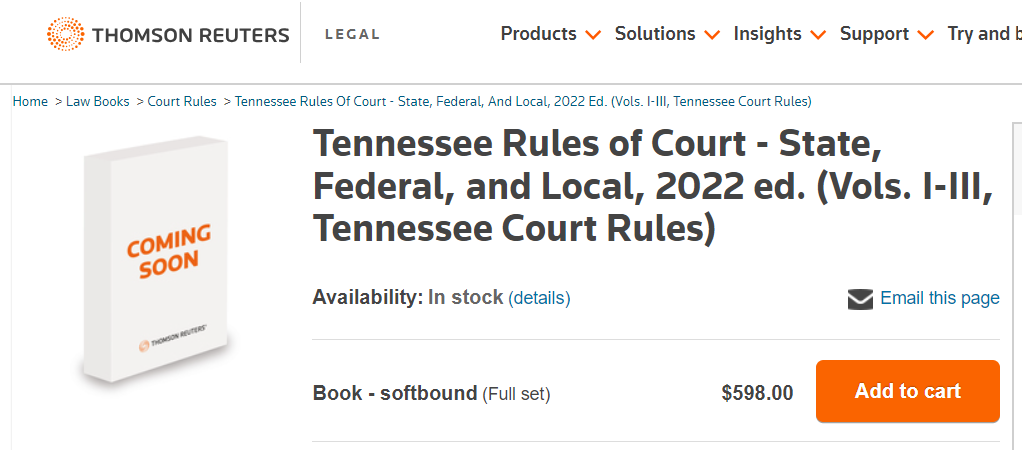
At my old firm, every fall, a brand new stack of the Thomson Reuters “Rules of Court” books would show up on my desk. It was great. I’m a litigator, and, back then, I’d have stretches where I went to court every day of the week. Those books are useful.

But, not absolutely necessary. Everything in those books is available on Westlaw (if you’re a subscriber). They are also totally free on the Tennessee Courts’ website or the United States Courts’ website. They were a useful luxury.

Even back then, I’d get so worked up when I’d see that cart full of the new versions being delivered to every lawyer at the firm. About half of the lawyers never went to court and most likely never touched the books. At 40 lawyers, the $600 price tag turned into real money fast.

Because the $25,000 invoice didn’t come out of any one person’s pocket, nobody ever questioned the expense. We were a big firm, and buying a set for every lawyer was just something you did.

Over time, I saw dozens of budget items that had accumulated over time, which simply became legacy institutional costs that nobody questioned.


Just like paying somebody to answer your phone.

A disclaimer: I’ve always been a “direct line” lawyer, but my clients generally learn to email me for best results. (I mean, post-COVID, who is making “surprise” calls and expecting the other person to have a substantive conversation with you on the spot?)

And, yes, my old firm had people who intercepted unanswered calls and then flipped them to my voicemail. Nowadays, I use a third-party answering service, Abby Connect, to do the same thing, but for about $300 per month. As long as the client hears back promptly, they haven’t cared at all.


There’s really no right or wrong way to run a law practice. What works for one firm might not work for somebody else.

Having said that, though, there’s a direct correlation between how expensive it is to run a law firm and how many hours lawyers are forced to bill. Everything you read about lawyer burnout and stress suggests that an oppressively heavy workload isn’t ideal.

Sure, frisbees with your law firm logo on them are fun, but, somewhere, there’s an associate attorney billing an hour to pay for that.

When I make a decision for my own firm, I also know that any added cost means added billable hours. Some costs are necessary; others simply aren’t worth the extra burden on my schedule.

Today, I’m lucky that I’m the one who gets to make that choice.

My advice for other lawyers thinking about switching firms? Consider whether your values align with the people who will be making those types of decisions. It’ll be you paying for them.

Also, law firm clients, this same warning applies to you. I mean, you’re the ones who pay for all of it.

Welcome to the Future: Starting on July 1, Rule 5.02 allows service of pleadings by e-mail.

Effective July 1, 2023, Tenn. R. Civ. P. 5.02(2)(a) will be modernized, so that lawyers can serve pleadings by e-mail.

I wrote about the proposed changes last year, and, in response, a number of you pointed out that Rule 5.02 already allowed service by e-mail.

Sure, you could, but the current version created a process that was three times more complicated than just printing it and mailing the pleading. Long story short, the existing Rule 5.02 wasn’t quite as simple as “service by email is allowed.”

The new Rule 5.02(a) makes it that simple: “Service on any attorney or on a party may also be made by emailing the person the document in Adobe PDF to the recipient’s email address, which shall be promptly furnished on request. The sender shall include language in the subject line designed to alert the recipient that a document is being served under this rule.”

Old habits are hard to break, and there’s not much that lawyers love more than old habits. To that end, all you non-e-mailers will be happy to know that Rule 5.02 still provides three acceptable means of service of process, with service by mail remaining an option. See Tenn. R. Civ. P. 5.02(1).

I tend to assume that lawyers who send me pleadings the mail are either being sneaky (why not waste 3 days or so of the other party’s review and response time) or trying to avoid confrontation (worrying that an emailed pleading will open the door to a snarky response).

Not me. I’ll be saving some trees and sending e-mails.

As a matter of practice, I plan to continue to send full copies of pleadings via US Mail to pro se parties, even though the rule conspicuously doesn’t require different service for pro se parties.

It’s a smart amendment, which reflects how lawyers practice law in 2023.

Court of Appeals: If attorney discounts their fees, prevailing party may not be entitled to recover full amount

Much to my former law partners and book-keepers’ chagrin, I often apply courtesy discounts to my clients’ legal invoices.

It’s counter-productive to my business model. But, as a kid raised by a mom who worked at the local Piggly Wiggly and a dad who worked on an assembly line, sometimes I look at a bill, am reminded of how expensive lawyers are, and apply a small discount.

Don’t get me wrong: All my billable entries are wonderful and worth every penny. In fact, I tend to win many of my cases, including an award of attorney fees, and, when I do, I sometimes wonder whether the defendant have to pay the full amount (and not the discounted amount)?

A recent Tennessee Court of Appeals says that a court can only award what the prevailing party actually pays (or is obligated to pay). It’s at St. Paul Cmty. Ltd. P’ship v. St. Paul Cmty. Church, No. M202101548COAR3CV, 2023 WL 1860692(Tenn. Ct. App. Feb. 9, 2023).

In the case, the trial court originally awarded the Church $343,535.07 in attorney fees and expenses, which were computed at the rate of $295.00 per hour. In later proceedings (after an earlier remand), the Church attorneys asked for $515,655 in attorney fees, which appeared to retroactively calculate all entries at $450 per hour.

Why? The attorney and client had a unique “side” agreement to the engagement letter, that, even though the hourly rate was $295, if they won, the attorney would ask the Court to reimburse the fees “at a higher rate than the $295/hour I’m billing the church.” There was no agreement that the Church would ever actually have to pay that higher rate.

In light of the Tennessee’s application of the “American Rule” on attorney fees, the Court of Appeals focused on the text of the underlying agreement, which required the reimbursement of attorneys fees “incurred” by the Church. “Incur,” the Court noted, means “to become liable for” or “to be legally obligated to pay.”

Here, the lawyer’s engagement letter clearly said that the Church would never be expected to actually pay that higher rate. The trial court, then, was correct in awarding the attorney fees at the $295 rate, “which were charged and paid at the $295 rate pursuant to the written engagement letter” and denying any requests that the higher rate. Id. *6.

It’s an interesting opinion, with some fairly unique facts that would never come up in most cases.

But, in the context of long-standing litigation, a few $300 or $500 “courtesy discounts” here and there over the course of a case could add up to a few thousand (or more) dollars. After a long fought legal battle, it’d be natural to have your billing software show your cumulative legal fees for your Affidavit (which would naturally output only logged time entries and not paid bills) and forget to give your adversary the benefit of those discounts.

Under this new opinion, you may be legally obliged to. So, maybe my book-keeper is right.

New Court of Appeals Opinion suggests that late-filed Answer may not prevent a default judgment

All the good Nashville lawyers I know are so busy right now. This is a good problem to have, but, nevertheless, it is a problem. There’s simply too much demand right now.

I overheard one local lawyer telling a story about a frantic call he received from a client, who was freaking out because they hadn’t filed an Answer to a lawsuit, and it had been more than 30 days after service.

“Have they filed a Motion for Default yet? If not, then it’s not late.”

I’m sure the lawyer was more tactful in the actual conversation, but the reasoning has some basis in local custom. Often, in Davidson County courts, if a defendant files an Answer before the hearing on a Motion for Default Judgment and pleads a tenable defense, a court will not grant a judgment under Tenn. R. Civ. P. 55, under the theory that the justice system prefers that “matters be decided on the merits” not a technicality. (See, generally, Discover Bank v. Morgan, 363 S.W.3d 479, 491 (Tenn. 2012)).

A recent opinion from the Tennessee Court of Appeals shows that there are risks in waiting to file an Answer.

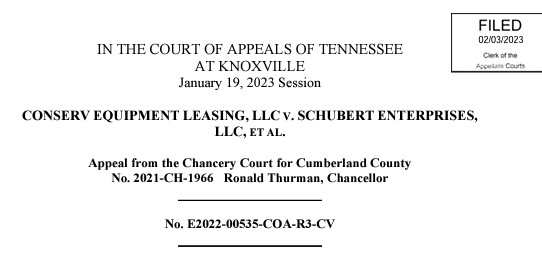
That case is Conserv Equip. Leasing, LLC v. Schubert Enterprises, LLC, No. E2022-00535-COA-R3-CV, 2023 WL 1489768 (Tenn. Ct. App. Feb. 3, 2023). There, the creditor filed a motion for default, and, a few days later, received a phone call from an attorney who “expected to be retained” by the defendants and asked for a 3 week continuance on the motion hearing. After the hearing was so continued, that defense attorney “fax-filed” an Answer at 3:59pm on the Friday before the Monday morning default hearing, with an original copy filed with the Clerk about 33 minutes before the hearing.

Defendant appeared at the hearing, objecting to the relief and presumably with filed Answer in hand, but the default judgment was nevertheless granted. At the trial court level, Defendants later tried to set aside the ruling on excusable neglect grounds and Tenn. R. C. P. 60.02.

The Court of Appeals noted that “[a]lthough courts construe Rule 60.02 ‘with liberality to afford relief from a default judgment,’ the movant bears the burden of showing ‘why the movant was justified in failing to avoid the … neglect’.” Id. at *2. The Court wrote that “[i]f the court finds that the defaulting party has acted willfully, the judgment cannot be set aside on ‘excusable neglect’ grounds…” and “[m]aking ‘deliberate choices’ amounts to willful conduct. Id.

In the end, the issue was remanded back to the trial court, whose order denying the Rule 60 motion failed to include findings of act and conclusions of law (per Tenn. R. Civ. P. 52.01). In short, the trial court didn’t provide any explanation for its ruling.

To be clear, though, the Court of Appeals didn’t say the trial court was wrong; instead, it sent it back down for the trial court to provide more explanation for its refusal to set aside the judgment. The most likely outcome, of course, is that the plaintiff will prepare a properly supported proposed order, the judge will sign it, and, then, that order will be appealed.

It’ll be an interesting case to watch, but, procedurally, it’s also a reminder: Don’t delay when dealing with court deadlines.

On Lawyer Stress (a/k/a the Post I will send clients when I raise my rates for 2023)

Do you think you might be having a heart attack?

No matter what the actual ailment is. Food poisoning. Anxiety. Indigestion. Insomnia.

When you wake up at 2am, with a racing heart, and a feeling that something isn’t quite right, and get asked “Do you think you might be having a heart attack?

Well, in that moment, you think one thing. That you might be having a heart attack.

I know this from my own experience, just last month. It was the very early Tuesday morning evening of a very busy week: I had a trial scheduled to start 32 hours later in Memphis and, at the end of the week, a bankruptcy conference in California.

And, in that moment, at 2am, yes, it felt like I was having a heart attack.

Continue reading “On Lawyer Stress (a/k/a the Post I will send clients when I raise my rates for 2023)”

My 2022 Worst of Legal List: A Highly Biased List of Niche Things I Disliked

I promised a follow-up to my “Best of List,” but, since complaining is more fun, I am writing about some things I disliked in 2022.

The courts system’s quick return to pre-COVID practices. You remember my rant when I caught COVID on a 5 hour docket in July. I think courts were too quick to abandon the pandemic innovations and return “to the way law was practiced when people rode horses to court.” Sure, a court might let you call-in for a hearing, but there is always a risk the technology won’t be up to speed, the judge won’t realize you’re on the line, or she won’t be able to hear you on the invariably staticky line. Having seen the trouble other lawyers had with call-in appearances, I decided to never risk my client’s case on a remote appearance. When in doubt and given the option, lawyers will generally appear in person. How about–for some hearings–there’s a process that allows for no other option other than to call-in?

There’s no state-wide, uniform e-filing system. My law practice has a fairly small foot-print. (My marketing materials call it a “curated practice.”) In the 3-4 counties where I do most of my work, I have separate log-ins for the different courts in each of those counties. Each e-filing system has its own set of rules, exclusions, and peculiarities. E-filing is awesome, so I’ll take a bad system over no system. But, having said that, why can’t the State of Tennessee establish a uniform system?

Our Tennessee foreclosure system is entirely based on physical newspapers. Until recently, I had a newspaper subscription, even though: (a) for the past 20 years, I’ve gotten 99% of my news online; (b) my local newspaper had shrunk to about 10 pages (total); and (c) my newspaper carrier generally delivered my morning paper either 8 hours late, the next day, or not at all. Physical newspapers are possibly the worst way to convey information in our modern age, but, nevertheless, Tennessee’s entire foreclosure and UCC sale system is tied directly to published notices in physical copies of newspapers. All over the country, newspapers are going to an online-only model (followed, most likely, by going out of business). But our foreclosure laws haven’t been updated. We’re headed for trouble unless we change these laws.

There’s no penalty for bogus lien filings in Tennessee. Sure, there’s the toothless “exaggeration of lien” statute (Tenn. Code Ann. § 66-11-139) or the confusing “slander of title” cause of action, but, by and large, if somebody records a piece of paper with “Notice of Lien” written somewhere on it (and includes the owner name and property address), they’ve got a totally un-lawful, but also practically-effective, lien. A few years ago, the Tennessee Legislature passed Tenn. Code Ann. § 66-21-108, which gave property owners a nuclear bomb to deal with invalid lien claims, but it was repealed within a year. As it stands now, there’s no useful remedy, other than to pay the invalid lien or to cancel your transaction.

Big Mortgage Lenders refuse to provide payoffs on their debts with impunity. One of the weirdest sub-plots throughout my 2022 was how near-impossible it was to get a payoff from mortgage lenders. In December, I had to sue a mortgage lender to get a payoff (and to stop an immediately pending foreclosure sale). It might have been the dumbest lawsuit I’ve ever filed (dumb as in the other side was dumb to make me go to the trouble): Within 24 hours of my getting a foreclosure injunction, the lender provided the payoff and, within a few hours of that, it was paid off in full. A win, except it cost more than $5,000 in unrecouped legal fees to address an unnecessary situation. There needs to be a law that imposes penalties, including attorney fees, in these situations.

I spent the entire year in a sales funnel. In 2022, after a full year as a small business owner, I took some time to evaluate my existing legal technology and services and what needed to be upgraded. On legal tech websites, I’d enter my email in order to download some awesome “Free Guide To _____” that promised a magical solution or explanation for some common problem or process. Having downloaded a number of those (none of which solved any problem), my phone rang all year long, over and over, with sales calls. It’s not “free,” if I end up in a Sales Funnel. My advice to service providers: How about sharing your expertise, impressing me with your vast knowledge, and leaving me alone, confident that I’ll return to you for my buying needs?

Phone calls from Tom James Company custom clothiers were the worst. If I ever find out who sold my name and phone number to Tom James Company, I will immediately sever ties with that organization (I suspect one of the bar associations did it). Tom James representatives were relentless in 2022. They called me so many times that I remembered the caller’s name (from the prior week’s call), could recite their opening line back to them, and remind them that I was the person who wasn’t interested because I buy all my suits from South Korea, just like BTS (not true, but why not go big, right?). After maybe 25 calls in 2022, I reached out to Tom James corporate, and asked if I could pay them something to be added to a no-call list.

Dealing with global, multi-state law firms. All of Nashville’s medium to big law firms are slowly selling out to mega-law firms. For the most part, I still deal with local folks on my litigation matters, but, on matters where a Tennessee law license may not be required, I have to deal with out-of-towners, and it’s rarely a pleasant, easy relationship. It’s a trend I’m dreading, as these firms bring their billable rates, minimum hourly requirements, other customs into the work they do in the local market. In short, their weirdness makes my job harder.

I miss old twitter. Many years ago, while waiting at a docket call in Montgomery County, I tweeted that I forgot to bring a pen for court. Within a minute, a local lawyer who follows me on twitter introduced himself and handed me a pen. Over the past decade plus of very-regular twitter use, I have found a vibrant and diverse lawyer community who post updates, victories, and advice. It’s awesome. Over the last few months, it’s gotten less active. If twitter as we once knew it goes away, we will have truly lost something.

The Lawyer-Industrial-Complex has gotten out of hand. Have you tried to hire a lawyer lately? If so, you were probably shocked by their hourly rates. The Clio 2022 Legal Trend Report (warning, you have to enter your email to access it) says that, in fact, lawyer rates are too low and haven’t risen with the general rate of inflation. I don’t know about that, but, holy smokes, lawyers and all the law adjacent services are so expensive right now. I’m using a Westlaw Rules of Civil Procedure book from 2020 because a new set (that will be obsolete in a month) is nearly $1,000. Some lawyers say that this isn’t a problem (more money in my own pocket, right?), but, frankly, it’s a trend that I don’t like. Prices are going up, but the quality of service is staying the same.

Having said that, where are all the good, reasonably priced Nashville lawyers? As noted above, I keep a small footprint for my law practice, and I refer out about 2/3 of the “new client” calls I get. My biggest problem with referrals has been “To whom”? I only refer cases to lawyers who will make me look good and will do an awesome job. Everybody on my existing list is swamped right now. What Nashville lawyer does good, competent, cost-efficient work? And, also, is looking for more work? I can’t find him or her. But I’m looking.