Nashville Bankruptcy Lawyers Prepare for the Inevitable Spike in Filings

During this coronavirus pandemic, lots of us aren’t working. (Don’t worry, clients, I am 100% working.)

Many of us are staying at home with the kids. We’re definitely not shopping at the mall or meeting up for drinks (well, some of us aren’t). The hotels are empty. Reservations for dinner are being cancelled. AirBNBs are vacant.

This state of affairs is historically unprecedented, and the impact it will have on all businesses, big and small, and all people people, rich and poor, will be felt for years.

One Nashville bankruptcy lawyer, Griffin Dunham, sees it coming. He’s already hearing from businesses that are struggling, and the choices they are making today can have a big impact over the next months.

Here are his quick thoughts on the decisions that people are dealing with right now.

Now, don’t get me wrong. This blog is called Creditor Rights 101, and I don’t advocate for not paying landlords or banks. But, at the same time, I know that this situation calls for tough decisions, and you’ll need somebody in your corner helping you make these decisions.

From my experience, he’s dead right about the need to act deliberately and with good counsel. These are strange times, and it’s the bankruptcy lawyers who can help you navigate these really tough decisions.

Four New Bankruptcy Filings add More Mystery…and Misery…in the Riverwood Cabins Case

A few weeks ago, I posted about the Riverwood Cabins, LLC Bankruptcy, which was notable to me because of the scope and magnitude of the amount of money that the Riverwood cabin buyers lost.

It’s a case where about 65 customers (and that number continues to grow) are asking what happened to their $4.5 million in deposits (also a growing number). The customer deposits appeared to evaporate into thin air in the months before the Bankruptcy case was filed.

One of the biggest questions was when the related companies were going to file their own bankruptcy cases (and why hadn’t they already?). The hope was that, when that happened, maybe we’d get some answers then.

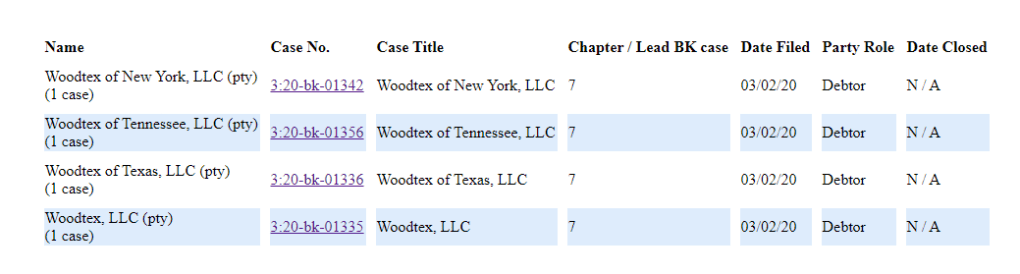
Well, we know the first part: Woodtex, LLC, Woodtex of New York, LLC, Woodtex of Tennessee, LLC, and Woodtex of Texas, LLC all filed their own Chapter 7 bankruptcy cases in Nashville Bankruptcy Court late on Monday afternoon.

As far as answers beyond that, the filings don’t do much else, but add more questions.

And more aggrieved customers. These filings show that there’s at least twice as many customers who lost their deposits, with these deposits still being unaccounted for.

But, strangely, there’s not that much debt owed, relative to the deposits that the companies were constantly taking in. With this much money coming into the company (as deposits), you’d expect to see an equally staggering amount of unpaid bills.

The only good news for the Woodtex customers is that, because the Woodtex entities focused on sheds and smaller buildings, the deposits are about 10% of the money that the Riverwood Cabins customers lost.

Set Your Clocks for 12:01am: Happy New Bankruptcy Act!

How are you celebrating Small Business Reorganization Act of 2019 Eve?

In case you’re wondering what I’m talking about, at 12:01am, the Small Business Reorganization Act of 2019 takes effect tonight.

So, if you wake up tomorrow morning and there have been a hundred or more small business and individual Chapter 11 bankruptcy cases filed overnight, this is why.

It’s because the debtors’ counsel think the new Act provides some tactical advantage for their small chapter 11 case. (And, disclaimer: by “small,” it’s a case where total debts is less than $2,725,625.)

Once upon a time, Chapter 11 was meant to be used for big cases–think K-Mart, Sears, Enron, American Airlines. Then, about 10 years ago, we started seeing more individuals and smaller “mom and pop” businesses filing bankruptcy.

Part of the reason was that these cases were “too big” for a Chapter 13. So, they got shoe-horned into an overly complex Chapter 11 case. It’s been generally a bad fit for many debtors.

In a way, the new Act makes a small chapter 11 case resemble a “big” chapter 13 case. Here’s how:

The process is accelerated, and the debtor must submit a plan within 90 days of the case being filed. Plus, the changes shave down some of the administrative requirements in a typical chapter 11, like the appointment of a creditors’ committee and the need to file a disclosure statement.

Also, there is now a “Sub-Chapter V” Trustee appointed in a case, who will oversee and, in some situations, manage the progress and implementation of a repayment plan.

Also, in the most Chapter 13 model possible, the discharge will not be granted until the debtor completes all payments due within the first three years of the plan or a longer period not to exceed five years (depending on the plan terms).

Finally, the part that gets all the attention is the elimination of the “absolute priority rule,” which requires a business owner to pay “new value” in order to retain any interest in a business unless creditors are paid in full. It used to be that creditors could object and require the debtor pay new money in order to keep a business, and, if none is paid, the creditors had to be paid in full. This is now gone.

So, if you wake up tomorrow morning and you see a lot of new Bankruptcy Cases, you may wonder why the debtor’s law firm stayed up so late to file it.

This is why.

But, creditors, please know this–there’s nothing really to do to stop or prevent this new Act’s application. Just wake up tomorrow and re-read the Act. And, be sure to re-read Chapter 13 while you’re at it.

Riverwood Cabins Files for Bankruptcy, with more than 4 Million in Customer Deposits at Issue

Ten or 12 years ago, it wasn’t a shock when a builder filed for Bankruptcy and left behind dozens of half-completed projects and unaccounted for customer deposits in its wake of discharge and dispair.

But, in our modern/better/faster/stronger economy, I was really surprised to see Riverwood Cabins, LLC file a Chapter 7 Bankruptcy in Nashville a few days ago.

Riverwood Cabins builds prefabricated cabins and modular log homes for customers (generally in Tennessee), and then delivers the cabins nationwide to the customer’s land for assembly.

Per the Bankruptcy Schedules, Riverwood claims assets of $265,205.18, and total debt of about $5,900,000.

Of that debt, here’s what’s mind-blowing: that debt includes $4,468,842 (*) in unaccounted for customer deposits that are claimed as debts.

To be clear, the customers who paid 50% down as a deposit for the cabin, and, now, that money is gone and entirely unaccounted for.

This isn’t a few dollars short here and there. This is 4 MILLION dollars.

In the Great Recession, a little shortage here and there wasn’t a shock.

Builders would dip into a little bit of funds from Project C so that they could finish up Project A. Then, a few weeks later… in order to finish Project C, they might dip into the funds on Projects E and F. In the end, the whole scheme would come crashing down when the shortages outpaced the new contracts from new customers.

But I haven’t seen this type of shortage before.

I’m literally shocked by the large number of customers (about 65) who don’t have cabins or any explanation of where their cabins–or their deposits–are.

Medical Debts: The Burden that Keeps on Crushing Debtors

A few months ago, I wrote about a hospital in Memphis that made national news for suing its employees for unpaid medical bills.

At the time, I was critical of the practice, both because it was terrible public relations for the employer and also such a hardship on the employees.

This new decision from the Bankruptcy Court for the Central District of Illinois suggests that this practice may hurt the employees worse than I anticipated.

In that case, the Chapter 7 debtor was faced with $164,053.95 in unsecured debt, of which $82,000 was for medically necessary services. To avoid the “means test” and stay in Chapter 7, she argued that her debts were not “primarily consumer debts” under Section 707(b)(1). The US Trustee objected, arguing for a conversion to Chapter 13.

The debtor had an interesting argument: medical debts are not “consumer debt,” as defined under the Bankruptcy Code, because medical debts are not incurred voluntarily, and “similar to tax debts that have been held by several courts not to be consumer debts.” See In re Westberry, 215 F.3d 589 (6th Cir. 2000).

Ultimately, considering the purpose and nature of medical bills, this Bankruptcy Court found the debts to be consumer debt, subjecting the debtor to the means test and forcing the case into a Chapter 13.

It’s a well reasoned opinion, but it has some pretty harsh applications to debtors in places like Memphis, where medical debts can crush debtors.

Sure, relief under the Bankruptcy Code is still available to this debtor, but, in situations like this, a debtor will have to deal with those debts in a chapter 13 plan, which requires the debtor to make payments over a 3 to 5 year plan. The rate of success in those cases is low, meaning that the case could get dismissed and the debtor isn’t able to get the debts discharged.

You’ll be hearing a lot about “predatory installment loans” in 2020

There’s a new lending device that’s gaining popularity across the country, and it’s coming to Tennessee soon.

As in, “to be considered by the 2020 Tennessee Legislature” soon.

It’s called an “online installment loan,” and it’s a new form of pay-day lending, but with a few extra bells and whistles that make it look more like a regular bank loan.

And while many people know the downsides of going to a title-lending place for a loan, this new device is being marketed to a broader group of American consumers, says Bloomberg News in an article published today, titled “America’s Middle Class is Addicted to a New Kind of Credit.” Per Bloomberg, these are:

…a form of debt with much longer maturities but often the same sort of crippling, triple-digit interest rates. If the payday loan’s target audience is the nation’s poor, then the installment loan is geared to all those working-class Americans who have seen their wages stagnate and unpaid bills pile up in the years since the Great Recession.

In just a span of five years, online installment loans have gone from being a relatively niche offering to a red-hot industry … and have done so without attracting the kind of public and regulatory backlash that hounded the payday loan.

[The] average online subprime installment loan customer has an annual income of about $52,000. About 80% have been to college and 30% own a home…[m]ore than 10% of the company’s core customer base makes over $100,000 a year.

These instruments generally have a longer repayment period, like 90 days to a year, but they have the same insanely high interest rates (ranging from 20% to 35% to, in some cases, 155%) as other title loans.

Not in Tennessee, right?

These lenders are targeting Tenn. Code Ann. § 47-14-104, and, specifically, that statute’s 10% cap on interest rates. The lenders hope to eliminate that cap entirely.

Res Judicata Part 2: What about Bankruptcy Court?

Remember a few months ago, when I talked about the concept of res judicata in Tennessee and how, in some situations, a smart plaintiff will include all relevant causes of action in its initial action? That way, the plaintiff may be able to avoid re-litigating similar issues later.

In that post, I noted that it can be a critical issue in bankruptcy cases, where a state court judgment for fraud can potentially fast-track a non-dischargeability finding under 11 U.S.C. Sec. 523.

Specifically, to do that, the plaintiff needs to plead specific facts and causes of action that would satisfy the elements of 11 U.S.C. Sec. 523 (but in the state court proceeding). In order to convince the bankruptcy courts, however, to apply issue preclusion, the plaintiff generally also has to actually litigate the matter, i.e. the judgment can’t have been based on a default judgment.

As a quick recap, here’s the typical checklist that a bankruptcy court may consider. Were the issues in the prior proceeding:

  • identical with those in the subsequent proceeding;
  • actually litigated;
  • necessarily decided in a final judgment on the merits; and
  • asserted against the same party or someone in privity.

The question that comes up, then, is whether a default judgment has issue preclusive effect? As you can guess from the above, in most cases, a default judgment (i.e. one that is entered solely because the defendant doesn’t respond) is not deemed to be “actually litigated.”

But, two pending cases from August 2019 suggest that courts are looking at these issues.

They are: Creech v. Viruet (In re Creech), 18-12584 (11th Cir. Aug. 7, 2019) (full copy here); the Draka v. Andrea (In re Andrea), 18-96014 (N.D. Ill. Aug. 6, 2019) (full copy here).

These are really interesting cases, and they are worth a reivew, if only to see the heightened standards that a bankruptcy court will apply in 523 actions. Which, by itself, is the primary reason so many creditors want courts to grant issue preclusive effect to default judgments.

In the end, it’s a short-circuit to avoid the relief that the Bankruptcy Code provides to debtors, so it’s a disfavored move. I’d be surprised if a default judgment will satisfy that burden.

Everybody Loves “It City”: United States Supreme Court to hear dispute over land deal in The Nations in November.

The Nashville Bankruptcy Bar got some exciting news from the United States Supreme Court recently, as the Big Court granted certiorari to consider a novel issue of law: Whether an order denying a motion for relief from the automatic stay is a “final order” under 28 U.S.C. § 158(a)(1).

For you real law nerds out there, here’s a copy of the case schedule.

You’ll note that cert was granted in May 2019, and the oral argument is set for November 13, 2019. (I have no idea why this news from May 2019 is just now hitting the local news.)

But, to our local bar, this is newsworthy because the United States Supreme Court is said to grant “cert” in extremely rare circumstances, said to be less than 0.01% of matters presented to it. Continue reading “Everybody Loves “It City”: United States Supreme Court to hear dispute over land deal in The Nations in November.”

Highlights from the Creditors Practice Annual Forum 2018: Stay Relief Violations

Last month, I taught a session at the Tennessee Bar Association’s Creditors Practice Annual Forum 2018.  My section was called “Litigating Stay Violations.”

The CLE was on September 26, 2018, so, sorry, you missed it. But, to get more mileage out of the materials I prepared, I’m going to post some of the info here.

First off, the automatic stay at 11 U.S.C. § 362 operates as a stay of most collection activity against the debtor in bankruptcy.

When the stay is violated, 11 U.S.C. § 362(k) comes into play, which provides in part that “an individual injured by any willful violation of a stay provided by this section shall recover actual damages, including costs and attorneys’ fees, and, in appropriate circumstances, may recover punitive damages.”

And, no, a violation doesn’t have to mean that the creditor had bad intent.

Actually, a willful violation of the automatic stay requires only that: (i) the creditor knew of the stay and (ii) acted intentionally in violation of the stay. TranSouth Financial Corp. v. Sharon (In re  Sharon), 234 B.R. 676, 687 (B.A.P. 6th Cir. 1999). “[P]roof of a specific intent to violate the stay” is not required, but instead only “an intentional violation by a party aware of the bankruptcy filing.” Id.

Basically, the debtor has to prove that the creditor had notice of the Bankruptcy and took intentional action that violated the stay. Long story short, it’s not a high bar to prove those factors.

Will an Adversary Proceeding Survive the Dismissal of the Bankruptcy Case? Maybe.

Eight years ago (8 years! You are reading a law blog that has lasted for 8 years!), I talked about the difference between a bankruptcy discharge and a dismissal.

The tl;dr version for creditors? Discharge is bad; dismissal is good.

But, what if you’re a creditor and the debtor has filed an adversary proceeding against you, but then the bankruptcy case is dismissed?

The tl;dr version? It depends.

Generally, the dismissal of the underlying bankruptcy case results in the dismissal of related adversary proceedings because federal jurisdiction is “premised upon the nexus between the underlying bankruptcy case and the related proceedings.” But, there are exceptions.

One such exception is for proceedings to enforce sanctions and contempt for violation of the automatic stay. A Bankruptcy Court will retain jurisdiction “for the purpose of vindicating the court’s own authority and to enforce its own orders.” See In re Bankston, 1:12-BK-14022-SDR, 2015 WL 6126440, at *2 (Bankr. E.D. Tenn. Oct. 15, 2015)

Basically, the reasoning goes, an action for contempt of court resulting from a party’s blatant disregard of the Bankruptcy Code and the authority of the Bankruptcy Court is something that the Bankruptcy Court takes very seriously and will enforce, independent of whether the underlying case still exists.

The reasoning is different for other types of proceedings that are dependent on the underlying case, like actions to recover avoidance preferences.