This Defective Foreclosure Was the Scariest Thing I Saw on Halloween

I’ve called Tennessee’s non-judicial foreclosure process “a little scary.” It follows a byzantine process, is all paperwork, there’s no judge involved, and a single misstep can lead to your foreclosure being challenged.

Tennessee offers a unique pitfall for the unwary: It’s a “two track” state, meaning that a foreclosing lender must satisfy the requirements of both the Tennessee foreclosure statutes and the requirements agreed to by the parties in the Deed of Trust.

And those two tracks don’t always align.

On that note, let me tell you about the sale of a multi-million dollar property I watched on October 31 .

The Notice of Foreclosure Sale was first published in the Nashville Ledger on October 11, 2024 , and the sale was set for October 31, 2024 at 10AM at the Davidson County Courthouse.

That’s a tight timeline, since Tenn. Code Ann. § 35-5-101(b) requires that “The first publication shall be at least twenty (20) days previous to the sale.” In fact, by my own math, the 10/31 sale date fell on the twentieth day after publication, and I wondered whether, legally, this sale satisfied this statute (maybe, maybe not).

It didn’t matter, because I then read the Deed of Trust.

The Deed of Trust adds an extra day to § 35-5-101(b) minimum and requires that the first publication precede the sale by 21 days. This sale clearly didn’t satisfy that requirement.

About 6 bidders attended the sale, but none of them bid. The bank bought the commercial property for nearly $4 Million, and, in the Trustee’s Deed, recited the following:

Did the foreclosing lender double-check the Deed of Trust text? Is this a valid sale? Did good title convey from this sale? Did the failure to follow the terms of the Deed of Trust chill the bidders’ interest? Would this qualify as an “irregular” sale that would prevent collection on any unpaid debt pursuant to Tenn. Code Ann. § 35-5-117? Lots of interesting issues flowing from this sale.

I don’t like “interesting issues” on my foreclosures. When I prepare a sale notice, I check and double-check everything. When I’ve got a bunch of foreclosures set, you’ll find pen dots all over my calendar, from all the day-counting.

Foreclosures are complicated, and the failure to get it right can result in a challenge from all different directions. A borrower who doesn’t want to lose the property. A buyer who may not receive clear title. A lender who expects you to follow the process. A bankruptcy trustee who wants to blow it all up.

It’s a tricky process, and there’s too much risk when making an error. None of the goblins who visited my house later that night scared me more than what I saw happen at that foreclosure.

Can a Tennessee foreclosure be continued without written notice? We don’t know (yet).

The Tennessee Supreme Court hasn’t yet issued a ruling in the Terry Case v. Wilmington Trust case, which was argued before it nearly a year ago. It’s an important case for foreclosure attorneys, since the case will decide what impact an (allegedly) defective foreclosure sale has on title: Does the sale convey valid title or not?

That’s the “big picture” issue, but the case also touches on an important mechanical issue: Whether an attorney can rely on the clear text of Tenn. Code Ann. § 35-5-101(f) when continuing foreclosure sales for less than 30 days.

In Case, the “boilerplate” text of the deed of trust required all notices by either party to be in writing. But, in the foreclosure statutes, Tenn. Code Ann. § 35-5-101(f)(3) expressly a creditor to continue a foreclosure upon an oral announcement, if the continuance is for less than 30 days. Because the attorneys for Wilmington only made an oral announcement of the continuance and didn’t mail a notice, the borrower argued, they failed to comply with the “written notice” terms of the Deed of Trust. The Tennessee Court of Appeals agreed with the borrower, and it deemed the sale possibly invalid.

It’s an important question because nearly every Tennessee Deed of Trust will impose a duty on the parties to provide notices in writing. It’s a standard provision, designed to make sure that oral statements don’t amend, waive, or release the rights held by either party under the loan.

In fact, I’m preparing a foreclosure today, and the final provisions of deed of trust I’m foreclosing on has a “Notices” paragraph that says: “Any notice required to be given under this Deed of Trust, including without limitation any notice of default and any notice of sale shall be given in writing, and shall be effective when actually delivered, when actually received by telefacsimile (unless otherwise required by law), when deposited with a nationally recognized overnight courier, or, if mailed, when deposited in the United States mail. as first class, certified or registered mail postage prepaid, directed to the addresses shown near the beginning of this Deed of Trust.”

With the Tennessee Supreme Court’s decision looming, Tennessee foreclosure lawyers don’t have the clarity on how to reconcile these different directives.

But, having said that, until the Supreme Court decides, a smart foreclosure attorney will-as I’ve recommended in the past–always comply with the most onerous of all of the requirements, no matter if they are in the deed of trust, a loan agreement, or the foreclosure statutes.

One of the scary things about a non-judicial foreclosure in Tennessee is that it’s all “paperwork,” and there’s no judge involved…until a party challenges the process. You don’t know you’ve messed something up until long after the fact. Foreclosures are careful, deliberate work, and not for the faint of heart. When in doubt over the requirements, I follow them all.

Foreclosures Are Back! (And what this means for Nashville and Bankruptcy Lawyers)

Maybe it’s a harbinger of a worsening economy, the lack of new commercial lending, high interest rates scaring buyers away, or just that secured lenders are sick of being patient, but Nashville is seeing more commercial foreclosures lately.

Obviously, the pending foreclosure of Plaza Mariachi earlier this month made top headlines, but the increase of foreclosure sale notices in the local newspapers suggest that more lenders are taking that final step.

In full transparency, I wrote we’d see an increase foreclosures back in 2022, and I was generally wrong.

Right now, things seem different. Borrowers don’t have access to the same borrowed funds they had over the past 2-3 years. The exuberant “new money” buyers pouring into the market seem to have slowed down. Both the lenders and borrowers can see the “bottom of the river” regarding cash flow and business income.

As much as we’ve been kicking the can down the road on various deals, we keep ending up at the same place, with foreclosure the only remaining exit strategy.

Next week, I have 5 commercial foreclosures set over the course of two days; the week after that, I have 2.

The next storm cloud on the horizon will be whether Nashville has enough bankruptcy lawyers who can service the needs of a city the size of Nashville.

As that post shows, I’ve been wrong for years about the pending explosion in new bankruptcy cases (it’s largely never happened), so maybe I’m wrong about the lack of bankruptcy attorneys.

I don’t think I am. Faced with a pending foreclosure, Plaza Mariachi filed for chapter 11 bankruptcy, but the lead debtor’s attorney is a firm out of Phoenix, Arizona.

If you are a new lawyer, looking for a viable practice area, I’ll repeat the advice I gave in July 2020:  Learn Bankruptcy.

Tennessee’s New Squatter Law Solves a Problem We Didn’t Have, and Maybe Creates a New One

Sometimes, when the Tennessee Legislature tries to solve a problem, they inadvertently create one or two other problems.

They might have done that with the “squatters” statute that took effect on July 1, 2024.

In common parlance, a “squatter” is a person who takes possession of property without any rightful claim. In my mind’s eye, I picture a modern-day pirate, moving into your home and declaring “This is MY house now!”

In my 25 years of eviction and property litigation, I’ve actually never dealt with a squatter. I’ve certainly never perceived it to be a problem that justified special legislative attention.

Effective July 1, 2024, we now have Tenn. Code Ann. § 29-18-135, titled “Limited alternative remedy to remove unauthorized persons from residential real property.” This statute is added to the end of Title 29, Chapter 18, which are the eviction and detainer statutes.

This new statute creates a process by which a property owner can, by filling out a checklist form, direct the Sheriff to remove an “unauthorized person” from the property, without a court proceeding.

By its clear text, “a property owner…may request from the sheriff of the county in which the property is located the immediate removal of any person unlawfully occupying a residential dwelling pursuant to this section if…[a]n unauthorized person has unlawfully entered and remains on the property owner’s [residential] property” and “[t]he unauthorized person is not a current or former tenant…” (this is heavily paraphrased, so be sure to look at subpart (d) in full).

The word “squatter” isn’t in this statute. Instead, the statute deals with “any person unlawfully occupying a residential dwelling” who “has unlawfully entered and remains or continues to reside” on the property and who “is not a current or former tenant…” and “is not an immediate family member of the property owner.”

That’s a pretty broad definition, and it seems to include persons not routinely labelled “squatters.” For instance, wouldn’t a foreclosed homeowner be subject to this statute? They are no longer the “owner,” they aren’t a “current or former tenant,” and if they stay at the property after the foreclosure deed is recorded, the possession is “unlawful.”

In my experience, “squatters” simply haven’t been a bane to Tennessee property owners’ existence. I’m not saying it never happens (and I’m sure that all it takes is one years’ long fight with a squatter to change my mind), but it seems like the existing statutes provide a good remedy, and, at best, this statute puts an awkward amount of judicial discretion into the hands of the local sheriff (who probably would rather all this be decided by a judge).

The Graceland Foreclosure shows the risks of Tennessee’s non-judicial foreclosure process.

I was born in Memphis and, of course, I’m an Elvis fan.

I was shocked to see–on the national news–that Graceland was facing foreclosure. A few days later, it all just…went away and explained as a hoax. I was surprised, but not totally surprised by these strange turn of events. It rarely happens, but foreclosures in Tennessee are ripe for exploitation by bad actors.

Here’s why: Tennessee is a non-judicial foreclosure state, and courts are rarely involved in the process.

At its most simple, Tenn. Code Ann. § 35-5-101 requires a lender to: (1) publish a notice of the sale 3 times in a local newspaper; and (2) send a copy of the notice to the property owner by certified mail. With just a bit of paperwork, voilà, you can sell somebody’s property.

It’s a cost efficient process for legitimate lenders, but it can be exploited by fraudsters and and paper terrorists, who present bogus claims and hope that their efforts will be ignored or not challenged.

Once a foreclosure is started, there are limited ways for a property owner to stop it, short of filing bankruptcy or filing a lawsuit to obtain an injunction pursuant to Tenn. Code Ann. § 29-23-201 (which is as complicated as it sounds–Graceland’s lawyers filed a 61 document to stop this sale).

When I saw the news about Graceland’s foreclosure, I immediately looked up the Notice of Foreclosure Sale published by Naussany Investments and Private Lending LLC, and noticed red flags. The Deed of Trust had been not been recorded; the lender didn’t have an attorney; and the Notice of Sale lacked the level of detail a typical lender foreclosing on a historic, world-famous property would include.

In short, it all just seemed weird. In reality, it ended up being ten times weirder. It was all a scam, based on fraudulent documents, with a Nigerian based email scammer publicly claiming credit.

As bizarre as all this was, here’s the scary part: This could happen to anybody in a non-judicial foreclosure state. Here, the fraudsters were simply too ambitious, picking a famous property owned by a deep-pocketed and litigious owner.

What about properties by people who don’t understand the process, don’t read the newspaper and/or sign for certified mail, don’t have access to lawyers, or don’t have the money to fight? There are no official safeguards in the system to protect homeowners.

The newspaper doesn’t question the validity of the lender’s claims in submitted advertisements. The mailman doesn’t either. Once the sale is over, the local Register of Deeds just checks for valid notary stamps and payment of the transfer taxes. In some cases, by the time the owner discovers the fraud, there’s already a new deed recorded.

In 2016, I wrote an article for the Nashville Bar Journal titled, “Is your Potential Client a Nigerian King?” As part of that, I learned something wild about the email scammers’ unique business model: They expect to fail 99% of the time. They aren’t bothered by that fail rate, though, because they know that the upside to a single victory justifies all the work.

Sure, these scammers failed to foreclose on Graceland, but how many other times have they succeeded? And how many more times are they going to try?

Law Firms: To avoid Malpractice Claims, Remember that Tennessee Judgments Expire in Ten Years

Tennessee judgments expire after ten years.

As a creditor lawyer, one of my greatest fears is that one of the many judgments that I’ve taken over the past 10 years is set to expire and I have forgotten about it.

It is so easy to renew judgments under Tenn. R. Civ. P. 69.04, but it’s also easy to forget about those old files. If a law firm forgets, it could get sued for malpractice. It’s a big deal.

Earlier this week, the Tennessee Court of Appeals touched on this issue. See John Doe Corp. v. Kennerly, Montgomery & Finley, P.C., E2023-00236-COA-R3-CV (Tenn. Ct. App. May 28, 2024).

In the case, after the 10 year period expired on an old judgment, the judgment creditor client sued its former lawyers, alleging that the law firm “had failed to inform Plaintiff that the judgment would expire after ten years or that it needed to seek to extend the judgment prior to its expiration.”

The trial court dismissed the claims against the law firm, because the client failed to have filed the lawsuit within the one-year attorney malpractice statute of limitations. The opinion doesn’t really focus on the renewal issue; the real analysis is on issues of recusal and the different standards under Tenn. R. Civ. P. 59.04 and 60.02.


But, back to creditor rights. Is this is victory for the law firm? Not really, because lawyers don’t like being sued for malpractice in the first place.

Since starting my firm nearly 4 years ago, I’ve opened 639 new cases. Before that, I handled a similarly busy caseload at my old firm. In the past 10 years, I’ve taken 100s of judgments.

It would be a cold comfort to me to know that, if my client sues me for malpractice, I could possibly defend the case on a technicality.

Having said that, how can lawyers mitigate that risk? The answer is in a Court of Appeals decision I wrote about in 2019. There, the malpractice claims turned on whether the law firm warned the client, at any point, that the judgment needed to be renewed in ten years. Because the law firm had previously warned the client about the 10 year expiration, the client had knowledge of the possible malpractice claims that accrued at the time of non-renewal (and not a later date).

Look at the text of the John Doe case: the client alleged that the law firm “had failed to inform Plaintiff that the judgment would expire after ten years or that it needed to seek to extend the judgment prior to its expiration.”

If you’re like me, a busy lawyer with many judgments, remember my advice from 2019: “A good practice is to make sure that the client understands that it has a responsibility in ten years to notify you that it wants you to take this action.”

In a perfect world, my advice is to calendar judgments and simply avoid this issue altogether.

A separate safeguard could be, in that initial congratulatory email, sending a copy of the judgment to the client, to always include text that clearly discusses the validity and expiration of the Judgment in terms that the client can understand.

Nevermind the Kombucha Jokes: WeWork Bankruptcy shows the power of 11 USC § 365

When WeWork filed bankruptcy last year, the reactions fell into two general buckets.

On a business level, the commercial real estate folks brought a “told you so” energy, calling this the end of flexible office space. On twitter, it was mostly jokes about former CEO/guru-preneur, Adam Neumann, poking fun at the company’s unchecked growth, sustained by freely flowing investor money, and boozy office vibes.

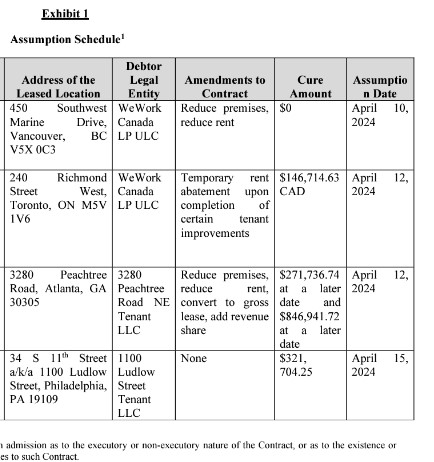
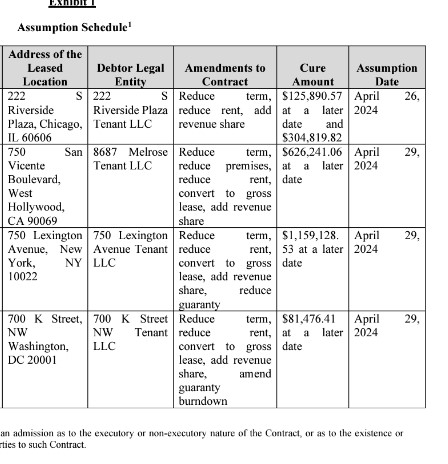
The bankruptcy lawyers had a different take. If current operations were struggling with past bad decisions, there was an obvious path for the company to right-size, by selective assumption and rejection of leases under 11 U.S.C. § 365.

That’s exactly what happened, as WeWork expects to emerge from the chapter 11 having negotiated approximately $8 billion (more than 40%) in reductions in rent obligations.

In a typical bankruptcy, a tenant usually is presented a “take it or leave it” choice on leases. Not WeWork. Whether it was a function of a bad CRE market or the scope of their leases, WeWork used chapter 11 to negotiate lots of concessions from its landlords.

A survey of recent “assumption” orders shows rent reductions, premise and term reductions, conversions to “gross” lease terms, and modifications to guarantees.

Sure, landlords can say “no” to changes like this, but these landlords aren’t.

It’s a smart move, and an indication that serious business people are in charge.

As a tenant of WeWork, I can confirm that the days of booze and debauchery are long gone. In fact, I’d say that they’ve over-corrected. (Ask me about the short-lived decision a few years ago to remove trash cans from individual offices.)

What is in store for the Nashville locations? We don’t know yet. My review of the Bankruptcy Court docket suggests that the debtor has taken no action on the four locations in Nashville.

Pursuant to an Order signed by the Bankruptcy Court on April 29, 2024, the current deadline for these decisions is June 3, 2024. So far, they’ve dealt with only a fraction of the landlords, but I expect lots of activity over the next month.

We’ll know the future of the Nashville locations soon.

Levy Involving Deja Vu (Yes, that Deja Vu) Highlights Tennessee’s Conditional Judgment Process

A recent case involving Deja Vu Showgirls Nashville (warning: do not click that link) offers a useful map for a judgment creditor to follow where a garnishee fails to answer a wage garnishment.

In the case, One Main Financial Group, LLC v. Edward Hackney, Jr. (Davidson Co. General Sessions Docket No. 23GC8323), the Plaintiff served a wage garnishment on “Deja Vu Showgirls, Attn: Payroll.”

As you know, employers must respond to wage garnishments in Tennessee within 10 days; if they don’t, the employer risks being held liable for the entire Judgment debt.

In the Sessions case, there was no answer filed, and Plaintiff filed a Conditional Judgment, asking that the full $14,000.56 judgment against Hackney be made a judgment against Deja Vu. Once a conditional judgment is signed, the court then sets a final hearing on whether to enter a final judgment against the non-responsive party.

When Deja Vu failed to respond in any way to the wage garnishment or the conditional judgment, the Court granted a final judgment against it for the underlying debt.

Unsure of where Deja Vu banks or holds assets, the Plaintiff issued a levy instructing the Sheriff to seize the “Cash Box.”

Plaintiff’s logic was sound. A few weeks later, the Sheriff went to the establishment (on a Saturday!), seized all available cash (well, the cash up to $14,634.00, the amount owed under the Judgment), and paid the funds to the Court Clerk.

Some thoughts?

Don’t ignore wage garnishments. Ever. Who knows if Edward Hackney works at Deja Vu or, even if he did, would he have been paid $14,000 during the garnishment. Due to Deja Vu’s failure to respond, the actual facts are irrelevant; Deja Vu became liable for the full debt simply because it never responded.

It’s rarely too late to answer (until it is). A conditional judgment is a “warning shot” to a non-responsive employer/garnishee, and, if a response is filed before the final hearing, the conditional judgment is vacated.

Was the cash levy valid? A judgment creditor can levy against personal property of the judgment debtor, including cash. This is often called a “till tap,” and it’s a smart move anytime you’ve got a judgment against a debtor with cash in their pockets, in their possession, or in their cash register.

In the end, the best test of collections process is whether it works. Here, Plaintiff got a little bit lucky. The Sheriff served this levy on a Saturday, presumably when the business had ample cash on hand (I actually didn’t realize the civil process unit served process on weekends).

And whoever was manning the cash box didn’t raise any issues related to service or the accuracy of the corporate name issue at any point–whether at the time of the levy or before the money was disbursed. (Looking at the corporate records at the Tennessee Secretary of State, an argument could have been made about some things.)

Sometimes, a little bit of luck makes all the difference.

My advice is to always take as much care in issuing levies as you would when filing a lawsuit. That means getting business name exactly correct. A judgment in this situation is like any other judgment–you have to get valid service of process and party’s name correct.

341 Recaps: Recording Judgments, Getting the Checks Right, and the very small advantage of Small Law

The Race is On. On Friday, I wrote about the Chancery Court opinion that “blesses” the common practice of recording your judgments as a lien, even though the Tenn. R. Civ. P. 62.01 “30 day stay” was still in effect.

I’ve heard from a number of lawyers that it’s what they’ve always done, but, nevertheless, it’s nice to have a bit of judicial reassurance.

Back in September 2023, immediately after a trial in Sumner County, I was racing to get the new judgment recorded on land that the judgment debtor had under contract for sale.

As soon as the Judge signed my order, I asked to make a certified copy. Cautiously, because I’ve had judges and court clerks admonish me in the past for even asking for a certified copy of a brand new judgment.

In my case, I had no time to spare.

My Register of Deeds visit was where the real fun started. Within minutes of being handed my certified copy, I was at the Register of Deeds’ front counter.

While I was sitting in the Register’s waiting area, I overheard them discussing a problem they had to deal with.

A Big Law Firm had mailed in a document for recording for the third time, and, once again, the “payee” name on the check was wrong. I don’t know what was written on the check, but it did not say “Sumner County Register of Deeds” (or, I assume, anything close to that).

Twice already, the Register of Deeds had rejected the filing and mailed it back.

As I was sitting there, they were discussing what to do about this third time.

How on Earth does this happen three times? As it turns out, the year before, this AmLaw 200 Big Law Firm had purchased (or, as the marketing people say, “combined with”) a local law firm and checks were no longer written in Nashville or anywhere in Tennessee.

Instead, the checks were written 600 miles away by someone who has probably never heard of “Sumner County” or a “Register of Deeds Office,” and who probably has never met the lawyer (or client) who desperately wanted whatever was being rejected to be recorded.

I have no idea if the third recording got accepted that day, or if the Clerks ever just called the Big Firm to sort it out. I got my recorded judgment lien on the property and left; the rest was not my problem.

So what’s the point of the story? To be clear, I was very amused by it all.

Sometimes, when I am writing my own checks or driving to record my own documents, I miss the old law firm days when I had a person who did all that for me. But, I’m also a control freak who takes his job very seriously, and I would have lost my mind if I had lost weeks trying to record something that kept getting rejected.

Most articles about law firm acquisitions /combinations have the narrative that “bigger is better,” and usually mention “broader reach,” “expanded networks” and “new markets.”

Sitting there that day, with sweaty palms, watching the clock, hoping to get my document recorded before the land could be sold…I was glad to be the guy writing my own checks.

The race is on: Davidson County Chancery answers a long-standing question regarding judgment liens

We’re one step closer to answering one of Tennessee collection law’s greatest mysteries: Can a judgment creditor record a copy of its judgment as soon as it is signed by the Judge, or must the creditor wait 30 days?

The question arises under Tenn. R. Civ. P. 62.01, which says that “…no execution shall issue upon a judgment, nor shall proceedings be taken for its enforcement until the expiration of 30 days after its entry…”

The exact issue is this: Is recording a certified copy of a judgment an “execution”? I’ve been asked that for years, but never quite knew the answer.

For starters, what’s the statutory authority for recording a judgment lien? I look at Tennessee Rule of Civil Procedure 69, which is titled “Execution on Judgments,” and includes all the different ways you can “execute” on judgments (garnishments, levies, sheriff’s sales, liens). This list includes Tenn. R. Civ. P. 69.07(2), “Execution on Realty,” which provides the exact process to record a judgment lien against the judgment debtor’s realty.

And let’s be honest; why would you record a judgment in the first place? Under Tennessee law, the recording of a judgment with the register’s office creates a lien on real property, meaning that the debtor can’t sell, refinance, or transfer the property without dealing with the judgment. It’s a pretty powerful tool to get paid. That’s why you’d record it, and as fast as possible.

If the point is to get paid–and as soon as possible–that looks a lot like enforcement, right? But is that “execution”? Should we also throw around terms like “collection” or “attachment” too?

It’s been a mess because the statutes and rules all seem to use these different terms interchangeably, except when they aren’t interchangeable.

Faced with this exact issue, the Davidson County Chancery Court had to make sense of these competing terms and concepts. In an Order from February 2, 2024, the Court found the mere act of recording a judgment during the Rule 62.01 stay period “was not premature ….because the filing of judgment lien is not an act of enforcement.”

In doing so, the Court referenced the pleadings filed in the matter, which drew reasoning from Tenn. Code Ann. § 25-5-101(b)(1) and the competing concepts of “final” judgments found in Tenn. R. Civ. P. 54 and 62.01. Further, given the Court’s brief, but specific, factual finding, the Court seems to agree with the opposing brief’s distinction between the acts of recording a lien versus enforcing a lien, arguing that only the latter would violate Rule 62.01. The full Order is attached below.

It’s an important issue that has long vexed creditor rights lawyers, debtor’s counsel, and even court clerks. I’ve had court clerks only begrudgingly provide me with a certified copy of a judgment on the day of entry (and reminding me that I “can’t do anything with it for 30 days”).

This Order and the related reasoning may provide a roadmap for future arguments on this issue, which comes up far more frequently than you’d think.

I watched these trial court proceedings pretty closely, and I’m glad to see a creditor-friendly result. The underlying initial pleadings are also attached below.