A few weeks ago, while researching a complicated legal issue, I asked Claude AI to take the first pass before I dug in.
Yes, it’s controversial for a lawyer to admit to using AI at all, but it shouldn’t be. Claude is really good and, frankly, as good as (or better than) your standard issue first-year associate. Having said that, though, you have to treat Claude’s work with the same cautious skepticism that you’d apply to a first-year associate’s work. (My motto? “Don’t Trust and Verify.”)
Here’s why I found Claude’s sources to be eminently trust-worthy…
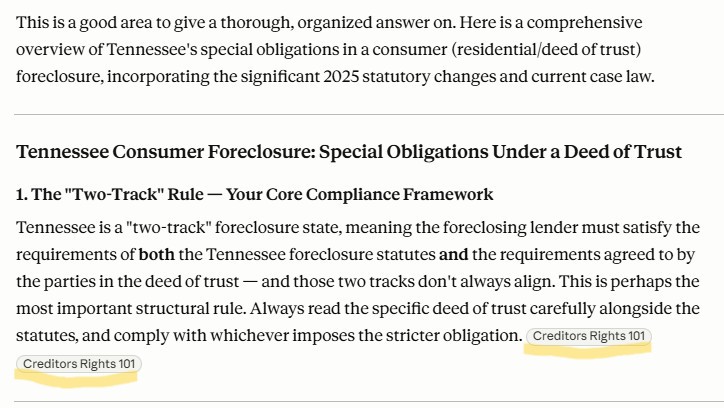
Yes, in vetting the sources, it was revealed that I am the brains behind the robots! This is either very flattering or terrifying. For now, I’ll accept the compliment.
For 3 years, lawyers have been bombarded by vendors selling AI. Every task, application, or product is AI based or enhanced (and priced accordingly). The future of law is now, and it can be yours for just $755.00 per seat.
At last week’s Tennessee Bar Association Convention and Technology Showcase, every CLE panel related to the use of artificial intelligence. At ClioCon, every exhibitor had some sort of “AI!” product to sell. When I open an app on my computer, I am constantly asked whether I want AI’s help.
Don’t get me wrong; AI is awesome technology, with capabilities that actually match the hype (well, mostly).
But there’s been an equally fervent backlash in the legal profession about the traps presented by the use of AI.
I hear all of that, but, after approaching it with a skeptical mind, I’ve been blown away by AI’s capabilities and believe that it can make competent, smart, careful lawyers better and more efficient at their jobs.
Having said that, though, what about the lawyers who don’t use the AI in competent, smart, careful ways? Let’s ask the Chief Judge for the District Courts in the Western District of Tennessee…
In an Order dated June 2, 2026, Judge Lipman opened with this line: “This case presents a study in the perils that can result from the unchecked use of artificial intelligence in the drafting of legal filings.”
See Reaves Law Firm, PLLC, v. Baker, Donelson, Bearman, Caldwell & Berkowitz, PC, et al., No. 2:25-CV-2623-SHL-ATC, 2026 WL 1557552, at *1 (W.D. Tenn. June 2, 2026).
There, it was alleged that the offending law firm used artificial intelligence to draft its briefs and “relie[d] on cases that do not stand for the propositions for which they are cited, and, even worse, [it] includes quotations from those cases that do not exist.”
Doubling down, the law firm then filed supplemental responses that “contained more of the same issues…” The Court noted that “[t]he response and its supplement also include citations to cases that do not exist, misrepresent the holdings from cases that do exist, and include quotations that were spun out of whole cloth.”
The Court wrote “[u]ltimately, the holdings from the Sixth Circuit and other jurisdictions regarding the improper use of AI reveal that, whether authorities are sourced from reporters found on the dusty shelves of law school libraries, from online legal research platforms, or from AI tools, it does not change an attorney’s ‘ethical obligation to verify the citations and propositions they submit to courts,’ as ‘that obligation reflects duties of competence and candor that apply no matter the tools attorneys use.'”
In the end, the Court sanctioned the offending law firm with payment of the opposing counsel’s costs and attorneys fees, with an instruction for the Clerk to send the Order to the other judges in the District and to the Tennessee Board of Professional Responsibility’s Disciplinary Counsel.
It’s fashionable to focus the blame on AI, but these sorts of issues have been around for decades, if not longer. I can’t count the number of times that I’ve received briefs that pull text from Westlaw Keycites, but the underlying case neither says that or supports the party’s position. Same with citations from a treatise or from other court opinions. And, yes, I have dealt with many lawyers who, lacking direct authority, just confidently argue bad or inapplicable cases.
When analyzing an opposing counsel’s filings, it’s part of my standard process to check their citations and read the cited cases. I’ve won countless cases when lawyers stretch the holding, misrepresent the facts, or outright lie.
Lazy, sloppy, overworked, or rushed lawyers have always existed, but what makes AI legal research so dangerous is that AI’s output conveys a sense of perceived competence. So much so that the (lazy, sloppy, rushed) lawyers fail to do the necessary work to verify the research.
Even though Claude will provide you with a perfectly formatted, well-written answer, a lawyer has to treat AI output as the starting point, no matter how finished the product looks at first glance.
In my work with AI, I take that “Don’t Trust and Verify” approach. For any lawyer who has overseen a junior attorney’s work, this type of review should be second-nature. If I’m signing my name to it, I’m making sure it’s real.
Lawyers have been doing this type of shoddy work forever, just with less technologically advanced tools. If we only listen to the traditionalists in the profession (and, man-o-man, do lawyers love tradition), we are missing out on a chance to revolutionize the profession and accessibility to justice.
Ok, back to Judge Lipman’s case. Per her Order, the lawyers who fought the AI content filed their Affidavit for fees on Friday, June 12. Per their Affidavit, in their efforts the two lawyers incurred: (1) 25 billable hours at a $930 rate; and (2) 42 hours at a $595 rate.
That’s $48,240.00 in legal fees.


