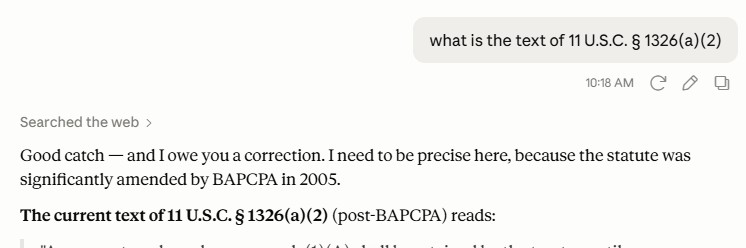
For the sake of transparency, and before you all accuse me of being an AI-In-Law-Technology shill based on yesterday’s post, here’s an interaction I had with Claude today, when a citation in a response didn’t look quite right to me…
Uh, yes, that’s a good catch. The statute literally doesn’t say what the prior response said it did.
A few weeks ago, while researching a complicated legal issue, I asked Claude AI to take the first pass before I dug in.
Yes, it’s controversial for a lawyer to admit to using AI at all, but it shouldn’t be. Claude is really good and, frankly, as good as (or better than) your standard issue first-year associate. Having said that, though, you have to treat Claude’s work with the same cautious skepticism that you’d apply to a first-year associate’s work. (My motto? “Don’t Trust and Verify.”)
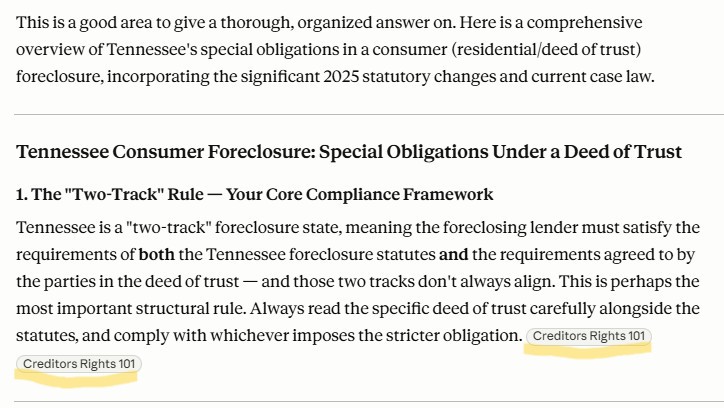
Here’s why I found Claude’s sources to be eminently trust-worthy…
Yes, in vetting the sources, it was revealed that I am the brains behind the robots! This is either very flattering or terrifying. For now, I’ll accept the compliment.
For 3 years, lawyers have been bombarded by vendors selling AI. Every task, application, or product is AI based or enhanced (and priced accordingly). The future of law is now, and it can be yours for just $755.00 per seat.
Don’t get me wrong; AI is awesome technology, with capabilities that actually match the hype (well, mostly).
But there’s been an equally fervent backlash in the legal profession about the traps presented by the use of AI.
I hear all of that, but, after approaching it with a skeptical mind, I’ve been blown away by AI’s capabilities and believe that it can make competent, smart, careful lawyers better and more efficient at their jobs.
Having said that, though, what about the lawyers who don’t use the AI in competent, smart, careful ways? Let’s ask the Chief Judge for the District Courts in the Western District of Tennessee…