The race is on: Davidson County Chancery answers a long-standing question regarding judgment liens

We’re one step closer to answering one of Tennessee collection law’s greatest mysteries: Can a judgment creditor record a copy of its judgment as soon as it is signed by the Judge, or must the creditor wait 30 days?

The question arises under Tenn. R. Civ. P. 62.01, which says that “…no execution shall issue upon a judgment, nor shall proceedings be taken for its enforcement until the expiration of 30 days after its entry…”

The exact issue is this: Is recording a certified copy of a judgment an “execution”? I’ve been asked that for years, but never quite knew the answer.

For starters, what’s the statutory authority for recording a judgment lien? I look at Tennessee Rule of Civil Procedure 69, which is titled “Execution on Judgments,” and includes all the different ways you can “execute” on judgments (garnishments, levies, sheriff’s sales, liens). This list includes Tenn. R. Civ. P. 69.07(2), “Execution on Realty,” which provides the exact process to record a judgment lien against the judgment debtor’s realty.

And let’s be honest; why would you record a judgment in the first place? Under Tennessee law, the recording of a judgment with the register’s office creates a lien on real property, meaning that the debtor can’t sell, refinance, or transfer the property without dealing with the judgment. It’s a pretty powerful tool to get paid. That’s why you’d record it, and as fast as possible.

If the point is to get paid–and as soon as possible–that looks a lot like enforcement, right? But is that “execution”? Should we also throw around terms like “collection” or “attachment” too?

It’s been a mess because the statutes and rules all seem to use these different terms interchangeably, except when they aren’t interchangeable.

Faced with this exact issue, the Davidson County Chancery Court had to make sense of these competing terms and concepts. In an Order from February 2, 2024, the Court found the mere act of recording a judgment during the Rule 62.01 stay period “was not premature ….because the filing of judgment lien is not an act of enforcement.”

In doing so, the Court referenced the pleadings filed in the matter, which drew reasoning from Tenn. Code Ann. § 25-5-101(b)(1) and the competing concepts of “final” judgments found in Tenn. R. Civ. P. 54 and 62.01. Further, given the Court’s brief, but specific, factual finding, the Court seems to agree with the opposing brief’s distinction between the acts of recording a lien versus enforcing a lien, arguing that only the latter would violate Rule 62.01. The full Order is attached below.

It’s an important issue that has long vexed creditor rights lawyers, debtor’s counsel, and even court clerks. I’ve had court clerks only begrudgingly provide me with a certified copy of a judgment on the day of entry (and reminding me that I “can’t do anything with it for 30 days”).

This Order and the related reasoning may provide a roadmap for future arguments on this issue, which comes up far more frequently than you’d think.

I watched these trial court proceedings pretty closely, and I’m glad to see a creditor-friendly result. The underlying initial pleadings are also attached below.

Can a Sheriff’s Execution Sale of Real Property be Continued? (Not Without Court Order or Express Statutory Authority)

A few months ago, I got an unexpected call from a local Sheriff’s Office, late on a Friday afternoon. (Hardly ever always a good thing.)

This Sheriff and I had done a real property “sheriff’s sale” a few years ago that was very successful, and he had one scheduled for Monday that he needed my help on.

Can a Sheriff’s Execution Sale of Real Property be Continued?” he asked.

The attorneys for the creditor and the judgment debtor were trying to work out a deal, but they were running out of time, but the Sheriff didn’t think he could give them more time.

I wasn’t sure either, so I went with my default answer: “It depends. Let’s talk this out.”

In the end, my advice was: “Under existing Tennessee execution law, he couldn’t: He had to proceed, or the judgment creditor had to call it off. There was no in between.”

It reminded me of foreclosures, before the Tennessee passed Tenn. Code Ann. § 35-5-101(f) in 2011.

Back then, unless the text of a deed of trust expressly authorized a foreclosure postponement, trustees weren’t sure if they could continue a sale. Some trustees included language in their sale notices allowing continuances, making it seem like it was no big deal (but if you if you pressed them on the authority to postpone a sale, they’d usually admit that there was none).

Back then, if a deed of trust was silent on continuance, most prudent lenders tended to proceed with a sale, regardless of whether the parties were negotiating potential resolutions. Tenn. Code Ann. § 35-5-101(f) was enacted to avoid those harsh results and help parties who were trying, in good faith, to resolve disputes and save their homes. It gave them some relief to work out a deal.

So, back to our Sheriff’s Sale. The analogy to foreclosures is apt, because the sheriff’s sale statutes track the foreclosure statutes. If you at Tenn. Code Ann. § 26-5-101, et. seq.–it’s nearly the exact same text. In short, a Sheriff’s Sale is, basically, the same thing as a foreclosure sale, but done by the sheriff.

But, for this blog post, I’ll point out a big difference: There’s no § 26-5-101 “(f)” — the part about the continuances. It’s the same text, except for that section.

Uh oh.

And, of course, there’s never going to be any sort of contract to fall back on, because there’s hardly ever going to be any sort of contract between a judgment creditor and judgment debtor providing any sale terms (as a deed of trust would between a borrower and lender).

Separately, there’s nothing in any other Tennessee statutes–talking about execution, sheriff sales, Tennessee Rule of Civil Procedure 69 or elsewhere–about continuances.

Finally, in talking to the Sheriff, I asked him–in a last ditch effort to see if I could help the parties on his sale get some more time to reach a resolution–whether their case’s Sale Order or Notice of Sheriff’s Sale said anything about ability to continue or postpone the sale? There was nothing at all they could point to.

In a perfect world, we’d have a statute that allows continuances in sheriff’s sales. In a less perfect world, the Court’s Sale Order would allow a continuance. In an even less perfect situation, we’d have a Notice of Sheriff’s Sale that would allow a continuance.

Their sale didn’t have any of that.

Don’t Worry About Party Fowl: Chapter 11 Bankruptcy Isn’t Always a Bad Thing

Bankruptcy doesn’t necessarily mean that a business is shutting down.

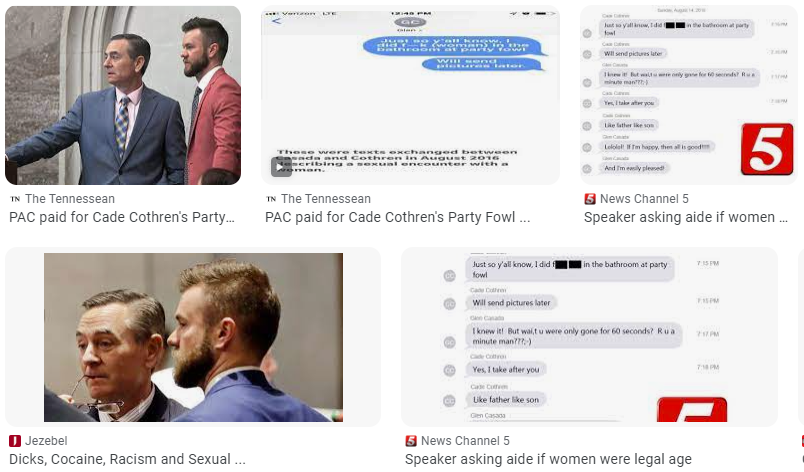
You wouldn’t think that, though, based on the reactions online to the news that Party Fowl, a local “Nashville Hot Chicken” restaurant, filed Chapter 11 bankruptcy last week.

Some of it can be chalked up to schadenfreude: The restaurant was the site of a fairly salacious political scandal involving some of Tennessee’s least likeable politicians in recent memory. Whether it’s echoes of that scandal or its location in the party-centric Gulch, Party Fowl tends to get a bad rap from locals.

The reactions also reveal common misconceptions about how Chapter 11 works. Sure, if a company files a Chapter 11 bankruptcy, something has gone terribly wrong, but it doesn’t necessarily mean the end of the company.

The goal in Chapter 11 is rarely to simply shut down, but, instead, it’s to reorganize and stay in business. This generally involves freezing payments to creditors (unless it’s post-bankruptcy vendor payments), restructuring the company’s debts (i.e. extending the payment terms and, sometimes, paying only a fraction of the amounts owed), rejecting leases (i.e. undoing bad business decisions), and, generally, cut operations and expenses going forward (i.e. downsizing). 

At the end of this process, a chapter 11 debtor will propose a plan of reorganization (based on a realistic budget it can handle) to keep its business alive and pay creditors over time.

Most companies continue operations after filing Chapter 11, and the customers will never notice any difference. Party Fowl filed bankruptcy nearly ten days ago, but they’ve been selling hot chicken continuously over the past two weeks.

Party Fowl appears to have some good reasons for filing. Based on their Company Profile (copy below), the debtor told the Bankruptcy Court that COVID was a big disruption with awful timing: They started a bold expansion in March 2020, and those new locations have struggled and drained resources, impaired cash flow, and led them to take out some fairly onerous and high interest merchant lender loans to bridge the gap. The bankruptcy filing allows the debtor stop paying those sky-high rate loans and use the income to right-size the business.

This is a Creditors Rights blog, written by a creditor rights lawyer, so please don’t think I’m going soft here. Based on the pretty extreme “Party Fowl, we hardly knew thee” reactions, I thought a little bit of background could be useful.

And, don’t worry, I’ve got lots of criticisms about the chapter 11 process, but I’ll save those for a later post. (Just wait until I tell you the story about the mega-bankruptcy case that paid the lawyers $100s of millions of dollars in legal fees and costs over 5 years, and the check my client received last month for 1.04% of his claim…)

Plaintiffs Counsel Beware: Tenn. Court of Appeals issues new opinion on “finality” of general sessions judgments

If you’ve ever filed a lawsuit involving multiple claims or multiple parties, you probably already know how Tenn. R. Civ. P. 54.02 works. If you don’t, here’s a primer that I wrote in 2017.

Yesterday, the Tennessee Court of Appeals issued a new opinion on this topic, which is a must read for sessions lawyers.

The case, Mary Bradley v. Catherine A. Pesce, W2023-00583-COA-R3-CV (Tenn. Ct. Ap. Dec. 19, 2023)(full copy here), involves a lawsuit against two defendants, filed in general sessions court in 2020. Plaintiff served one defendant, but never got the other served. After taking a judgment in June 2022 against the served defendant, plaintiff nonsuited the claims against the never-served defendant in January 2023.

Using the date of the dismissal, the judgment defendant filed an appeal of the June 2022 judgment. The issue, of course, was whether her appeal was timely under Tenn. Code. Ann. § 27-5-108, which provides “[a]ny party may appeal from a decision of the general sessions court to the circuit court of the county within a period of ten (10) days.”

Wasn’t the defendant required to appeal within 10 days of the June 2022 judgment?

Looking to Tenn. R. App. P. 3(a), the Court of Appeals first asked whether a ruling in a matter is “final” where other claims (like a cross-claim) are still pending. The Court noted that the “finality rule” is applicable even in general sessions cases, citing other opinions that “the time for filing a notice of appeal [does] not begin to run until every claim raised in the general sessions court [is] adjudicated.” Further, the Court considered the 2018 amendments to Tenn. Code Ann. § 27-5-108, which provide that one party’s timely appeal takes all issues to the circuit court, even when other claims remain pending.

In the end, the Court concluded that because “the general sessions court action …was against two parties: Appellant and Ms. Weaver,” then “[t]he judgment against Appellant was not final and appealable until all the claims of all the parties were adjudicated,” and “[t]his occurred on or about January
5, 2023.” As a result, the appeal of the June 2022 ruling was not a final order until the dismissal order was signed.

In short, the concepts behind Rule 54.02 apply in Tennessee General Sessions Court, and litigants should keep this opinion in their mind any time a case involves multiple claims and parties.

Here, it seems like the judgment debtor acted out of necessity (and not by design). Frankly, the safest course of action would have been to file the appeal in June 2022 and be entirely certain that the appeal was timely (which would have, by operation of Tenn. Code Ann. § 27-5-108, taken the entire matter to circuit court).

On the other side of the aisle, an experienced plaintiff’s lawyer knows the incredible challenges that an evading or difficult-to-serve defendant presents, and that lawyer should take precaution to make any partial judgment final (and executable) as soon as possible.

This could be done in a few easy ways. The plaintiff could ask for text in the sessions judgment that tracks the language of Rule 54.02, making it clear that the order is a final order. The plaintiff could, at the time of the entry of the initial judgment, dismiss the other claims and parties. Or, if the other claims and parties were simply too crucial, the plaintiff could delay all relief or, at worst, live with a bit of ambiguity as to the finality of the partial judgment.

The appellate court’s reasoning is sound, but a savvy plaintiff has a number of ways to protect their client.

A more pressing question is this: If the “partial” sessions judgment isn’t final in a situation like this, then shouldn’t the Court Clerk refuse to issue execution? (Spoiler: Most will issue execution, but, based on this case, they shouldn’t.)

Tennessee Court of Appeals questions “reasonableness” of contingency fees in collection judgment

Many collections lawyers handle cases on a contingency basis. They don’t bill by the hour, but, instead, they keep some percentage (usually 33%) of the money they actually collect for the clients. Sounds fair, right?

A recent study showed that a Nashville lawyer’s average rate exceeds $500 per hour, and that adds up pretty quick. With lawyers being so expensive, it makes sense that some clients would ask their attorney to share in the success (or, maybe, frustration) of the collection process.

(As a quick disclaimer, I rarely take collections cases on a contingency and, when I do, I’ve done my advance homework and am confident that, candidly, we’re all going to make a lot of money.)

Because the contingency fee attorney is not sending bills that track every minute of his time, a down-side is that he may not have a clear measure of how much in fees he has expended on a case. This is important in breach of contract cases, when the lawyer asks the judge to add an award of attorney fees to the creditor’s judgment. Under Tennessee law, a trial court must consider whether the fees requested are “reasonable,” using very specific guidelines established by the Tennessee Supreme Court.

If the lawyer hasn’t kept track of her work, then what amount does the attorney ask for? Generally, contingency-fee lawyers simply ask for their contingency-fee amount to be added to the judgment. That is generally allowed.

Not so fast, a September 2023 Tennessee Court of Appeals opinion says.

In that case, after they were awarded $50,000 on their breach of contract claim, the plaintiffs asked for attorney’s fees “in the amount of one-third of the total Judgment, or sixteen thousand six hundred and sixty-six dollars and sixty-six cents ($16,666.66).” See Fulmer v. SARCO, GP, No. M202201479COAR3CV, 2023 WL 5787082, at *2 (Tenn. Ct. App. Sept. 7, 2023).

In questioning the attorney fees, the Court of Appeals wrote that “[w]hile a one-third fee may have been what [plaintiffs] agreed to pay their counsel, it is not what [defendants] agreed to pay in the Note” (which only referenced “reasonable attorney fees”). Id. The defendants were not party to the contingency fee agreement, and “what [plaintiffs] agreed to pay their own attorney is not dispositive of what constitutes a reasonable fee under the circumstances of this case.” Id.

Instead, the trial court must have some proof substantiating the fees and services provided, consistent with the factors listed in Tennessee Supreme Court Rule 8, RPC 1.5. Id.

I understand the reasoning here, but I disagree with the general premise that a contingency fee is, per se, not reasonable.

As an example, consider my practice. If I accept one of my no-brainer, “we’re all going to make a lot of money” contingency fee cases mentioned above (and my homework is correct), I could possibly make a $333,333.33 fee on a lawsuit that lasts two months. Does that the fact that I got the matter resolved quickly and efficiently necessarily mean that my fee violates the Tennessee standards for reasonableness? This opinion suggests it might.

In my limited contingency practice, I lean really heavily on my skills, expertise, and homework (i.e. the “novelty and difficulty” referenced in the Rule) in picking my cases. In short, on those cases where I hit a grand slam, it can occasionally look easy, but a lot goes into that. It’s like the ship repairman, who charged $2.00 for tapping the engine with a hammer one time and $9,998.00 for knowing where to tap. He is worth every penny.

In the end, the Court of Appeals remanded the question back to the trial court, and there’s some chance that the plaintiffs make these same arguments in defense of their contingency fee.

Good lawyering is mostly great paperwork: A reminder to include all the details in your Judgments

It looks very exciting on TV, but success in the legal profession is often a matter of being really good at paperwork.

Proof-reading and getting the details right are essential….

But what makes great lawyers really great is the knowledge and foresight to know which details to include.

On TV, cases tend to end after a passionate closing argument, and the lawyer and client walk out of the courthouse victorious. In reality, most of my cases end with me pouring over the details of a single document–the Order that the Judge will sign–and victoriously e-filing it with the Court Clerk.

When I prepare an order for a Judge’s signature, I try to think through every possible scenario where I’d enforce the terms. When I type the judgment debtor’s name, I make sure I’ve spelled the name the same way it’s spelled on the debtor’s old checks or property deed. If there’s some special request or relief I’ve asked for in my motion, I make sure to recite that in the order and have the order expressly grant it.

A trend I’m noticing lately is that lawyers leave out critical details in their orders, and the omissions hurt their cases.

A good example relates to post-judgment sheriff sales. Sheriff’s sales confuse courts, clerks, lawyers, and sheriffs. The law is tricky and draws on 2-3 separate statutory bases (Tenn. R. Civ. P. 69.07 ; Tenn. Code Ann. § 26-5-101, Tenn. Code Ann. § 35-5-101). County sheriffs are good at a lot of things, but they really dislike having to navigate confusing Tennessee statutes on their own.

A good creditor attorney will think through the entire process, starting at the end (i.e. what will the title company need to insure title on this sale), anticipate all the questions, and have the Order address any possible question that could arise.

Who owns the real property? (Look at the Order.)

What are the liens that are impacted by this Sheriff’s Sale? (Look at the Order.)

Who will prepare and publish the Notice of Sheriff’s Sale? (Look at the Order.)

What’s the minimum price pursuant to Tenn. Code Ann. § 26-5-115? (Id.)

Will there be a deposit? What happens after the sale? When does the buyer get a deed? Will there be a sale contract? What happens with the redemption rights? And so on…

I recently saw an Order Authorizing Sheriff’s Sale that said, basically, “the relief granted in the Motion is GRANTED.”

And that was it. The Order had no specific reference to relief described in the Motion and provided no guidance to the sheriff. Instead, to enforce the Order, the lawyer had to also send a copy of the Motion and hope that the sheriff would connect the dots between the two pleadings.

The lawyer’s job is make the process run as smooth as possible, and that includes anticipating issues and preventing them. One strategy to make the process work is to think through all the issues in advance and, before the Judge signs the order, include it all in the document the Judge signs.

Update on Recent Changes to Tennessee’s Post-Eviction Judgment Enforcement

We’ve got some clarity on last month’s changes to Tenn. Code Ann. § 27-5-108(d), which have confused and annoyed both tenants and landlords. And, apparently, the Court Clerk’s Office.

As you’ll recall, effective July 1, 2023, the Tennessee Legislature changed the post-detainer judgment process to require that the Sheriff immediately go remove eviction defendants from property–even when the landlords hadn’t asked the Sheriff to.

Effective July 27, that’s no longer the process in Davidson County.

Per a press release, the Davidson County Circuit Court announced the process “will revert back to the process in place prior to July 1, 2023.”

What? The Legislature hasn’t changed the law; it seems that we’re just going ignore the new Tenn. Code Ann. § 27-5-108(d).

I totally agree with the outcome, but I also feel weird about the Clerk’s Office simply deciding that we’re not going to follow a very clear (yet really dumb) statute. I didn’t realize we had a choice.

Tennessee Legislature Unites Both Tenant and Landlord Lawyers with Imprudent Changes to Tenn. Code Ann. § 27-5-108 (d)

In an apparent rush to be as unfriendly to tenants as possible, the Tennessee Legislature has upset lawyers for both tenants and landlords.

I’m talking about the new Tenn. Code Ann. § 27-5-108 (d), which became effective July 1, 2023.

The prior version said:

(d) If no appeal is taken within the time provided, then execution may issue.

The new version says:

(d)(1) Except as provided in subdivision (d)(2), if no appeal is taken within the time provided, then execution may issue.

(2) For a writ of possession, if no appeal is taken within the time provided, then execution shall issue by operation of law.

Do you see the difference? Under the new (d)(2), a writ of restitution “shall” automatically issue after an eviction judgment.

Some quick background: A “detainer /eviction judgment” is the court order that says a landlord is entitled to possession of the property, usually due to lack of payment of rent or some other breach under a lease. A “writ of restitution” is the subsequent legal paperwork that directs the Sheriff to physically remove a person (and all their stuff) from the property.

To be clear, the entry of the former one does not necessarily require the issuance of the latter.

In most cases, no Writ is ever needed. Most tenants act fast in response to the mere threat of having the Sheriff show up, unannounced, with hired labor to physically remove them and move all their possessions to the street.

Most landlords reach out to the tenant and do everything in their power to accommodate a reasonable and peaceable move-out, to avoid the cost and mess of having the Sheriff throw out all of a tenant’s stuff.

And, sure, not all evictions are the same, and there will always be a few–the “worst of the worst”–where the Sheriff’s help is needed. But those are a rare exception.

As a landlord-tenant lawyer, of the 500 eviction judgments I’ve won, I’d guess that I’ve issued less than 10 writs of restitution.

Why on earth did the 2023 Tennessee Legislature decide that each and every eviction judgment needs this immediate and atomic action? This makes no sense, as a matter of policy or practical application.

Tenant lawyers hate it. Landlord lawyers hate it. I’m guessing the Sheriff’s Office hates it (or will hate it).

And, worse, there’s no way around the law. The Davidson County Circuit Court has already provided notice that this will happen on all eviction judgments.

Just today, I filed an eviction judgment with the Court and, as part of the filing process, I was forced to also to pay the $67.00 Writ of Restitution fee. Neither I nor my client want that process to issue.

The only people who think this is a good idea is the Tennessee Legislature.

Plaintiff Beware: General Sessions Nonsuits aren’t “Decisions” that can be appealed

If a creditor client has a claim that is close to $25,000, I’ll reccomend that the lawsuit be filed in General Sessions Court. To do that, a creditor owed $33,000 must shave its claim to fit the $25,000 limit, as a trade off for the fast pace and reduced costs.

No matter the outcome, you can always appeal the decision for “de novo” review in Circuit Court. In fact, under Tenn. Code Ann. § 27-5-108(a)(1), “[a]ny party may appeal from a decision of the general sessions court…”

If you lose? Appeal. If you win, but thought you should have won more? You can also appeal. “Any party ” means any party.

This broad right has resulted in some plaintiffs not even bringing witnesses to court. In the event that a defendant shows up with exhibits and wants a trial, the plaintiff will voluntarily dismiss the case and, then, just appeal the order of dismissal.

A new Tennessee Court of Appeals case casts this strategy in serious doubt. The Court noted that a nonsuit is a voluntary dismissal by right, at the request of the plaintiff. Walker v. Shelby Cnty. Sheriff Dep’t, No. W202200466COAR3CV, 2023 WL 3000875, at *7 (Tenn. Ct. App. Apr. 19, 2023). As a result, the trial court exercises no discretion and the nonsuit order is not a “decision,” as used in Tenn. Code Ann. § 27-5-108(a)(1), and is not appealable. Id.

Lawyers who represent creditors in general sessions need to take note of this. If faced with this difficult situation, voluntary dismissal remains an option, but the plaintiff must refile a new action after that voluntary dismissal.

That may not be a good option, though, for a few reasons.

Under Tenn. R. Civ. P. 41(2) limits who many times a plaintiff can voluntarily dismiss claims before losing them. Also, a plaintiff may be dealing with potentially time-barred claims, meaning that the filing date of new case would not satisfy the Tennessee statute of limitations. Finally, as a practical matter, the plaintiff may be concerned that it will never get service of process on the defendant in a later case, and plaintiff may want to get the current action pending.

In any of those situations, the creditor’s lawyer has only once good choice under Tennessee law: Try the case and force the judge to issue a ruling on the merits, which can be appealed.

Welcome to the Future: Starting on July 1, Rule 5.02 allows service of pleadings by e-mail.

Effective July 1, 2023, Tenn. R. Civ. P. 5.02(2)(a) will be modernized, so that lawyers can serve pleadings by e-mail.

I wrote about the proposed changes last year, and, in response, a number of you pointed out that Rule 5.02 already allowed service by e-mail.

Sure, you could, but the current version created a process that was three times more complicated than just printing it and mailing the pleading. Long story short, the existing Rule 5.02 wasn’t quite as simple as “service by email is allowed.”

The new Rule 5.02(a) makes it that simple: “Service on any attorney or on a party may also be made by emailing the person the document in Adobe PDF to the recipient’s email address, which shall be promptly furnished on request. The sender shall include language in the subject line designed to alert the recipient that a document is being served under this rule.”

Old habits are hard to break, and there’s not much that lawyers love more than old habits. To that end, all you non-e-mailers will be happy to know that Rule 5.02 still provides three acceptable means of service of process, with service by mail remaining an option. See Tenn. R. Civ. P. 5.02(1).

I tend to assume that lawyers who send me pleadings the mail are either being sneaky (why not waste 3 days or so of the other party’s review and response time) or trying to avoid confrontation (worrying that an emailed pleading will open the door to a snarky response).

Not me. I’ll be saving some trees and sending e-mails.

As a matter of practice, I plan to continue to send full copies of pleadings via US Mail to pro se parties, even though the rule conspicuously doesn’t require different service for pro se parties.

It’s a smart amendment, which reflects how lawyers practice law in 2023.