Sometimes, I use Google for Legal Research

I received an e-mail from a potential client this week that sort of confused me. Frankly, I didn’t know the answer.

The dispute related to a term I hadn’t seen before. The issue involved a check that his bank had returned, unpaid, to the other bank as “Return to Maker.” When I saw that, I went around the other bank lawyers. That’s my real “first step in researching weird legal issues”–asking the older bank lawyers if they’ve ever seen this.

When they either hadn’t (or weren’t at their desks), well, I consulted Google.

And, sure, you’re probably thinking that a lawyer shouldn’t admit to googling legal questions, but you’re wrong. Google is great to get general answers or concepts, before digging down on Westlaw.

In fact, I suspect Google is how the readers of this blog got here. But, Google can’t be entirely trusted, and you have to consider the legitimacy and trust-worthiness of the source when you click on the results.

So, yes, I found out that “return to maker” means, generally, that the payor bank has reason to deny the check due to a suspicion that the negotiable instrument has been forged, modified, or is generally unsure of the legitimacy. That note instructs the drawee bank to revisit the issue with their customer.

With that information (and before I gave out any legal advice), I did that deep dive on Westlaw  to confirm my analysis under Tennessee’s UCC adoption of Article 3.

So, there you have it. If a lawyer denies using Google, don’t believe them.


Presenting at 2017 Family Law Forum: The Life Cycle of a Divorce

As you all know, I regularly speak at Continuing Legal Education seminars for lawyers on topics related to foreclosure, bankruptcy, and other creditor rights issues in the law.

Well, to my surprise, the Tennessee Bar Association has asked me to talk about family law, at its annual Family Law Forum: The Life Cycle of a Divorce, on May 24, 2017.

Now, before you prepare your expert-level questions about parenting plans and in futuro alimony, please know that I’m speaking on Social Media legal issues in family law matters, including things that lawyers must warn their clients against.

I’m an expert on that, because I’ve been law tweeting actively for eight years at @creditorlaw, and my firm has only asked me to delete two tweets. That’s basically a perfect track record.

And, just in case one of you do that thing where you ask presenters weirdly complicated questions, I’ve enlisted Phil Newman, a great lawyer who I refer all family law matters, to serve as my co-presenter.

I’ll post more details later.

Advice for New Lawyers: Always be Prepared, Even for the Easy Arguments

I’m not going to use this post to complain about millennials. Instead, I’m going to complain a little bit about lawyers who are lazy and don’t think for themselves. But, sometimes, this means younger lawyers who happen to be born in the “millennial footprint” (defined as being born from 1982 to 2004).

In the not so recent past, another lawyer agreed to announce a foreclosure continuance for me. This is one of the easiest tasks a degreed lawyer can handle. In fact, some firms send people in Harley Davidson t-shirts to do this, so it’s not quite rocket science.

So, I told the lawyer that the sale was at the Register of Deeds and started to walk away. Then, he asked, “where is that?” I’ll save you the annoying details, but it involved ten minutes of my time showing him how awesome google is for answering questions.

So, recently, I was headed to General Sessions Court with the intent of asking for a “free” continuance in a matter that was set for the first time. If you read this blog, you know that I got to Sessions Court all the time. And, without a doubt, the Court will grant you a free continuance on the first setting of a matter.

But, instead of just going to court and citing “this is what you Judges always do,” I thought I’d be prepared with, you know, the actual legal authority for this. So, I followed my own advice and looked at the Local Rules for General Sessions Court. And, I made the request with complete confidence that it would be granted.

Of course, when I asked for the continuance, the Judge gave it to me without question, but I was prepared for the worst case scenario.

Ok, this blog post doesn’t have a specific point, other than to note that I–having appeared in Sessions Court at least 500 times–took the time to be prepared with legal authority for a very routine request.

So, maybe that’s the point. Lawyering is hard, and so is being a Judge. Always be prepared for the worst case scenario, and take the time on your own initiative to be prepared.


The Law is All Paperwork: An Improperly Authenticated Judgment may Result in Dismissal of Foreign Judgment Action

On my Facebook page, I describe myself as “The Garth Brooks of Paperwork.” Which is a way of poking fun at lots of things about me and my job.

But, law students, please know that success as a lawyer is basically 65% being really good at paperwork.

Thankfully, for the other 35% of us, you can generally amend pleadings to correct mistakes or errors. I’ve recently found a situation where you can’t amend a court filing, such that the entire case might be dismissed.

It’s when there’s an error in your initial filing of a Notice of a Foreign Judgment under the the Uniform Enforcement of Foreign Judgments Act (the “Act”), found in Tennessee at Tenn. Code Ann. § 26-6-101 et.seq.

If a judgment creditor fails to attach a proper exhibit, i.e. a properly authenticated copy of the out-of-state judgment to be enforced, there is a line of cases in Tennessee that say the entire lawsuit is defective because the failure to follow the statutory procedure for authenticating a foreign judgment is fatal as a matter of law.

What’s scary about this line of cases is that there appears to be no ability to file a Motion to Amend Pleadings under Rule 15. Those types of requests are generally granted and would usually allow the plaintiff to correct the error and move on.

Not in proceedings under the Act, Tennessee Courts have said. A recent trial court decision found that a Notice of Filing was not one of the expressly provided list of “pleadings” in Rule 7.01 and, therefore, not subject to amendment under Rule 15.01.

Tenn. R. Civ. P. 15.01 allows parties to amend their pleadings, and leave to amend pleadings is freely granted by the courts when justice demands. Tenn. Rule 7.01 defines “pleading” as a complaint, answer, counter-complaint, answer to a cross-claim, a third-party complaint and third-party answer and states that “no other pleading shall be allowed.’ The Notice of Filing required by Tenn. Code Ann. § 26-6-104 is not one of the pleadings listed in Rule 7.01.

Apparently, then, the judgment creditor’s only recourse when the foreign judgment notice is defective is to dismiss the domestication action, and then re-file a corrected, new proceeding. Yikes.

Lawyers Beware: New E-Mail Scams Using Fake E-mails Target (and Catch) Local Law Firm

I’ve talked about the new versions of the Nigerian e-mail scams targeting lawyers, but now there’s an even newer scam that lawyers need to be aware of.

This new threat, referred to as a “Business Email Compromise” scheme, entails a hacker breaking into the lawyer’s email account, monitoring the emails for some period of time, and waiting for a transaction involving a wire transfer to be discussed.

Once a transaction is identified, the scammer will then send a fake email (using a slightly modified e-mail address) that appears legitimate (at a glance) from one of the parties, but directs the party holding the funds to wire those funds to a different account than previously discussed. This new account is one controlled by the scammer.

If you think this can’t happen to you, then read this Complaint filed in Davidson County Chancery Court on April 26, 2016 (link here: 201604271031.). In that lawsuit, the scammers diverted nearly $900,000 from two property closings in March 2016 using emails that were slight variations of the real accounts.

Instead of “flippin@click1.net”, they used “flippin@cliick1.net”; Instead of “richardbacon50@comcast.net”, they used “richardbacon50@comcastt.co.”

Using these fake email accounts, the scammers sent the closing agent “follow-up” emails, presenting new wire recipient account information. By the time the fraud was discovered, the money was gone, and the only parties left to sue were–you guessed it–the closing attorneys who didn’t notice the changes in the emails.

Here are some red flags to watch for:

  • A last second change in wire instructions;
  • The change in wire instructions is made only via email;
  • A request that funds be released earlier or on an expedited basis;
  • The request uses broken English or bad grammar;
  • The new wire instructions uses an offshore institution or an institution you’ve never heard of; or
  • The new wire instructions involves payment to a person/party not previously in the transaction.

Some best practices in these situations are to:

  • Include wire instructions as part of, attached, and incorporated into the settlement statement personally executed by the parties; and
  • Before wiring any funds, verify the accuracy of the existing (or new) wire transfer instructions by a telephone call to the proper party receiving the funds (not the potentially fraudulent address on the e-mail or potentially fraudulent telephone number included in the e-mail).

As lawyers incorporate new technologies into their practices, so do the ways that scammers can use that technology against lawyers. Watch out.

Resources to Learn More About For Profit Student Loan Forgiveness

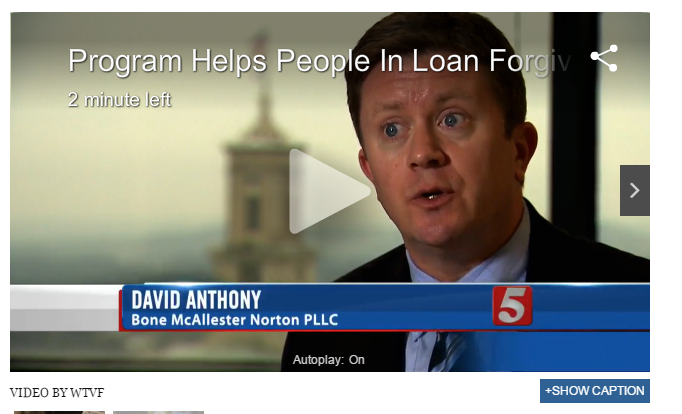
Student loans are a big problem for folks in the Middle Tennessee area. After I gave an interview on the “for profit” student loan forgiveness story last week, my phone started ringing off the hook.

One of the statements I made (which didn’t make the interview) was that a borrower who wants to make a forgiveness request may not need to hire a lawyer to help them with this process.

I mean, I love taking client money as much as the next lawyer, but there are resources online that you should review before talking to a lawyer.

I think the official Federal Student Aid website was a great resource. The site is written in good, clear text and contains a a link at the bottom, under the “How to Repay Your Loans” tab. The specific link is “Forgiveness, Cancellation, and Discharge.” This section contains a comprehensive “Frequently Asked Questions” section, as well links to the application to utilize the forgiveness process.

Lawyers are great and can be a benefit in any process like this. But, before you hire one, I’d suggest that you read the website and get an understanding of the issues first. Then, you know, bring in the big guns.

Loophole Under Federal Laws May Allow Some “For Profit” College Student Loans to be Forgiven


Last week, I talked to NewsChannel5 about a loophole under federal law that may allow borrowers to have their student loans forgiven, where they attended a “for profit” college that has either closed or made clearly false claims to attract students.

NewsChannel5

The law doesn’t apply to traditional colleges or universities, but, instead, to “for profit” colleges, a list of which can be found here.

These colleges generally target non-traditional students (i.e. older students with full time jobs), generally offer only night or online courses, and are known for advertising aggressively.

A great background “primer” on these issues can be found in “The Rise and Fall of For Profit Schools,” which suggests that the “advertising aggressively” part is the root of the trouble. Saying that “these schools made promises they couldn’t keep,” the article says that the industry may misrepresentations to get the attention of prospective students. This generally involves advertising inflated post-graduation job placement rates, misleading claims about potential future earnings, and lies about their faculty and facility quality.

With the economic downturn, as unemployed workers were looking for work and new job skills, those prospective students were the perfect marks for such alleged claims. Because many were unemployed or low income, the student body relied on federal student financial aid to pay the tuition.

The NewsChannel5 report drew from this Wall Street Journal article, which presented the shocking numbers of students availing themselves of the loan forgiveness process. Five years ago, the government had received only a handful of such requests; in the past 6 months, the story says, “more than 7,500 borrowers owing over $164 million have made applications.

Yikes.

Tennessee Supreme Court Considers Noisy Corn Maze in the Context of “Nuisance” Laws

In the fall, you’ll see corn mazes sprout up all over Tennessee. In fact, Memphis loves Marc Gasol so much that they made a corn maze mural of Big Spain. I’ve been to this corn maze, however, and I encourage you to not attend on the nights offering the “haunted” version. (It’s horribly terrifying.)

Ok, back to the legal talk. All this reminds me of a recent Tennessee Supreme Court opinion involving a corn maze, which is a great primer on the law surrounding “nuisance.” It’s at Shore v. Maple Lane Farms, dated August 19, 2013.

In the case, two neighboring landowners squared off in a dispute over the 225 acre farm’s noisy new side business. After years of raising cattle, corn, and other produce, Maple Lane Farms expanded to include an annual spring festival and, later, a fall festival and corn maze. The Plaintiff moved next door in 2003, and, over the next few years, the Farm’s side activities got louder. Beyond the quaint occasional pumpkin festivals, the Farm moved on to regular music festivals, ATV rides, fireworks, and even aerial tours of the corn maze via helicopter.

As you can imagine, music festivals and helicopter fly-overs can get loud, and the farm’s neighbor filed suit in Blount County Chancery Court for them to be quiet, citing local zoning laws.  The opinion has a long discussion of the procedural aspects, but I’ll talk about noisy neighbors here.

Citing the law that “directs landowners not to use their property in a way that injures the lawful rights of others,” the Court said a “nuisance is anything that annoys or disturbs the free use of one’s property or that renders the property’s ordinary use or physical occupation uncomfortable. It extends to everything that endangers life or health, gives offense to the senses, violates the laws of decency, or obstructs the reasonable and comfortable use of the property.” “As long as an interference with the use or enjoyment of property is substantial and unreasonable enough to be offensive or inconvenient, virtually any disturbance of the use or enjoyment of the property may amount to a nuisance.”

The Court noted that the test is for a “reasonable person,” not for the “hypersensitive.” In judging a noise complaint, the Court noted “[a]mong the relevant circumstances are the locality, the character of the neighborhood, the nature of the use causing the noise, the extent and frequency of the injury, the time of day when the noise occurs, and the effects on the enjoyment of life, health, and property of those affected by the noise.” Remedies include damages and injunctive relief.

So, as you’re walking around a corn maze this fall, yelling for help or waiting for the fireworks to start, think of the angry neighbors next door.

The really interesting part of this opinion is actually later, in the Court’s interpretation of the Farm’s defense under the Tennessee Right to Farm Act. I’ll save that talk for another day.

New Lawsuit filed in Davidson County Challenges Nashville’s AirBNB Restrictions

An interesting case was filed yesterday in the Davidson County Circuit Court. The lawsuit, styled Rachel Anderson and P.J. Anderson v. The Metropolitan Government of Nashville and Davidson County, Davidson County Circuit Court No. 15C3212, attacks Nashville’s regulations on Airbnb.com listings.

A copy of the Complaint can be found here.

Essentially, the Plaintiffs allege that the ordinances violate their constitutional due process and equal protection rights by imposing an arbitrary interference and limits on their operation of their residence as a rental property on the short-term rental site Airbnb.com.

It’s a strange lawsuit, with a lot of details alleged. It was filed by the in-house counsel at the Beacon Center of Tennessee.

Teaching CLE on Social Media for Lawyers: Do you really want your Lawyer as a Facebook Friend?

Because I’m an expert level blogger–or, well, I am when I actually, you know, blog–I’ve been asked to teach the audio CLE seminar “Marketing Your Legal Practice: Websites, Blogs, and More,” presented by M. Lee Smith Publishers. This seminar takes place on Thursday, August 27, 2015, at 2pm CST.

Just like the title says, I’ll be talking about all the things in social media and online that lawyers need to be thinking about. Plus, if you know me, I shoot pretty straight and offer my opinions when I think certain things are a waste of time.

Tune in, follow my advice, and watch the referrals roll in. Or, maybe, watch the scam emails from fake clients roll in (watch that CLE too).