On Law Firm Names and Branding

What’s in a name?

There’s a scene in Season 6 of Mad Men that considers this question.

After the merger of “Sterling Cooper Draper Pryce” with their rival, “Cutler Gleason and Chaough,” the partners meet to decide on a name going forward. The secretaries are confused: the official name is “SCDP-CGC,” but many are answering the phones with “Sterling Cooper Draper Pryce Cutler Gleason and Chaough.”

Both are mouthfuls. Every alternative considered is offensive to the partners in different ways. Some don’t like the order of the names. Some don’t like that the deceased partners remain in the title. Some partners don’t like that their own name (or initial) isn’t on the list. Some are just awkward and impossible to say. Every solution is worse than the one before.

In the end, they decide on “Sterling Cooper & Partners,” which is perceived as the least offensive choice (well, except to “Sterling” and “Cooper”).


This reminded me of law firm names.

Law firms have been, generally, named after a few of the lawyers in the firm. Maybe they are the founders and first partners. Maybe they are the rainmakers. Maybe adding a last name to the list is way to recruit the next generation of leaders.

Even though the rules of professional conduct no longer require law firms to use lawyers’ last names, law firm names are still, typically, just a list of last names. And, yes, it can be a mouthful, when it exceeds 3 or 4 names. When I’m typing it out for a letter, all I think about is the back office drama that went into the 7th partner getting his or her name added and how, maybe, that partner is going to fight whoever tries to be the 8th name. When a partner has a hard to pronounce name (like “Chaough”), I wonder if that was a mark against his or her partnership candidacy.

Over the past few decades, as partner ranks have grown, law firms have started to get inventive. In some cases, no matter how many actual partners there are, the firm simply has 2 or 3 partner names listed, following the Mad Men concept of annoying most of the partners equally.

Some mega firms go even more scaled back, using branding that highlights only 1 or 2 names. Sure, lots of people know “Skadden Arps,” but did you know it’s actually “Skadden, Arps, Slate, Meagher & Flom LLP” and that none of Skadden or Arps or any of them are still at the firm?

Having said that, though, if you are reading this blog, you’ve probably heard of Skadden Arps, right? That’s good branding. If you call and ask for Mr. Skadden (or even Mr. Flom), they aren’t there anymore. But, you can be sure that whoever takes your call is going to be very well educated, have great credentials, and will be very expensive and litigious. That’s the “Skadden Arps” way.

I get it. Sometimes, a random assortment of last names has meaning in the market. When you’re a brand name with market cachet, you tend to want to keep that name.


There has been chatter over the past 4 months about the potential demise of Neal & Harwell, PLC, a Nashville litigation law firm that’s been around for more than 50 years. It has been historically regarded as a premier litigation firm in Nashville, based, largely, on the reputation of Mr. Neal and Mr. Harwell. At first, it was second-hand and unsubstantiated whispers, then, about a month later, founding partner Mr. Harwell left for a new firm, and then, over the following weeks, lawyers slowly started leaving for other firms.

Today, the Nashville Post reported that 20 of the remaining Neal & Harwell lawyers will join Womble Bond Dickinson (US) LLP. Womble Bond Dickinson was founded in 1876 in London and has 37 offices all over the world. The picture in the Post’s article is of Womble’s Nashville office managing partner, who has a “202” area code and who is based in both Washington DC and in Nashville.

I don’t know much about Womble Bond, but I remember that it’s one of those big law firms trying to get in on Nashville. I’m sure it’s a great move for all involved, and we’ll be seeing Womble Bond lawyers on the court dockets soon.


I may be biased, but I’ve never liked the long list of last names as a corporate name. Sure, sometimes there’s value (see above), but, sometimes, it’s just about ego, tradition, and lack of creativity. Not to mention that it’s a practice that favors old white guys.

We’ve seen lots of lawyers jumping firms over the past few years, which has included a number of named partners (who are discretely removed from the name), but I can’t remember a founding captain of a firm switching firms and leaving his name behind. Has that ever happened?

Notwithstanding my general dislike of last names as law firm names, I’ve been secretly hoping that one or many of the lawyers at the old firm would decide to simply keep the name and continue practicing as “Neal & Harwell, PLC” for years to come. It’s a brand built with 50 years of effort from many lawyers–and not just Mr. Neal and Mr. Harwell. Lots of unnamed partners have carried that flag for decades, and, just because they weren’t in the name, it doesn’t mean that they didn’t help build up that name.

Did they shut it down when Jim Neal (a huge legal figure) passed away? (No) Are there lawyers all over the country who think of great litigators in Nashville, have no idea about any of this, and will simply tell their Tennessee clients to call the “Neal & Harwell” firm? (Surely)

None of this is my business, and I don’t even know if keeping the old name was possible. (Maybe the Tennessee Rules of Professional Conduct prohibit it.) As somebody who left a firm and has suffered through many e-mail iterations over the last 5 years, maybe I’m just biased about keeping the old name and prefer to avoid the hassle.

But I would have considered it. That name meant something. RIP, Neal & Harwell. You were always a pain in the neck to have litigation cases against, and I respected you and your attorneys.


A remembrance of Professor Tom Nenon and a Reminder of the Value of the Small Things

University of Memphis professor Tom Nenon passed away last week. I want to tell you a very small story about Tom, who had a very big impact on my life.

When I first met Tom Nenon, he’d hadn’t yet been made provost. He was just a professor in the (Memphis State) Philosophy Department.

This was in 1993, and I was starting my sophomore year, still struggling to find my way at a big university.

After a first semester in some difficult pre-med courses, I received a not-so-kind letter from the scholarship office over the Christmas holidays, informing me that, if my grades didn’t rise and exceed a certain threshold, I’d lose my full-ride (and then some) scholarship. My grades weren’t awful, but they were middling.

I was a first generation college student, and my first year was a bumpy ride. As the kid of a grocery store check-out clerk and a factory worker, I had no idea what college looked like or how I fit in there.

When I shared the letter with my family over the holiday break, my parents just shrugged their shoulders and said something to the effect of “Oh well, you tried. College isn’t for everybody.” It’s crazy, but also completely understandable. They had worked every day of their lives to build a great home and life, and they simply didn’t see why their healthy, smart 18 year old son would waste 4 of his prime working years.

It was nice to not get fussed at, but it was also pretty clear that, if I lost this scholarship, it was my problem to solve and, maybe, the end of college for me.

I was terrified. What scared me the most was that my grades weren’t the result of too much fun or partying or enjoying the college life-style. Instead, I was trying as hard as I could and, for the first time in my life, began to wonder if I was good enough to succeed.


I’d love to tell you that the second semester of my freshman year was all redemption and great successes. Nope, it was still really hard. In the end, I got my grades just up enough to keep the scholarship, with Biology II and General Physics making sure to keep me in doubt about my future.


The next year, my sophomore year, I avoided all the science classes. My parents–who were confused why I was even at college–were even more confused to hear about my studies in Sociology, Communication, and Classical Issues in Philosophy.

I was still a bit lost, but felt like, maybe, I was heading in the right direction.

Then I met Tom Nenon, my Philosophy 1101 professor.

If you’ve read this far, you’re probably expecting to hear about an internship or research project or some mentorship that grew into a life-long friendship. This is not that.

Here’s what Tom did for me. A few months into the semester–maybe in October–at the end of a lecture, he asked if “David Anthony was present and could meet me in my office.”

It was big lecture class, with about 75 students, and I remember the looks on my friends’ faces wondering what I had done. I was also a little bit concerned.

In his office, he greeted me as if I was a long-lost friend, and he sat me down and told me how impressed he has been with my work in class. He asked if I had ever considered studying philosophy, and he gave me a sales pitch about the department, the students and faculty, and all the things I could do with a philosophy degree (by that time, I had vaguely identified a law degree as a possible path). I felt like a 5 star point guard in the basketball facility. It was awesome.

In the end, I didn’t become a philosophy major. I took 3-4 more philosophy courses, but followed my heart into the English department. Other than a few hi’s and how are you’s, I’m not sure I talked much with Professor Nenon after that.

But here’s why I’m posting all this. After that day in his office, I never questioned whether I belonged on that campus. I also never questioned taking courses that I was passionate about. I never made anything less than an “A” in any class. And I never forgot the guy who not only saw my potential but made sure to celebrate and encourage it.


When Nenon was appointed Provost years later, I emailed him to congratulate him but also to share my gratitude for that very small moment that had such a ripple effect on my own journey.

His response was very kind and effusive, and I wish I still had it.

But, having read more about his life and passion for others, I am sure that I am just one of the thousands of students, friends, and colleagues whose lives and journeys were touched by Tom, and I’m so glad I was able to thank him, even if it came 20 years after the fact.

It’s a reminder how often we have the ability to help or encourage somebody, with the smallest gesture, and how easy it can be.

Thanks for the final lesson, Professor Nenon.

Foreclosures Are Back! (And what this means for Nashville and Bankruptcy Lawyers)

Maybe it’s a harbinger of a worsening economy, the lack of new commercial lending, high interest rates scaring buyers away, or just that secured lenders are sick of being patient, but Nashville is seeing more commercial foreclosures lately.

Obviously, the pending foreclosure of Plaza Mariachi earlier this month made top headlines, but the increase of foreclosure sale notices in the local newspapers suggest that more lenders are taking that final step.

In full transparency, I wrote we’d see an increase foreclosures back in 2022, and I was generally wrong.

Right now, things seem different. Borrowers don’t have access to the same borrowed funds they had over the past 2-3 years. The exuberant “new money” buyers pouring into the market seem to have slowed down. Both the lenders and borrowers can see the “bottom of the river” regarding cash flow and business income.

As much as we’ve been kicking the can down the road on various deals, we keep ending up at the same place, with foreclosure the only remaining exit strategy.

Next week, I have 5 commercial foreclosures set over the course of two days; the week after that, I have 2.

The next storm cloud on the horizon will be whether Nashville has enough bankruptcy lawyers who can service the needs of a city the size of Nashville.

As that post shows, I’ve been wrong for years about the pending explosion in new bankruptcy cases (it’s largely never happened), so maybe I’m wrong about the lack of bankruptcy attorneys.

I don’t think I am. Faced with a pending foreclosure, Plaza Mariachi filed for chapter 11 bankruptcy, but the lead debtor’s attorney is a firm out of Phoenix, Arizona.

If you are a new lawyer, looking for a viable practice area, I’ll repeat the advice I gave in July 2020:  Learn Bankruptcy.

Smaller Law 101: Advice from Taylor Swift about Bad Client Intake

When I think about my least favorite cases, it’s generally because the client is terrible in some crucial way.

I remember the day I got my own all-time least favorite case. It was about 20 years ago, and my day started with a simple matter in Williamson County General Sessions Court. While I was waiting for my case, there was a dramatic hearing on the docket right before mine.

A contractor had filed a pro se collection lawsuit, and, during the trial, the contractor came with a wild energy, ready to fight. He got into an argument with the lawyer on the other side, threatened the homeowners, had no documents to support his case, and ended the trial by yelling at the Judge (who had ruled against him and told him to hire a lawyer and appeal it, if he thought the decision was wrong).

As the contractor stormed out of the courtroom, yelling at everybody, I remember thinking “I would hate to be that guy’s lawyer.”

In the two hours that it took for me to get lunch and make it back to my office in Nashville, my boss had a new case for me. Yes, it was that guy. He had told his cousin about how he had gotten screwed over by a biased judge and needed a lawyer for the appeal in Circuit Court. The cousin–a client of my firm–recommended my boss, who handed the file directly to me.

I told my boss what I saw in court that day and begged him not to take the case.

I’ll spare you all the details, but that client never got less angry and more reasonable. He was mad at me for asking for paperwork and proof. He didn’t understand why we needed evidence. He was mad at the bills we sent him. He refused to participate in any meaningful aspect of the process. He hated me and questioned everything I said to him about the case. Settlement was never an option. We were going to fight this to the end. My boss took a “hands off” approach.

In the end, he showed up for the trial in Circuit Court, but it was only slightly less wild than the first trial. We lost spectacularly, and my memories of that trial are as vivid to me as my memories of my wedding day and the births of my children.


I tend to think about that case during the holiday season, because, after that trial, I went directly to a real estate agent’s elaborate holiday party in a 6,000 square foot model home in Brentwood (this was the good times, pre-Great Recession). I drowned my PTSD in eggnog.

I was reminded of it all, when I saw Matt Margolis‘ tweet about how better the practice of law can be when you get to choose your clients. Matt recently started his own law firm, Margolis PLLC.

That may be the greatest benefit of running your own firm. At my old firm, you got handed cases, whether you wanted them or not. Some clients are unreasonable. Some have bad claims. Some can’t afford a lawyer. In a big firm, often you don’t always have a choice. It’s too bad, though, because taking on bad cases or bad clients is an easy way to create unhappy lawyers.

Don’t get me wrong: In your own firm, you will absolutely take on bad cases and bad clients, but it’s different when it’s your own choice. At worst, it’s a lesson you (hopefully) learn from. Having recently closed the last of what I referred to as “The Sinister Seven,” I can assure you that it’s a learning process (ask me about the sequel, “The Terrible Two”). Taylor Swift and I both can benefit from some honest self-reflection.

After three plus years of running my own firm, you would be shocked at how picky I have become (I call it The Client Decision Tree, and I’ll do a full post on that soon). Some lawyers see those initial client calls like a job interview, and I do too: But it’s usually me doing the vetting.

I refer out about three times as many cases than I accept, and it’s been a revelation. Some clients simply make things more difficult, and that can impact your entire practice.


To this day, my engagement letters say “the attorney-client relationship is one of mutual trust and confidence,” and it’s not just filler to distract the client from the hourly rate and retainer. If I get a sense from a potential client that she doesn’t respect my role, the legal process, or trust me (i.e. listen to me), that client never gets an engagement letter.

Life is too short and reputations are too fragile to do work for clients who aren’t a good fit with my firm. Say yes to too many bad clients, and you’ll find you have less time, patience, and space for the awesome clients.

Nashville Has a Bankruptcy Lawyer Problem

There are hardly any bankruptcy lawyers in Nashville under the age of 40.

With three law schools in the Middle Tennessee area, you’d think there’d be more than enough lawyers in Nashville to satisfy any and every conceivable legal need. 

If so, you’d be wrong. In my recent experience, Nashville is an under-lawyered city, if you judge from the number of new calls I get (across the legal spectrum) and, as result, the difficulty I have finding a lawyer to refer these callers to.

(As an aside, it might just be that the clients are calling their old lawyers at their new firms and are stunned by the new hourly rates.)

Having said that, I’m really concerned about the lack of young bankruptcy attorneys.

I wrote about this 2020–“The Bankruptcies are Coming, but Where are the Bankruptcy Attorneys“–and my bold March 2020 and April 2020 prediction about the looming wave of bankruptcy filings was totally wrong. In fact, the opposite was true: Bankruptcy filings in Middle Tennessee hit a historic low mark during that time.

As the country braces itself for an economic dip and you hear about law firm layoffs, I repeat my old advice: Learn Bankruptcy.

A bankruptcy practice is one of the best kept secrets in the profession. It’s all based on the Bankruptcy Code, which you can read cover-to-cover in an afternoon. It’s a small, collegial and sophisticated bar (the fact that it’s so small tends to prevent the shenanigans lawyers pull in the broader legal universe).

Plus, starting in a bankruptcy practice exposes you to nearly every legal issue imaginable, since so many state and federal law issues end up in bankruptcy court. Many complex transaction lawyers cut their teeth doing 363 sales in bankruptcy court.

During the last recession, Nashville was lucky and recovered quickly, with real estate prices rising, corporate growth, and a robust commercial lending base in the immediate years after the downturn. 

The downside of that is that we’ve lost a generation of bankruptcy lawyers to corporate, commercial lending, and other (more sexy) practice areas. Today, in the year 2023, the lawyers who file debtor bankruptcies are largely the same ones who were filing those cases fifteen years ago. You can count the firms who file small/medium corporate chapter 11 cases on one hand.

I expect to see more national and local bankruptcy filings in 2024. If you’re a law student or recent grad trying to differentiate yourself from the pack, learning a little bit about bankruptcy law may be a smart move.

Smaller Law 101: My 2023 Holiday Gift Guide for Disgruntled Lawyers

It’s holiday party season for lawyers, and, man-o-man, have I spent a bit too much time around tipsy lawyers over the past few weeks (disclaimer: I’ve been to 2 parties).

It’s also the time of year for: all-nighter transaction work; squeezing files for extra billable hours; year end bonuses; meetings with compensation committees; and polishing up resumes for when all of the above go wrong.

Long story short, these are stressful, uncertain times, and I seem to be answering a lot of the same questions about leaving Big Law and starting a law firm.

So, for those of you who have stressed-out lawyers in your lives, I offer these suggestions as my 2023 Gift Guide for Disgruntled Lawyers.

Want to start your own firm, but have no idea where to start? Buy your lawyer a year subscription to Clio, a comprehensive online practice management platform that offers everything needed to run a law firm: time tracking; billing; online payments; document management; contacts; case and matter management; and everything else. Clio integrates with hundreds of third-party apps, and it’s designed to be the central hub through which all operations run. It’s awesome and costs about $1,000 per year. And, of course, it’s fully online (and secure), so there’s no need for that $25,000 on-site server that makes those strange buzzing noises behind the locked door at the old law firm.

What about everything else? That’s where an annual subscription to Microsoft365 comes in. For about $150, you get e-mail (Outlook), Word, Excel, Powerpoint, Teams, OneDrive, Sharepoint, and about 25 other programs that you’ve never heard of, but are awesome and useful (Bookings has changed my life). Plus, unless you’ve been living under a rock, you probably know that Microsoft is an industry leader on AI research, and you’ll get to be on the frontlines of Microsoft Copilot. That weird picture at the top of this post? It was AI generated by Microsoft Designer.

I haven’t seen anything about phones yet. Here, you’ve got two good options. The industry standard for video communications, Zoom, is now offering VoIP phone services (with pricing starting at $120 annually). Since you will have to get Zoom (all of the remote court appearances and conferences are on Zoom), this is worth looking into. (I use Ringcentral for phone, fax, and business texting, and it’s a bit wonky, but it works).

What about copies, printing and scanning? Most lawyers probably use some high-capacity printer, which is rented from a third party service (and the firm pays a monthly fee and a per page quota each month). You don’t need that. Find a good, mid-quality print/copy/scan machine from HP, which will cost you about $500.

What about the fancy offices? Don’t sign a 5 or 10 year lease for commercial office space. Instead, call one of the 5-7 fancy coworking spaces that have opened in Nashville. I use WeWork, which has been awesome (and has accommodated me in Austin, Chicago, and Seoul). Other options on Music Row include Ampersand Studios, Industrious, Kennect, and e-spaces. These spaces are all “turn key,” meaning they offer printing, internet, limited staffing, and package handling for a low monthly membership fee, generally ranging from $200 to $350.

What about websites and marketing? Some lawyers do this themselves. I don’t recommend that because branding is too important. For all of my various iterations of my own law firm, I’ve used Huckleberry Branding. They’ve designed my logos, helped with color schemes, designed a custom website, helped with content, and also all the incidentals that come with it all (including letterhead, envelopes, and business cards). While I’m embarrassed to have done this 3 times, I’d hire them again if there were a 4th time. They are awesome, and getting started with good branding is too important to do on your own.

What about staffing? You may wonder about who will do all the “little things” to keep the new firm running. (At my old firm, there was a person dedicated to making sure there were cold Cokes at all the meetings.) At a small firm, the lawyer will do all these little things, as well as the medium and big things. To make it a little easier, I’d recommend hiring a phone answering service. I use Abby Connect, a 24/7 answering service whose goal is serve as an extension of my own firm. I’ve used others (Posh) in the past, and the main differentiating factor tends to be pricing and frequency of use. These services cost range from $200 to $500 per month.

What about everything else? Stamps.com for everyday mail. Simple Certified Mail for certified mail. Simplifile to record documents (state-wide) with Register of Deeds’ offices. Lawpay to accept credit card payments (and, yes, Clio offers Clio Payments). If you’ve got lots of documents and need to super-charge document management, the biggest player in the market is NetDocuments (which I use) and is about $75.00 per user per month. I use Minnesota Lawyers Mutual Insurance as my malpractice carrier, and I can’t tell you if they are any good because I hope to never call them ever (about $150.00 a month for robust coverage).

What if this is still too complicated? Buy them a one-hour “Ask an Expert” call with Adriana Linares, of Law Tech Partners, a lawyer-turned-legal-technology consultant who takes a no-nonsense approach to coaching up entrepreneurs on making the early-firm decisions, as well as the late-firm decisions (I had a call with Adriana a few weeks ago).

It’s wild to think that you can run a fully functioning law firm for under $1,000 a month, but it’s entirely possible. It’s also lots of fun to explore all the innovations in legal technology. It’s an unprecedented time for growth in legal tech, and a lawyer with an entrepreneurial spirit has more options now than ever before in how she can practice law.

If there’s a lawyer in your life who believes her law firm isn’t giving her the freedom to nurture that entrepreneurial spirit, I hope this Gift Guide is the first step to a fruitful and lucrative 2024.

If any of you are thinking about making this jump, reach out with any questions, fears, or complaints. I’m happy to help. If I’ve left anything out or if you have any other questions, let me know, and I’ll respond.

Mic Drop: Happy Birthday to Me and My Law Firm

Today (August 8) is my birthday, and it’s also the three-year anniversary of when I started my own firm (well, August 7). With this post, I’ll ask you to indulge me a bit.

It’s a happy birthday toast to my law firm.

It hasn’t been a straight line, but it’s always been onward and upward. I cringe a little bit re-reading my August 2020 post announcing the move. My mission statement still rings true, but, in retrospect, I hadn’t quite run my “big plans” past the other firm (or the other other firm). I was just so excited to be building something new:

I tend to wake up, involuntarily, at 4:45 a.m. or so, to worry about whether it was the right choice and about all the work to be done to build something. Opening bank accounts. Picking office space. Hiring staff. Hiring lawyers. And, of course, doing the legal work for all the clients. And by “wake up, involuntarily,” I really mean “freak out” about what’s next.

My mistake was that I had no idea what I was looking for, until I happened to find it. It’s crazy that, 3 years ago, I typed out the above words, but it never once crossed my mind to actually start my own firm. Instead, I had spent the prior 3 years looking for, simply, a different Big Law Firm. /s/ Because everybody knows that the best way to have a voice in the big firm decisions and autonomy in your law practice is to move to a Big Law Firm. /end sarcastic voice/

Fail fast. So, I had all these big plans for an innovative way to run a law firm, and then somehow decided that I should definitely open an office for a 100 year old law firm based in a city 300 miles away. Reading that last sentence, I totally see the red flag. In reality, it took about 2 weeks. One more (brief) false start later, I decided to go Solo.

Trial and Error is sometimes the best teacher. I won’t recount the mistakes I made in the first 15 months running my own firm, but I’ll tell you that, by November 2021, I was annoyed, fed up, and ready to find the biggest law firm that needed a creditor rights expert. To that end, I met with a legal recruiter, Tara Boosey (who had an office in my building), and told her that I was sick of it, described what my dream job looked like, and told her to find it for me. Her advice? “It sounds like you already have the perfect job for you.” Not what I wanted to hear at that moment, but such great advice.

Just focus on the firm I have. Then it clicked. The work and referrals had always been there, but the unlikely encouragement really focused me on my path. A past obstacle was that clients tend to call me whenever something comes up, and I fretted about the client who maybe calls once a year for an IP referral or the other who sends me 1-2 complex commercial transactions that are way over my head. How could I help them, if I wasn’t at a huge law firm? Simple: I wouldn’t. I’d focus on exactly what I do (and do best), I’d build a network of small-law experts who I trusted, and the smart clients would appreciate a thoughtful referral to another awesome attorney.

And, then, focus even more. Even though the phone never stops ringing, I bill less hours than I used to at the big law firm. That’s because I also spend so much more doing everything else: marketing, IT, accounting, you name it. There are only so many hours in the day. If I couldn’t accept every new case, then I’d have to decide which of the clients I could help. I began to ask things like: Which clients are jerks? Which ones take forever to pay? Which ones are unreasonable? Which ones don’t listen to me? Those were the first ones to go. I call it the Client Decision Tree.

The good clients sustained the firm. Three years ago, when I announced that I was leaving my old firm, one client lost his mind, thinking he didn’t have the option to go with me. In a frantic email, he wrote “Wherever you are, that’s where I want my cases.” Needless to say, that client made the cut and has followed me through every step, through 4 different email addresses (ugh). Since August 7, 2020, I’ve opened 517 new client matters1. Maybe I’m not as low volume as I thought; that number is surprisingly high. A large part of that (maybe 200) were old matters that followed me when my bank clients said “take everything.” (It turns out that my fears that I wouldn’t have any clients unless I stayed in a Big Law Firm were incorrect.)

Working less is a good thing. Once upon a time, no matter what the old firm’s billable minimum was, I exceeded it. Obsessively. It was unhealthy, and maybe bad lawyering. The law should be thoughtful, strategic work, and “high volume” anything does not create the best product. I had a crushing workload. Billable hour mandates are driven by expenses and overhead, and, if those could be kept in check, I believed that my new model could produce high quality work, balanced with a healthy lifestyle. So far, so good: Last year, my hours hit an all-time low, but my net income hit an all-career high.

The mission statement wasn’t entirely crazy, either. Since opening my own firm, I’ve been recognized as an Attorney for Justice by the Tennessee Supreme Court every year. I have helped a Nashville group distribute more than a million dollars in property tax protection and racial justice reparation funds. I’ve started a charitable program, Lawyers Give Back, that has supported 17 different area charities. And, yes, the firm works really hard in service of our clients. I still lose sleep worrying about my cases–there are just intentionally less of those cases to worry about.

In the end, I discovered that I had my dream job. At the old firm, I took my kids to school maybe 10 times over the course of 5 years. In the last 3 years, I bet I’ve done 300 drop-offs and pick-ups. I’m a better lawyer, and I’m also a more engaged husband and father. (After a “law firm divorce,” I can assure you that your law partners don’t actually love you like family.)

Byeonhosa Noraebang! I never took real vacations; instead, I’d tack a few extra days onto 3 day weekends here and there. This year, my family took a dream vacation, spending 3 weeks in South Korea. Our trip culminated with a great dinner with two Korean banking lawyers (and friends), who took our family to noraebang afterwards (on the 10th anniversary of BTS’s debut).

If you’ve made it this far, you may be wondering what my point is, other than a bit of bragging. That’s fair, but we should be able to authentically celebrate all sorts of successes and not just brag on LinkedIn about being a Super Lawyer.

There’s a stigma attached to being a solo lawyer, which isn’t fair. A lawyer doesn’t have to work at a big law firm to be successful or to produce sophisticated work. Three years ago, I couldn’t comprehend that, a result of years of false messaging from law schools and bar associations. Even 20 years into my own legal career, I fell for that BS, and my ignorance wasted a lot of my time.

Don’t get me wrong. Running a small firm is hard and can be a complete pain in the neck (feel free to read some of my other blog posts on that topic). I often tell people “It’s the best job on earth, and it’s the worst job on earth, but it’s never in the middle. I used to spend a lot of time in the middle.”

I also used to tell my kids that they were forbidden from ever becoming lawyers, because it was such an awful job. Not anymore. Now, for the first time, I can picture a day when one of my kids might take over the little firm.

What a three years it’s been. I’ll conclude this post with a celebratory link to BTS’s Mic Drop (a song in which South Korea’s greatest boy band encourages you to relish your successes and also to tell your haters to annyeonghi gaseyo).

Now, I’ll turn off the work email early and go enjoy a birthday dinner with my family.

  1. A prior version of this post said 549, which is what my billing software shows and sounded bizarrely high. On further research, that included a few adminstrative / pro bono / conflict type file assignments, so I reduced the number. ↩︎

Smaller Law: You Don’t Answer Your Own Phones, Do You?

Last year, I was making small talk with a Medium Firm lawyer at a fancy lawyer dinner, and I was complaining about all the phone calls.

The conversation hit an abrupt stop….

Him: Wait a second. You don’t answer your own phone calls, do you?

Me, after an awkward 5 second pause: HA! No way, of course not, are you kidding? (said, literally, while my phone was vibrating in my pocket with a new call)


One of my favorite parts of having my own firm also relates to the least fun part of it: I make every administrative decision and also pay for every decision.

When the cost of every subscription, new technology, and sponsorship comes directly out of your own pocket, you develop a critical eye when making decisions.

With every one, I always ask: Will this help me serve my clients and/or make their experience working with me better? If yes, I then ask: Is it absolutely necessary?


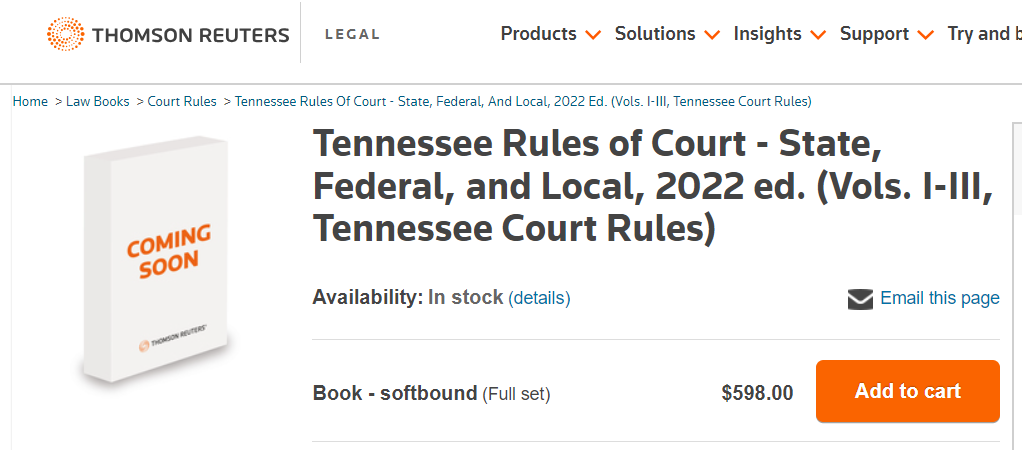
At my old firm, every fall, a brand new stack of the Thomson Reuters “Rules of Court” books would show up on my desk. It was great. I’m a litigator, and, back then, I’d have stretches where I went to court every day of the week. Those books are useful.

But, not absolutely necessary. Everything in those books is available on Westlaw (if you’re a subscriber). They are also totally free on the Tennessee Courts’ website or the United States Courts’ website. They were a useful luxury.

Even back then, I’d get so worked up when I’d see that cart full of the new versions being delivered to every lawyer at the firm. About half of the lawyers never went to court and most likely never touched the books. At 40 lawyers, the $600 price tag turned into real money fast.

Because the $25,000 invoice didn’t come out of any one person’s pocket, nobody ever questioned the expense. We were a big firm, and buying a set for every lawyer was just something you did.

Over time, I saw dozens of budget items that had accumulated over time, which simply became legacy institutional costs that nobody questioned.


Just like paying somebody to answer your phone.

A disclaimer: I’ve always been a “direct line” lawyer, but my clients generally learn to email me for best results. (I mean, post-COVID, who is making “surprise” calls and expecting the other person to have a substantive conversation with you on the spot?)

And, yes, my old firm had people who intercepted unanswered calls and then flipped them to my voicemail. Nowadays, I use a third-party answering service, Abby Connect, to do the same thing, but for about $300 per month. As long as the client hears back promptly, they haven’t cared at all.


There’s really no right or wrong way to run a law practice. What works for one firm might not work for somebody else.

Having said that, though, there’s a direct correlation between how expensive it is to run a law firm and how many hours lawyers are forced to bill. Everything you read about lawyer burnout and stress suggests that an oppressively heavy workload isn’t ideal.

Sure, frisbees with your law firm logo on them are fun, but, somewhere, there’s an associate attorney billing an hour to pay for that.

When I make a decision for my own firm, I also know that any added cost means added billable hours. Some costs are necessary; others simply aren’t worth the extra burden on my schedule.

Today, I’m lucky that I’m the one who gets to make that choice.

My advice for other lawyers thinking about switching firms? Consider whether your values align with the people who will be making those types of decisions. It’ll be you paying for them.

Also, law firm clients, this same warning applies to you. I mean, you’re the ones who pay for all of it.

Smaller Law 101: Advice on Growing your next Law Firm

Exactly three years ago, I was struggling with two decisions. One, whether to buy a boat. Two, whether to leave my long-time law firm.

As to the boat, the world is full of advice about that. Ask anybody you know, and you’ll instantly hear the joke about the “two best days of a boat-owner’s life.” There’s so much information online (generally negative) that a prospective boat buyer has to actively ignore it all.

As to the second (far more important) decision, I was surprised by how little information was out there. Bar associations tend to avoid the topic like the plague. Their business model is to keep big law firms happy, or, at the very least, to not encourage mutinies. Other lawyers aren’t much help either–you’ll rarely get an honest response. They’ll either embellish (for good or bad) or, worse, let slip to somebody that you’re thinking of leaving.

As a result, most lawyers keep quiet and rely on legal recruiters or their own ego, two very unreliable and heavily biased voices.

In this wild Nashville legal market where lawyers are constantly switching firms (and, in a surprise twist, switching back to the original firm), there’s value in real talk. Sometimes the billable hours aren’t greener at the other firm.

For me, I got the law firm decision right. Having said that, even though I’ve had three very successful years, it’s all been built on a foundation of small mistakes, miscalculations, and lessons learned the hard way.

I could write a book about all the things I’ve learned about entrepreneurship, law firm management, marketing, and psychology but, instead, I’ll write some blog posts here over the next few months as the 3 year firm-iversary approaches.

As for the boat? I totally screwed up that one, a mistake so notable that it was documented on the front page of USA Today.

If you’re considering leaving your existing firm, I hope that these blog posts over the coming weeks will be useful –or maybe just keep you out of the national news.

On Lawyer Stress (a/k/a the Post I will send clients when I raise my rates for 2023)

Do you think you might be having a heart attack?

No matter what the actual ailment is. Food poisoning. Anxiety. Indigestion. Insomnia.

When you wake up at 2am, with a racing heart, and a feeling that something isn’t quite right, and get asked “Do you think you might be having a heart attack?

Well, in that moment, you think one thing. That you might be having a heart attack.

I know this from my own experience, just last month. It was the very early Tuesday morning evening of a very busy week: I had a trial scheduled to start 32 hours later in Memphis and, at the end of the week, a bankruptcy conference in California.

And, in that moment, at 2am, yes, it felt like I was having a heart attack.

Continue reading “On Lawyer Stress (a/k/a the Post I will send clients when I raise my rates for 2023)”