The Graceland Foreclosure shows the risks of Tennessee’s non-judicial foreclosure process.

I was born in Memphis and, of course, I’m an Elvis fan.

I was shocked to see–on the national news–that Graceland was facing foreclosure. A few days later, it all just…went away and explained as a hoax. I was surprised, but not totally surprised by these strange turn of events. It rarely happens, but foreclosures in Tennessee are ripe for exploitation by bad actors.

Here’s why: Tennessee is a non-judicial foreclosure state, and courts are rarely involved in the process.

At its most simple, Tenn. Code Ann. § 35-5-101 requires a lender to: (1) publish a notice of the sale 3 times in a local newspaper; and (2) send a copy of the notice to the property owner by certified mail. With just a bit of paperwork, voilà, you can sell somebody’s property.

It’s a cost efficient process for legitimate lenders, but it can be exploited by fraudsters and and paper terrorists, who present bogus claims and hope that their efforts will be ignored or not challenged.

Once a foreclosure is started, there are limited ways for a property owner to stop it, short of filing bankruptcy or filing a lawsuit to obtain an injunction pursuant to Tenn. Code Ann. § 29-23-201 (which is as complicated as it sounds–Graceland’s lawyers filed a 61 document to stop this sale).

When I saw the news about Graceland’s foreclosure, I immediately looked up the Notice of Foreclosure Sale published by Naussany Investments and Private Lending LLC, and noticed red flags. The Deed of Trust had been not been recorded; the lender didn’t have an attorney; and the Notice of Sale lacked the level of detail a typical lender foreclosing on a historic, world-famous property would include.

In short, it all just seemed weird. In reality, it ended up being ten times weirder. It was all a scam, based on fraudulent documents, with a Nigerian based email scammer publicly claiming credit.

As bizarre as all this was, here’s the scary part: This could happen to anybody in a non-judicial foreclosure state. Here, the fraudsters were simply too ambitious, picking a famous property owned by a deep-pocketed and litigious owner.

What about properties by people who don’t understand the process, don’t read the newspaper and/or sign for certified mail, don’t have access to lawyers, or don’t have the money to fight? There are no official safeguards in the system to protect homeowners.

The newspaper doesn’t question the validity of the lender’s claims in submitted advertisements. The mailman doesn’t either. Once the sale is over, the local Register of Deeds just checks for valid notary stamps and payment of the transfer taxes. In some cases, by the time the owner discovers the fraud, there’s already a new deed recorded.

In 2016, I wrote an article for the Nashville Bar Journal titled, “Is your Potential Client a Nigerian King?” As part of that, I learned something wild about the email scammers’ unique business model: They expect to fail 99% of the time. They aren’t bothered by that fail rate, though, because they know that the upside to a single victory justifies all the work.

Sure, these scammers failed to foreclose on Graceland, but how many other times have they succeeded? And how many more times are they going to try?
Tennessee Court of Appeals Makes Clear: Foreclosing Party Must Prove It “Sent” Foreclosure Sale Notice, Not that it was Actually “Received”

I’ve said that the Tennessee foreclosure process can be intimidating because it’s, largely, non-judicial. Because there’s no judge involved, it comes down to the foreclosure lawyer strictly following the intricate labyrinth of statutory requirements.

One of the fundamental steps, of course, is to “send” the homeowner a copy of the Notice of Foreclosure Sale. Under Tenn. Code. Ann. § 35-5-101(e), that sale notice “shall be sent on or before the first date of publication provided in subsection (b) by registered or certified mail, return receipt requested.”

When I’m conducting a foreclosure, it’s a great relief to get that signed, certified mail green card back, because I know that my borrower received the Sale Notice and knows about the sale.

But, what about the situations in which the green card doesn’t come back signed?

This has always been an issue, because a borrower in default on his loans likely sees a certified mail green card as bad news and doesn’t rush to the post office to sign for it, especially when a copy is also sent by first class mail.

It became an even bigger issue during the COVID pandemic, when mail delivery was disrupted and people weren’t leaving their house to go to the post office. One of my 2021 foreclosures was challenged because, instead of getting a signature (presumably to avoid human contact), the postman marked it delivered and wrote his badge number on the signature line.

Do I have to prove that the owner received the Notice of Sale?

A new opinion from the Tennessee Court of Appeals reminds us that proof of “delivery” is not necessary.

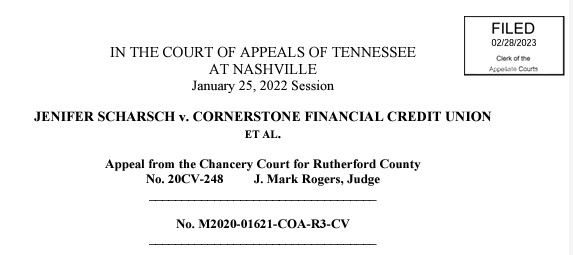
The case is Jennifer Scharsch v. Cornerstone Financial Credit Union, No. M2020-01621-COA-R3-CV (Tenn. Ct. App. Feb. 28, 2023). There, the borrower disputed “receipt” of the foreclosure sale notice. The Court made short work of this argument.

The Court wrote that Tenn. Code Ann. § 35-5-101(e) “only provides that the trustee shall ‘send’ the notice.” Id. (citing Smith v. Hughes, 639 S.W.3d 627, 640 (Tenn. Ct. App. 2021). Further, “[t]here is no statutory requirement that the notice be received by the debtor.” Davis v. Wells Fargo Home Mortg., No. W2016-02278-COA-R3-CV, 2018 WL 1560077, at *11 (Tenn. Ct. App. Mar. 29, 2018).

Because the foreclosing lender had submitted affidavit proof that it sent the notice, the lender satisfied its obligation under § 35-5-101(e).

“Even if [the borrower] never received the letter, [the foreclosing parties] satisfied the requirements of the deed of trust and Tennessee Code Annotated § 35-5-101. So whether [the borrower] received the notice of the foreclosure sale was not material for purposes of summary judgment.” Id.

On my sales, to be clear, I always want there to be a “receipt.” I want the call that has a payment proposal, or threatens a bankruptcy, or anything that shows that they received what I sent. But, due to the total unpredictability of the green-card signature system (and a borrower’s ability to dodge a signature), I don’t want the responsibility of proving that in order to have a valid sale.

New TN Court of Appeals Opinion: Even a defective foreclosure conveys good title

Tennessee is a non-judicial foreclosure state. In order to foreclose on somebody’s house or commercial property, all a lender must do is mail the proper paperwork to the proper parties. A lawsuit or other court involvement is not necessary.

That’s a drastic over-simplification, but, basically, it’s true.

In fact, when I did my first-ever foreclosure 20 years ago, I was so nervous about not having a court involved in such a complex and significant process that I filed a judicial foreclosure action. That way, at the end, I’d have a Judge’s blessing that “This was done correctly.”

What happens to a sale if the foreclosure attorney doesn’t do the paperwork correctly? Is it a valid sale? Can it be challenged?

Yesterday, the Tennessee Court of Appeals reminded us all that even a defective sale can convey good title, at Brady L. Daniels Et Al. v. Vince Trotter, E2020-01452-COA-R3-CV (Tenn. Ct. App. July 20, 2022).

In the case, it was alleged that the creditor did not provide proper notice of the sale, per Tenn. Code Ann. § 35-5-101(e). In the opinion, the Court discussed what, if any, impact of a failure to get the paperwork correct would have on the sale and cited two statutes.

The first, Tenn. Code Ann. § 35-5-106, provides that “[s]hould the officer, or other person making the sale, proceed to sell without pursuing the provisions of this chapter, the sale shall not, on that account, be either void or voidable.”

The second, Tenn. Code Ann. § 35-5-107, provides that the officer or other individual making the sale who fails to comply with the requirements in this chapter of conducting a private foreclosure sale is guilty of a class C misdemeanor and is liable for all damages incurred by the party injured due to his or her noncompliance.

These two statutes, the Court noted, are “intended to eliminate the uncertainty with land titles resulting from foreclosure sales.” Citing the Tennessee Supreme Court, the Court later wrote that a defect in a foreclosure process would not result in the sale being set aside but, instead, the damaged party would simply be entitled to compensatory damages.

Tennessee’s Non-Judicial Foreclosure Process Can be Intimidating

Tennessee is a non-judicial foreclosure state.

What that means is that, when conducting a foreclosure, there is no need to file a lawsuit or get a court involved. Instead, the foreclosure attorney can do it all via a variety of paperwork, without any court involvement.

As a lender or foreclosing creditor, that’s pretty awesome, since you may be able to avoid legal expense and, in some cases, third party scrutinty. (Well, I mean, I only enforce liens that are 100% valid, so I have no issues with this, but some might.)

As a foreclosure attorney, however, a non-judicial process can be a little scary, since the success of the process rises or falls based entirely on your compliance with the statutes, relevant provisions of the deed of trust, and your own paperwork.

In fact, on the first foreclosure I ever handled all on my own, I was terrified by the process. I was so uncertain about the process that I actually talked the client into the benefits of conducting a judicial foreclosure (both because the facts were a little weird, and also because it sure felt reassuring to have a Judge “bless” my process via a court order).

Since then, I’ve done hundreds more foreclosures, but I still remember that initial uncertainty about doing such a significant legal process, all without any court or third party involvement.

The point of today’s post is to: (1) remind you that Tennessee is a non-judicial foreclosure state; and (2) note that, despite that, a creditor always has the ability to file a Complaint for Judicial Foreclosure where the law or facts present a weird issue.

In the end, the real test of your compliance with all the requirements of the Deed of Trust and Tennessee statutes will the title company in the sale transaction when you go to sell the property to a later buyer. If you don’t get the process right, you’ll end up with a defective title and an unmarketable mess.

Good luck, new foreclosure attorneys.

What Does “Materially Less” Mean in Tennessee Foreclosure Sales?

The Nashville Post interviewed me on what constitutes “materially less” in bank foreclosure sales in a December 14 article titled “Appeals court clarifies just what ‘materially less’ means in foreclosure auctions“. This clarification gives banks some guidance in determining what amount must be bid at a creditor’s foreclosure sale in order to preserve their deficiency balance.