Get Your Foreclosures Started Now: New Tenn. Code Ann. § 35-5-101 takes effect in Two Weeks

The Tennessee Legislature has made some significant changes to the foreclosure process in Tennessee, and those changes to Tenn. Code Ann. § 35-5-101 take effect on July 1, 2025.

This post is not to summarize the changes. (I’ll do that at this Tennessee Bar Association CLE, Upcoming Changes to Tennessee Foreclosure Law, alongside the Tennessee Bankers Association.)

The point of this post is more urgent.

By my analysis, the new statute doesn’t apply to foreclosures initiated before July 1 and, for those of you who aren’t ready or willing to learn a new law, I tell you this: Issue your foreclosure sale notices now.

Here’s my analysis. Tenn. Code Ann. § 1-3-101 says “[t]he repeal of a statute does not affect any right which accrued, any duty imposed, any penalty incurred, nor any proceeding commenced, under or by virtue of the statute repealed.”

The Tennessee Supreme Court has considered a similar question and wrote “[t]hough ‘procedural’ changes in the law generally apply retrospectively to causes of action arising before such changes become law,… where the pending action has gone beyond the procedural stage to which the amendment pertains, an amendment will not apply.” See Smallwood v. Mann, 205 S.W.3d 358, 365 (Tenn. 2006).

In short, even though procedural legislation generally applies retroactively, this general concept doesn’t apply when the case has progressed beyond the procedural stage impacted by the new law.

By my own analysis (disclaimer: I could be wrong), if a foreclosure was already in its publication stage before July 1, 2025, the new law doesn’t apply.

After more than 25 years, I’ve practiced through many changes in the law. In that time, I’ve learned that there are always growing pains, confusion, and a little bit of chaos in the days, weeks, and months after a big change.

What I’m saying is: Call your bankers and ask them if you have any foreclosures on their desks.
Tennessee Court of Appeals Makes Clear: Foreclosing Party Must Prove It “Sent” Foreclosure Sale Notice, Not that it was Actually “Received”

I’ve said that the Tennessee foreclosure process can be intimidating because it’s, largely, non-judicial. Because there’s no judge involved, it comes down to the foreclosure lawyer strictly following the intricate labyrinth of statutory requirements.

One of the fundamental steps, of course, is to “send” the homeowner a copy of the Notice of Foreclosure Sale. Under Tenn. Code. Ann. § 35-5-101(e), that sale notice “shall be sent on or before the first date of publication provided in subsection (b) by registered or certified mail, return receipt requested.”

When I’m conducting a foreclosure, it’s a great relief to get that signed, certified mail green card back, because I know that my borrower received the Sale Notice and knows about the sale.

But, what about the situations in which the green card doesn’t come back signed?

This has always been an issue, because a borrower in default on his loans likely sees a certified mail green card as bad news and doesn’t rush to the post office to sign for it, especially when a copy is also sent by first class mail.

It became an even bigger issue during the COVID pandemic, when mail delivery was disrupted and people weren’t leaving their house to go to the post office. One of my 2021 foreclosures was challenged because, instead of getting a signature (presumably to avoid human contact), the postman marked it delivered and wrote his badge number on the signature line.

Do I have to prove that the owner received the Notice of Sale?

A new opinion from the Tennessee Court of Appeals reminds us that proof of “delivery” is not necessary.

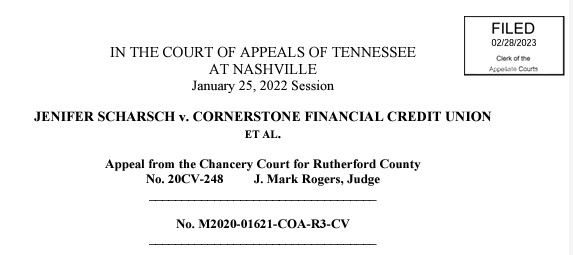
The case is Jennifer Scharsch v. Cornerstone Financial Credit Union, No. M2020-01621-COA-R3-CV (Tenn. Ct. App. Feb. 28, 2023). There, the borrower disputed “receipt” of the foreclosure sale notice. The Court made short work of this argument.

The Court wrote that Tenn. Code Ann. § 35-5-101(e) “only provides that the trustee shall ‘send’ the notice.” Id. (citing Smith v. Hughes, 639 S.W.3d 627, 640 (Tenn. Ct. App. 2021). Further, “[t]here is no statutory requirement that the notice be received by the debtor.” Davis v. Wells Fargo Home Mortg., No. W2016-02278-COA-R3-CV, 2018 WL 1560077, at *11 (Tenn. Ct. App. Mar. 29, 2018).

Because the foreclosing lender had submitted affidavit proof that it sent the notice, the lender satisfied its obligation under § 35-5-101(e).

“Even if [the borrower] never received the letter, [the foreclosing parties] satisfied the requirements of the deed of trust and Tennessee Code Annotated § 35-5-101. So whether [the borrower] received the notice of the foreclosure sale was not material for purposes of summary judgment.” Id.

On my sales, to be clear, I always want there to be a “receipt.” I want the call that has a payment proposal, or threatens a bankruptcy, or anything that shows that they received what I sent. But, due to the total unpredictability of the green-card signature system (and a borrower’s ability to dodge a signature), I don’t want the responsibility of proving that in order to have a valid sale.