Seller Beware: There’s one small change in the new Tennessee foreclosure laws that you need to know

The practice of law is “form” driven. That means that, once a lawyer drafts a really good document, she tends to go back to that document the next time that same issue comes up.

This is particularly true with foreclosures in Tennessee.

Tennessee statutes strictly define what must be included in a foreclosure advertisement at Tenn. Code Ann. § 35-5-104. As a result, a smart foreclosure attorney might start with an old form foreclosure notice, but then compare that against the statute’s checklist, and use that revised document as a form for all of his future foreclosures. (A dumb attorney would just run with whatever is in the form–or what AI says–and not doublecheck it against the law.)

With a little bit of detail work on the front end, a savvy lawyer has a form document that will guide him for years…until the law changes.


This week, I and the Tennessee Bankers Association taught a class for the Knoxville Bar Association called “Modernization of Tennessee’s Foreclosure Laws“, which tracked the foreclosure law changes that went into effect on July 1, 2025.

The TL;DR version is that the newspaper publications have been reduced from 3 times to 2 times and, now, foreclosing parties must post the notice with a “third-party internet posting company.” See Tenn. Code Ann. § 35-5-101.


If you are updating your form, however, you need to dig in on that other statute. There’s a discrete change in the sale notice requirements.

It’s at Tenn. Code Ann. § 35-5-104(a)(7), which adds that the sale notice “shall…[i]dentify the website of the third-party internet posting company that posts an advertisement pursuant to § 35-5-101(a)(2).”


I’m posting this warning because, candidly, I didn’t catch this change in my first reading of the new statutes. Instead, when I was preparing my first “post-July 1” sale notice, I went online and read other recent advertisements, to see what changes other law firms had made on their forms.

In doing that, I noticed this text in many of them: As of July 1, 2025, notices pursuant to Tennessee Code Annotated § 35-5-101 et seq. are posted online at https://foreclosuretennessee.com by a third-party internet posting company.

That’s weird, I thought. Why are they saying that? That’s when I dug in on § 35-4-104 and found that little change.


Non-judicial foreclosures in Tennessee are tricky. You have to comply with both the letter of the statute exactly and with the terms of the relevant lien instrument. In short, you have to be awesome at paperwork.

Big-picture compliance with the changes in Tenn. Code Ann. § 35-5-101 is easy. This post is a reminder that there’s a very little change in Tenn. Code Ann. § 35-104 that could have a big impact on your sale.
New Tennessee Foreclosure Statute Doesn’t Change Lender’s Obligations under Deed of Trust

The changes to Tennessee’s foreclosure laws went into effect on July 1, 2025, and, as you can imagine, Tennessee banks and foreclosure lawyers have had lots of questions on how to navigate them.

This post isn’t going to answer all of them (for that, tune in to my upcoming presentation to the Knoxville Bar Association).

Today, let’s discuss one specific issue that keeps coming up: Now that new Tenn. Code Ann. § 35-5-101(a)(1) only requires publication “two (2) times in a newspaper,” does that preempt what my deed of trust says?

Many deeds of trust don’t have specific requirements; they just make a passing reference to “applicable law.” With those, you follow the statute and (now) do two publications.

Be careful, though: Lots of deeds of trust contain more specific requirements.

A few weeks ago (and after July 1), I prepared to foreclose under a $57,000,000 deed of trust. Naturally, I read every word of that deed of trust. (Many, many, many times.)

That deed of trust required the trustee to “advertise the time, place, and terms of sale at least three (3) different times in some newspaper published in the county where the Land is located…”

Remember, Tennessee is a “two track” foreclosure state,  meaning that a foreclosing lender must satisfy the requirements of both the Tennessee foreclosure statutes and the requirements agreed to by the parties in the Deed of Trust.

So, in short: Yay, they have reduced the number of times a foreclosing lender must publish the foreclosure sale notice in the newspaper! Also, be sure to check your deed of trust to make sure you haven’t agreed otherwise.

Get Your Foreclosures Started Now: New Tenn. Code Ann. § 35-5-101 takes effect in Two Weeks

The Tennessee Legislature has made some significant changes to the foreclosure process in Tennessee, and those changes to Tenn. Code Ann. § 35-5-101 take effect on July 1, 2025.

This post is not to summarize the changes. (I’ll do that at this Tennessee Bar Association CLE, Upcoming Changes to Tennessee Foreclosure Law, alongside the Tennessee Bankers Association.)

The point of this post is more urgent.

By my analysis, the new statute doesn’t apply to foreclosures initiated before July 1 and, for those of you who aren’t ready or willing to learn a new law, I tell you this: Issue your foreclosure sale notices now.

Here’s my analysis. Tenn. Code Ann. § 1-3-101 says “[t]he repeal of a statute does not affect any right which accrued, any duty imposed, any penalty incurred, nor any proceeding commenced, under or by virtue of the statute repealed.”

The Tennessee Supreme Court has considered a similar question and wrote “[t]hough ‘procedural’ changes in the law generally apply retrospectively to causes of action arising before such changes become law,… where the pending action has gone beyond the procedural stage to which the amendment pertains, an amendment will not apply.” See Smallwood v. Mann, 205 S.W.3d 358, 365 (Tenn. 2006).

In short, even though procedural legislation generally applies retroactively, this general concept doesn’t apply when the case has progressed beyond the procedural stage impacted by the new law.

By my own analysis (disclaimer: I could be wrong), if a foreclosure was already in its publication stage before July 1, 2025, the new law doesn’t apply.

After more than 25 years, I’ve practiced through many changes in the law. In that time, I’ve learned that there are always growing pains, confusion, and a little bit of chaos in the days, weeks, and months after a big change.

What I’m saying is: Call your bankers and ask them if you have any foreclosures on their desks.

The Next Frontier of Foreclosure Litigation could be over “irregular” sales.

When Tenn. Code Ann. § 35-5-117 (originally § 35-5-118) was enacted in 2010, foreclosure lawyers were terrified.

This was the first time that the Tennessee legislature limited a creditor’s collection rights after a foreclosure. And the text was pretty ambiguous.

The statute created two general scenarios where a debtor could fight efforts by a creditor to obtain a deficiency judgment after a foreclosure:

  • Where the debtor can make “a showing of fraud, collusion, misconduct, or irregularity in the sale process” (see Tenn. Code Ann. § 35-5-117(b)); or
  • Where the debtor can “prove by a preponderance of the evidence that the property sold for an amount materially less than the fair market value of property at the time of the foreclosure sale” (see Tenn. Code Ann. § 35-5-117(c)).

At the time, foreclosure attorneys focused on what “materially less” than “fair market value” meant. The legislative history of the statute revealed that the lawmakers pulled that phrase from divorce law, where a “material change in circumstances” could impact child custody decisions. (Not much guidance on foreclosure cases.)

Ultimately, the appellate courts found that 88%-90% of the last known appraisal was sufficient, with later opinions approving 80% bids. With this “mathematical” clarity, foreclosing lenders had some guidance to avoid traps under 117(c).

But what about the part we all overlooked, Tenn. Code Ann. § 35-5-117(b)? We took that part for granted because, seriously, does any lender or foreclosure attorney commit fraud, collusion, misconduct, or irregularity in the sale process?

I don’t ask this in a rhetorical way. It’s an interesting question, and, in light of customary foreclosure practices in Tennessee, I think it’s ripe for litigation.

Here’s an example, which you can try at home. Grab your local newspaper (assuming one still exists in your area), and look for the foreclosure notices. Pick the first one you see, and call the foreclosure attorney and see what happens.

In my experience, it’s likely that:

  • The attorney/staff will never answer your call/email.
  • The attorney/staff will not call/email you back.
  • If you do hear back, you will not be provided with any information other than what is in the sale notice.
  • In many situations, you will not even get confirmation whether the sale is proceeding or not.
  • There will be sale terms announced in the minutes before the sale, but those are only rarely shared with interested parties in advance. Things like: Whether buyers need to bring cash. If so, how much. When will closing happen. Whether buyers need be pre-qualified.

These are fundamental questions that any reasonable bidder would expect to be provided. If an interested party doesn’t get these answers in advance, then they simply will not show up or, if they do, will be unprepared to bid. This uncertainty and failure to communicate leaves foreclosure bidding to the low-ball bidders, who make their money by exploiting the ambiguity (and low bid prices).

The failure to respond to interested parties’ reasonable questions will chill interest in a sale and will reduce the number of potential bidders. This could rise to the level of a violation of the foreclosure trustee’s duties under the Deed of Trust and could, possibly, render the sale “irregular.”

Foreclosing lenders in Tennessee should consider subpart 117(b) and how they or their counsel handle sales. Sure, no lender thinks their sale is “irregular,” but, on the right facts, you never know how a court will rule.

Foreclosures Are Back! (And what this means for Nashville and Bankruptcy Lawyers)

Maybe it’s a harbinger of a worsening economy, the lack of new commercial lending, high interest rates scaring buyers away, or just that secured lenders are sick of being patient, but Nashville is seeing more commercial foreclosures lately.

Obviously, the pending foreclosure of Plaza Mariachi earlier this month made top headlines, but the increase of foreclosure sale notices in the local newspapers suggest that more lenders are taking that final step.

In full transparency, I wrote we’d see an increase foreclosures back in 2022, and I was generally wrong.

Right now, things seem different. Borrowers don’t have access to the same borrowed funds they had over the past 2-3 years. The exuberant “new money” buyers pouring into the market seem to have slowed down. Both the lenders and borrowers can see the “bottom of the river” regarding cash flow and business income.

As much as we’ve been kicking the can down the road on various deals, we keep ending up at the same place, with foreclosure the only remaining exit strategy.

Next week, I have 5 commercial foreclosures set over the course of two days; the week after that, I have 2.

The next storm cloud on the horizon will be whether Nashville has enough bankruptcy lawyers who can service the needs of a city the size of Nashville.

As that post shows, I’ve been wrong for years about the pending explosion in new bankruptcy cases (it’s largely never happened), so maybe I’m wrong about the lack of bankruptcy attorneys.

I don’t think I am. Faced with a pending foreclosure, Plaza Mariachi filed for chapter 11 bankruptcy, but the lead debtor’s attorney is a firm out of Phoenix, Arizona.

If you are a new lawyer, looking for a viable practice area, I’ll repeat the advice I gave in July 2020:  Learn Bankruptcy.

Can a Sheriff’s Execution Sale of Real Property be Continued? (Not Without Court Order or Express Statutory Authority)

A few months ago, I got an unexpected call from a local Sheriff’s Office, late on a Friday afternoon. (Hardly ever always a good thing.)

This Sheriff and I had done a real property “sheriff’s sale” a few years ago that was very successful, and he had one scheduled for Monday that he needed my help on.

Can a Sheriff’s Execution Sale of Real Property be Continued?” he asked.

The attorneys for the creditor and the judgment debtor were trying to work out a deal, but they were running out of time, but the Sheriff didn’t think he could give them more time.

I wasn’t sure either, so I went with my default answer: “It depends. Let’s talk this out.”

In the end, my advice was: “Under existing Tennessee execution law, he couldn’t: He had to proceed, or the judgment creditor had to call it off. There was no in between.”

It reminded me of foreclosures, before the Tennessee passed Tenn. Code Ann. § 35-5-101(f) in 2011.

Back then, unless the text of a deed of trust expressly authorized a foreclosure postponement, trustees weren’t sure if they could continue a sale. Some trustees included language in their sale notices allowing continuances, making it seem like it was no big deal (but if you if you pressed them on the authority to postpone a sale, they’d usually admit that there was none).

Back then, if a deed of trust was silent on continuance, most prudent lenders tended to proceed with a sale, regardless of whether the parties were negotiating potential resolutions. Tenn. Code Ann. § 35-5-101(f) was enacted to avoid those harsh results and help parties who were trying, in good faith, to resolve disputes and save their homes. It gave them some relief to work out a deal.

So, back to our Sheriff’s Sale. The analogy to foreclosures is apt, because the sheriff’s sale statutes track the foreclosure statutes. If you at Tenn. Code Ann. § 26-5-101, et. seq.–it’s nearly the exact same text. In short, a Sheriff’s Sale is, basically, the same thing as a foreclosure sale, but done by the sheriff.

But, for this blog post, I’ll point out a big difference: There’s no § 26-5-101 “(f)” — the part about the continuances. It’s the same text, except for that section.

Uh oh.

And, of course, there’s never going to be any sort of contract to fall back on, because there’s hardly ever going to be any sort of contract between a judgment creditor and judgment debtor providing any sale terms (as a deed of trust would between a borrower and lender).

Separately, there’s nothing in any other Tennessee statutes–talking about execution, sheriff sales, Tennessee Rule of Civil Procedure 69 or elsewhere–about continuances.

Finally, in talking to the Sheriff, I asked him–in a last ditch effort to see if I could help the parties on his sale get some more time to reach a resolution–whether their case’s Sale Order or Notice of Sheriff’s Sale said anything about ability to continue or postpone the sale? There was nothing at all they could point to.

In a perfect world, we’d have a statute that allows continuances in sheriff’s sales. In a less perfect world, the Court’s Sale Order would allow a continuance. In an even less perfect situation, we’d have a Notice of Sheriff’s Sale that would allow a continuance.

Their sale didn’t have any of that.

Lender Groups ask Tennessee Supreme Court to weigh in on conflicting authority on wrongful foreclosures

In July, I wrote about a July 2022 Court of Appeals opinion holding that even a defective foreclosure sale conveys valid title to real property. That’s because Tenn. Code Ann. §§ 35-5-106 and 35-5-107 expressly say that title is not impacted by a defective sale and, instead, the foreclosing trustee is liable for monetary damages.

Within a few minutes, a local banker commented on the post and asked: Yeah, but did you see this one from last month?

He was talking about Terry Case v. Wilmington Tr., N.A. as Tr. for Tr. MFRA 2014-2, No. E202100378COAR3CV, 2022 WL 2313548 (Tenn. Ct. App. June 28, 2022)– issued less than a month earlier–which held (sort of) exactly the opposite: “[A] trustee’s mere failure to comply with the terms of a deed of trust will render the foreclosure sale invalid.” Id. at *8.

How does the law reconcile these drastically different outcomes, based on the same wrongful foreclosure allegations?

Tennessee is a non-judicial foreclosure state, but don’t be lulled into a sense that foreclosures are simple (i.e. just “paperwork”). Instead, a foreclosing lender must simultaneously adhere to two separate processes, one of which is found in Tennessee statutes and the other in the underlying deed of trust.

Sometimes, they match; sometimes, they don’t.

If the lender doesn’t comply with any of the requirements of both tracks in full, though, this developing caselaw imposes drastically different remedies for non-compliance. Fail to satisfy the statutes? No big deal. Fail to satisfy the deed of trust? Here’s a nuclear bomb to your title.

Needless to say, this is confusing to creditors, borrowers, and buyers at foreclosure sales.

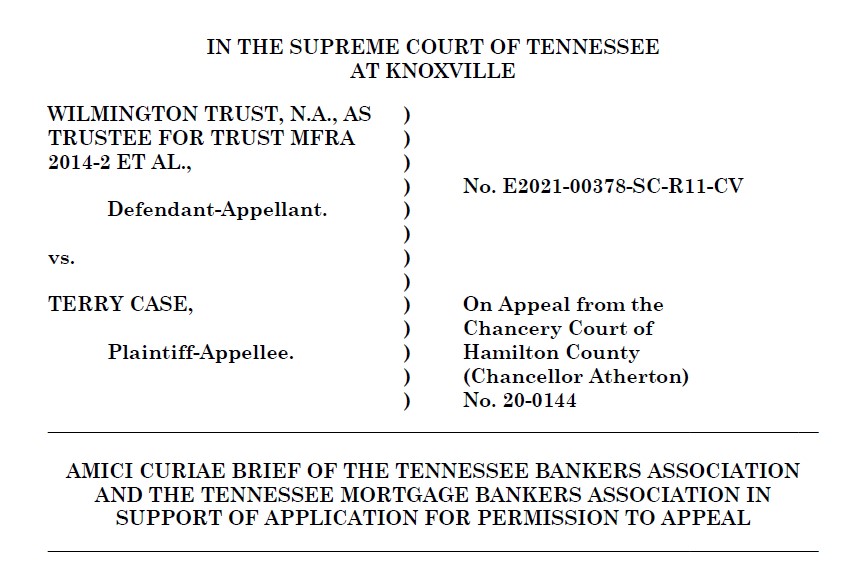
The plaintiff in the June 2022 case has filed an Application for Permission to Appeal to the Supreme Court (a full copy is attached below), seeking clarification on the splintered issues of law surrounding wrongful foreclosure claims. The Application opens with a direct message: “Tennessee wrongful foreclosure law is in a state of disarray.”

On behalf of the Tennessee Bankers Association and the Tennessee Mortgage Bankers Association, my office filed an Amicus Brief in support of the request to have the Supreme Court step in (also below).

This is a big deal. If this caselaw stands, title to foreclosed real properties will remain clouded until the wrongful foreclosure claims expire (6 years from the sale date). And, sure, a title company can vet the sale process, but title companies don’t like any risk, no matter how small.

This will render post-foreclosure title completely uninsurable. This isn’t good for anybody. Borrowers, lenders, buyers–everybody loses here.

Per the Numbers: Tennessee foreclosures are historically low, but storm clouds are forming

My banker clients are a pessimistic bunch.

That’s partially because the bankers that I deal with are in “special assets” or are the bank’s general counsel.

Long story short, they aren’t the ones at the ribbon-cutting ceremony for the expensive new restaurant; nope, my clients are the ones who get called in at the end, when the loan has gone bad and we’re figuring out what to do with used restaurant equipment. My clients always notice the storm clouds on the horizon.

With that in mind, for more than a year, they’ve been predicting a tidal wave of commercial and consumer loan defaults, followed by a spike in foreclosures.

And, generally, they’ve been wrong.

In Tennessee, one recent study showed that–to date–there have only been 3,316 foreclosure sale notices published (state-wide) in 2022. That sounds like a lot, but it’s less than a third of what we had in 2017 (10,810) and 2018 (11,711).

In 2022, the most sale notices have been published in Shelby County (496), followed by Hamilton County (304), Davidson County (271), and Knox County (223). Honorable mention to Williamson County (153) and Montgomery County (132).

The 3,316 figure for 2022 is an increase from 2021 (2,169). These drop aren’t entirely COVID driven, as Tennessee had just 5,982 sale notices published in the pre-pandemic glory days of 2019.

That low volume in 2019-2020 was the result of a number of factors, including COVID-related forbearances, sky-rocketing property values, and low interest rates. And, as you know, all of those factors are disappearing.

(Side-note: We can’t be sure about COVID, of course, but I’m pretty sure we won’t see mortgage rates in the 2’s and 3’s for a very long time.)

In the end, here’s where the bankers are probably right: There’s a backlog of foreclosures, and the crush is coming soon. The bankers are correct that the sky is falling; their timing was just off by a year.

Homebuyer Beware: Some of the property listings on Zillow are Foreclosures and Sheriff’s Sales

Last year, I had a foreclosure scheduled for a Williamson County property in an “in demand” neighborhood and, somehow, Zillow picked up my Foreclosure Sale Notice and listed my sale on the property’s Zillow page. In April, I wrote a post about the 500 phone calls and emails I received from all over the world, asking about the property.

In fact, I got one today from Detroit.

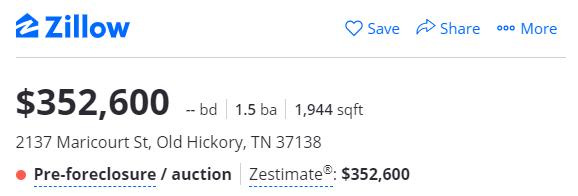
But, a few minutes later, I got a call about another Zillow listing, this time on a Sheriff’s Sale I’m conducting in August on 2137 Maricourt Street, Old Hickory, Tennessee 37138.

The full Notice of Sheriff’s Sale of Real Property can be found on The Wilson Post’s Public Announcements page. I have no idea how it ended up on Zillow, but anything that generates more potential bidders is good.

As indicated in the Sheriff’s Sale Notice, the property is scheduled for auction at 11:00AM, on August 3, 2021. The Sale Notice contains the terms of sale, including opening bid and the bidding process.

I post here in order provide a quick link to the Notice of Sale, which I’m planning to forward to potential bidders. This should present a great opportunity to a bidder.

In this strong real estate market, there are limited opportunities to find good deals on Middle Tennessee real property. The investors have long figured out foreclosure sales, then they figured out tax sales, and, now, Sheriff’s Sales are the next frontier. Sheriff’s Sales used to be rare–given that the process is fairly complex and confusing (even to lawyers)–but these are becoming more common, given the rise in property values and the unyielding demand for residential real estate.

As Zillow continues to grow into a trusted resource, though, I worry that a typical homebuyer may be lulled into seeing only the upsides of the potential deals listed on Zillow, without fully exploring the risks that distressed asset sales present.

I’m not suggesting that a buyer shouldn’t consider participating in a sheriff’s sale (seriously, please come on August 3), but I am encouraging every caller to educate themselves on the process and to consult with a real estate lawyer in advance.

Does Post-Judgment Interest change every six months? (Probably not)

I had an “in-person” court appearance yesterday morning, renewing and extending a judgment from 2011. As a creditor, old judgments can be a gold-mine, as home values have soared in Middle Tennessee, and a well placed judgment lien might have some equity.

Plus, it’s sort of nice to take a trip down memory lane, back to when creditors automatically got 10% interest on their judgments.

As long time readers know, in 2013, they revised the post-judgment interest rate statute, Tenn. Code Ann. § 47-14-121, and switched to a variable (and lower) rate, subject to change every six months.

Yesterday, in my proposed Order Renewing Judgment that I handed up to the Judge, I included language that the renewed judgment would accrue interest “as provided in the original judgment, at the then applicable rate of interest under state law.”

The Judge asked me if that meant that interest was 10% over all of this time (and into the future) or, instead, was it a variable rate, changing each time the rate changes.

Well, Judge, that’s a legal question that drives hundreds of visitors to my creditor rights law blog every year.

The Judge asked me if I had a case or other authority to show whether or not the rate fluctuates. I hadn’t researched it (because it wasn’t really an issue on this unopposed Motion), so the Judge simply crossed out “then existing rate” and wrote in “applicable rate,” which punted the issue down the road.

But, we sort of have an answer, thanks to a local lawyer’s comment on this blog post from early last year:

From the TNCourts.gov website: “Beginning July 1, 2012, any judgment entered will have the interest set at two percent below the formula rate published by the Tennessee Department of Financial Institutions as set in Public Chapter 1043. The rate does not fluctuate and remains in effect when judgment is entered.”

And, no, that’s not a case or a statutory cite. It’s just an introductory paragraph on the Administrative Office of the Courts website. But, it’s something. And, it’s as good as we’ve got for right now. “The rate does not fluctuate and remains in effect when judgment is entered.”

As a practical matter, the best practice would be to always use a specific interest rate in any judgments. Instead of saying post-judgment interest “as provided under Tennessee law” or at the “applicable post-judgment interest rate,” always just say the a specific rate, whether it’s 5.25% or 7.45%. This text would create a presumption of a specific, certain rate of interest going forward.

As more of these Great Recession era judgments come up for renewal and lenders are dusting off these pre-2013 judgments for execution against houses and defendants with drastically changed circumstances, I’m betting that, very soon, this is going to be an issue that a creditor is going to need briefed.