Tennessee’s Post-Judgment Interest Rate Hits Record High

Effective July 1, 2023, the statutory rate of post-judgment interest in Tennessee is 10.25%, the highest that it’s been in my 20 plus years of practice.

Long-time readers know that, in 2012, the Tennessee Legislature amended the Tennessee post-judgment interest statute, Tenn. Code Ann. § 47-14-121.

At the time, Tennessee creditor rights attorneys complained both about the decrease in the interest rate (at the time, it dropped from 10% to 5.25%) and also the confusion related to tracking a variable rate (it changes every 6 months). Back then, none of us envisioned a world where the rate would exceed Tennessee’s old rate.

Well, welcome to the future.

What’s next? A review of the historical list of Tenn. Code Ann. § 47-14-121 interest rates shows that rates have been steadily climbing since 2016, with the greatest spike in the past year.

When the Legislature made these changes during the Great Recession, it was designed to provide relief to judgment debtors. That the rate has reached an all-time high is good for creditors, of course, but also indicative that interest rates are pushing the economy toward a tipping point.

Plaintiff Beware: General Sessions Nonsuits aren’t “Decisions” that can be appealed

If a creditor client has a claim that is close to $25,000, I’ll reccomend that the lawsuit be filed in General Sessions Court. To do that, a creditor owed $33,000 must shave its claim to fit the $25,000 limit, as a trade off for the fast pace and reduced costs.

No matter the outcome, you can always appeal the decision for “de novo” review in Circuit Court. In fact, under Tenn. Code Ann. § 27-5-108(a)(1), “[a]ny party may appeal from a decision of the general sessions court…”

If you lose? Appeal. If you win, but thought you should have won more? You can also appeal. “Any party ” means any party.

This broad right has resulted in some plaintiffs not even bringing witnesses to court. In the event that a defendant shows up with exhibits and wants a trial, the plaintiff will voluntarily dismiss the case and, then, just appeal the order of dismissal.

A new Tennessee Court of Appeals case casts this strategy in serious doubt. The Court noted that a nonsuit is a voluntary dismissal by right, at the request of the plaintiff. Walker v. Shelby Cnty. Sheriff Dep’t, No. W202200466COAR3CV, 2023 WL 3000875, at *7 (Tenn. Ct. App. Apr. 19, 2023). As a result, the trial court exercises no discretion and the nonsuit order is not a “decision,” as used in Tenn. Code Ann. § 27-5-108(a)(1), and is not appealable. Id.

Lawyers who represent creditors in general sessions need to take note of this. If faced with this difficult situation, voluntary dismissal remains an option, but the plaintiff must refile a new action after that voluntary dismissal.

That may not be a good option, though, for a few reasons.

Under Tenn. R. Civ. P. 41(2) limits who many times a plaintiff can voluntarily dismiss claims before losing them. Also, a plaintiff may be dealing with potentially time-barred claims, meaning that the filing date of new case would not satisfy the Tennessee statute of limitations. Finally, as a practical matter, the plaintiff may be concerned that it will never get service of process on the defendant in a later case, and plaintiff may want to get the current action pending.

In any of those situations, the creditor’s lawyer has only once good choice under Tennessee law: Try the case and force the judge to issue a ruling on the merits, which can be appealed.

Welcome to the Future: Starting on July 1, Rule 5.02 allows service of pleadings by e-mail.

Effective July 1, 2023, Tenn. R. Civ. P. 5.02(2)(a) will be modernized, so that lawyers can serve pleadings by e-mail.

I wrote about the proposed changes last year, and, in response, a number of you pointed out that Rule 5.02 already allowed service by e-mail.

Sure, you could, but the current version created a process that was three times more complicated than just printing it and mailing the pleading. Long story short, the existing Rule 5.02 wasn’t quite as simple as “service by email is allowed.”

The new Rule 5.02(a) makes it that simple: “Service on any attorney or on a party may also be made by emailing the person the document in Adobe PDF to the recipient’s email address, which shall be promptly furnished on request. The sender shall include language in the subject line designed to alert the recipient that a document is being served under this rule.”

Old habits are hard to break, and there’s not much that lawyers love more than old habits. To that end, all you non-e-mailers will be happy to know that Rule 5.02 still provides three acceptable means of service of process, with service by mail remaining an option. See Tenn. R. Civ. P. 5.02(1).

I tend to assume that lawyers who send me pleadings the mail are either being sneaky (why not waste 3 days or so of the other party’s review and response time) or trying to avoid confrontation (worrying that an emailed pleading will open the door to a snarky response).

Not me. I’ll be saving some trees and sending e-mails.

As a matter of practice, I plan to continue to send full copies of pleadings via US Mail to pro se parties, even though the rule conspicuously doesn’t require different service for pro se parties.

It’s a smart amendment, which reflects how lawyers practice law in 2023.

Court of Appeals: If attorney discounts their fees, prevailing party may not be entitled to recover full amount

Much to my former law partners and book-keepers’ chagrin, I often apply courtesy discounts to my clients’ legal invoices.

It’s counter-productive to my business model. But, as a kid raised by a mom who worked at the local Piggly Wiggly and a dad who worked on an assembly line, sometimes I look at a bill, am reminded of how expensive lawyers are, and apply a small discount.

Don’t get me wrong: All my billable entries are wonderful and worth every penny. In fact, I tend to win many of my cases, including an award of attorney fees, and, when I do, I sometimes wonder whether the defendant have to pay the full amount (and not the discounted amount)?

A recent Tennessee Court of Appeals says that a court can only award what the prevailing party actually pays (or is obligated to pay). It’s at St. Paul Cmty. Ltd. P’ship v. St. Paul Cmty. Church, No. M202101548COAR3CV, 2023 WL 1860692(Tenn. Ct. App. Feb. 9, 2023).

In the case, the trial court originally awarded the Church $343,535.07 in attorney fees and expenses, which were computed at the rate of $295.00 per hour. In later proceedings (after an earlier remand), the Church attorneys asked for $515,655 in attorney fees, which appeared to retroactively calculate all entries at $450 per hour.

Why? The attorney and client had a unique “side” agreement to the engagement letter, that, even though the hourly rate was $295, if they won, the attorney would ask the Court to reimburse the fees “at a higher rate than the $295/hour I’m billing the church.” There was no agreement that the Church would ever actually have to pay that higher rate.

In light of the Tennessee’s application of the “American Rule” on attorney fees, the Court of Appeals focused on the text of the underlying agreement, which required the reimbursement of attorneys fees “incurred” by the Church. “Incur,” the Court noted, means “to become liable for” or “to be legally obligated to pay.”

Here, the lawyer’s engagement letter clearly said that the Church would never be expected to actually pay that higher rate. The trial court, then, was correct in awarding the attorney fees at the $295 rate, “which were charged and paid at the $295 rate pursuant to the written engagement letter” and denying any requests that the higher rate. Id. *6.

It’s an interesting opinion, with some fairly unique facts that would never come up in most cases.

But, in the context of long-standing litigation, a few $300 or $500 “courtesy discounts” here and there over the course of a case could add up to a few thousand (or more) dollars. After a long fought legal battle, it’d be natural to have your billing software show your cumulative legal fees for your Affidavit (which would naturally output only logged time entries and not paid bills) and forget to give your adversary the benefit of those discounts.

Under this new opinion, you may be legally obliged to. So, maybe my book-keeper is right.

New Court of Appeals Opinion suggests that late-filed Answer may not prevent a default judgment

All the good Nashville lawyers I know are so busy right now. This is a good problem to have, but, nevertheless, it is a problem. There’s simply too much demand right now.

I overheard one local lawyer telling a story about a frantic call he received from a client, who was freaking out because they hadn’t filed an Answer to a lawsuit, and it had been more than 30 days after service.

“Have they filed a Motion for Default yet? If not, then it’s not late.”

I’m sure the lawyer was more tactful in the actual conversation, but the reasoning has some basis in local custom. Often, in Davidson County courts, if a defendant files an Answer before the hearing on a Motion for Default Judgment and pleads a tenable defense, a court will not grant a judgment under Tenn. R. Civ. P. 55, under the theory that the justice system prefers that “matters be decided on the merits” not a technicality. (See, generally, Discover Bank v. Morgan, 363 S.W.3d 479, 491 (Tenn. 2012)).

A recent opinion from the Tennessee Court of Appeals shows that there are risks in waiting to file an Answer.

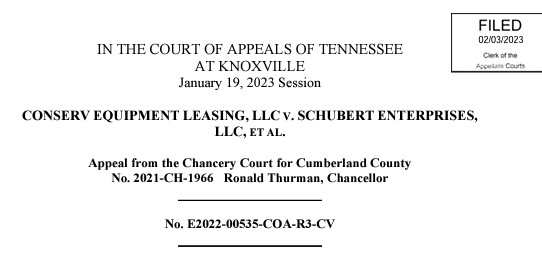
That case is Conserv Equip. Leasing, LLC v. Schubert Enterprises, LLC, No. E2022-00535-COA-R3-CV, 2023 WL 1489768 (Tenn. Ct. App. Feb. 3, 2023). There, the creditor filed a motion for default, and, a few days later, received a phone call from an attorney who “expected to be retained” by the defendants and asked for a 3 week continuance on the motion hearing. After the hearing was so continued, that defense attorney “fax-filed” an Answer at 3:59pm on the Friday before the Monday morning default hearing, with an original copy filed with the Clerk about 33 minutes before the hearing.

Defendant appeared at the hearing, objecting to the relief and presumably with filed Answer in hand, but the default judgment was nevertheless granted. At the trial court level, Defendants later tried to set aside the ruling on excusable neglect grounds and Tenn. R. C. P. 60.02.

The Court of Appeals noted that “[a]lthough courts construe Rule 60.02 ‘with liberality to afford relief from a default judgment,’ the movant bears the burden of showing ‘why the movant was justified in failing to avoid the … neglect’.” Id. at *2. The Court wrote that “[i]f the court finds that the defaulting party has acted willfully, the judgment cannot be set aside on ‘excusable neglect’ grounds…” and “[m]aking ‘deliberate choices’ amounts to willful conduct. Id.

In the end, the issue was remanded back to the trial court, whose order denying the Rule 60 motion failed to include findings of act and conclusions of law (per Tenn. R. Civ. P. 52.01). In short, the trial court didn’t provide any explanation for its ruling.

To be clear, though, the Court of Appeals didn’t say the trial court was wrong; instead, it sent it back down for the trial court to provide more explanation for its refusal to set aside the judgment. The most likely outcome, of course, is that the plaintiff will prepare a properly supported proposed order, the judge will sign it, and, then, that order will be appealed.

It’ll be an interesting case to watch, but, procedurally, it’s also a reminder: Don’t delay when dealing with court deadlines.

Per the Numbers: Tennessee foreclosures are historically low, but storm clouds are forming

My banker clients are a pessimistic bunch.

That’s partially because the bankers that I deal with are in “special assets” or are the bank’s general counsel.

Long story short, they aren’t the ones at the ribbon-cutting ceremony for the expensive new restaurant; nope, my clients are the ones who get called in at the end, when the loan has gone bad and we’re figuring out what to do with used restaurant equipment. My clients always notice the storm clouds on the horizon.

With that in mind, for more than a year, they’ve been predicting a tidal wave of commercial and consumer loan defaults, followed by a spike in foreclosures.

And, generally, they’ve been wrong.

In Tennessee, one recent study showed that–to date–there have only been 3,316 foreclosure sale notices published (state-wide) in 2022. That sounds like a lot, but it’s less than a third of what we had in 2017 (10,810) and 2018 (11,711).

In 2022, the most sale notices have been published in Shelby County (496), followed by Hamilton County (304), Davidson County (271), and Knox County (223). Honorable mention to Williamson County (153) and Montgomery County (132).

The 3,316 figure for 2022 is an increase from 2021 (2,169). These drop aren’t entirely COVID driven, as Tennessee had just 5,982 sale notices published in the pre-pandemic glory days of 2019.

That low volume in 2019-2020 was the result of a number of factors, including COVID-related forbearances, sky-rocketing property values, and low interest rates. And, as you know, all of those factors are disappearing.

(Side-note: We can’t be sure about COVID, of course, but I’m pretty sure we won’t see mortgage rates in the 2’s and 3’s for a very long time.)

In the end, here’s where the bankers are probably right: There’s a backlog of foreclosures, and the crush is coming soon. The bankers are correct that the sky is falling; their timing was just off by a year.

New Tennessee Court of Appeals Resolves Ten-Year Old Question about Post-Judgment Interest Rate

For nearly a decade, I’ve been writing about the Tennessee post-judgment interest statute, Tenn. Code Ann. § 47-14-121, which was amended in 2012 to change from the long-standing fixed rate of 10% to a variable rate that changes every 6 months.

I say “writing,” but others may say “complaining.” They’d probably cite this post: What I Don’t Like About the New Post-Judgment Interest Rate Statute In Tennessee (Everything).

My initial concern was one that many Tennessee lawyers shared: Because the interest rate is subject to change every six months, will the applicable rate on an existing judgment also change every six months?

Nobody knew. Not attorneys. Not court clerks. Not even the trial court judges.

In a very helpful comment to this 2020 post about the issue, Tennessee attorney Michelle Reynolds provided the best answer I’d seen (and one that I’ve since argued):

From the TNCourts.gov website: “Beginning July 1, 2012, any judgment entered will have the interest set at two percent below the formula rate published by the Tennessee Department of Financial Institutions as set in Public Chapter 1043. The rate does not fluctuate and remains in effect when judgment is entered.”

Of course, that’s not a case or a statute. It’s an “introductory paragraph on the Administrative Office of the Courts website.”

In an opinion issued last night, however, we have our answer!

In the case (Laura Coffey v. David L. Coffey, No. E2021-00433-COA-R3-CV (Tenn. Ct. App. Apr. 11, 2022), the Tennessee Court of Appeals notes this long-standing confusion and then immediately dispels it.

In its analysis, the Court notes that the rate to be applied under Tenn. Code Ann. § 47-14-121(a) is clear and unambiguous (it’s math), and it’s the entirely separate provision at Tenn. Code Ann. § 47-14-121(b) that introduces fluctuations in the general rate. Noting the clarity in (a), the Court finds that (b) does not create ambiguity as to existing judgments.

Under Tenn. Code Ann. § 47-14-121(a), the Court writes, the “applicable post-judgment interest rate does not fluctuate when applied to a particular judgment; instead, it remains the same for the entire period of time following entry of the judgment…until the judgment is paid.”

It’s always a great day when an unresolved issue gets clarity. Sometimes I make a joke that only “law nerds” will appreciate a legal development like this; for this one, though, I think all Tennessee lawyers will benefit from this opinion.

Tennessee Judgments Always Incur Post-Judgment Interest

A good rule of thumb for prevailing parties in litigation is this: If you want something, be sure to include that in the court order.

Well, duh. The Judge can’t give it to you if it’s not expressly written in the order.

A recent opinion from the Tennessee Court of Appeals (Hartigan v. Brush, No. E202001442COAR3CV, 2021 WL 4983075 (Tenn. Ct. App. Oct. 27, 2021)), however, makes clear that post-judgment interest applies on all monetary judgments in Tennessee, no matter if the order expressly says so.

There, the Court noted that, under Tenn. Code Ann. § 47-14-122, “Interest shall be computed on every judgment…,” and, as a result, post-judgment interest is “mandatory.”

It’s an issue that’s unlikely to come up often, partially because every prevailing party generally includes an express grant in their judgment. But, when the order doesn’t expressly say it, have this recent case ready to go.

Welcome to Nashville: Property Developers, Bachelorettes, and National Law Firms

The Nashville Post ran a story on Tuesday about the “shifts in the local legal market” and all these national law firms moving to town and scooping up lawyers to create local offices.

It’s a topic that local lawyers have been talking about for a few years, generally in the form of complaints about the out-of-towners coming in, planting a flag (albeit a very fancy flag), and changing the local market in ways that don’t necessarily change it for the better.

And, yes, I fully acknowledge that this is, basically, the “lawyer” equivalent of when long-timer Nashvillians complain about the people from California moving to their neighborhood and running up the home prices.

Last fall, I had a commercial real estate matter with one of these new law firms. The lawyer I dealt with was based out of Phoenix (but, weirdly, always called me from a Miami area code). It was a small deal, but also the most difficult project I worked on last year. Literally, every thing that could be argued about was argued about. To this day, if you are calling from the 305, you are getting my voice-mail (sorry, J-Lo).

For good or bad, it was definitely a different experience, and I worry whether this is what the next 10 years looks like.

I know I sound like those traditionalist lawyers who refuse to acknowledge change and who, last year, probably refused to do Zoom hearings or, years ago, refused to use e-mails.

But, it is going to change the local legal profession.

Lawyers at mega-firms have to bill more to pay for those mega-offices (both in Nashville, but also in NYC, LA, and all of those other “national” cities) and the mega-salaries being offered. More issues get nit-picked, more calls get scheduled, and, slowly, the way you do a deal in Nashville feels more like how you do it in NYC, Chicago, or whatever other of the 20 cities the lawyer you’re dealing with is based out of.

In the end, you have to wonder whether this results in more costs to the client and, if it does, is it worth it? (And, disclaimer, if a huge law firm wants to buy my firm, I will instantly delete this post.)

I had drinks with a couple of local lawyers from other firms a few weeks ago. We talked about office space (still expensive!), some local gossip, and these issues. (Recap: Many of our well-respected-lawyer-friends work at these firms; they are awesome and do good work; we’re just jealous; who is next, etc.)

In the end, one of the other lawyers wrapped it all up with a sly grin: Sure, it’s going to change the Nashville legal market, but there’s a silver-lining. Over the next 3-5 years, it’s going to artificially raise the standard hourly rate for legal work by 33%to 50% for all of us. (And, sure, this was said as a joke, but also as a statement of fact. This is a very good prediction.)

If you’ve lived in Nashville more than 5 years, you’ve heard complaints just like what I’ve said in this post. You’ve also heard the typical response, which points out that the complaining neighbor’s own property value has sky-rocketed due to the hot market. Same goes for lawyers.

We live in interesting times in Nashville.

CLE You Can Use: The TBA’s Creditor Practice Annual Forum is this Wednesday

If you need CLE credit and want to learn more about creditors’ issues, the Tennessee Bar Association has a great course coming up this week: This year’s Creditors Practice Annual Forum is this Wednesday, September 30, 2020.

This is generally an in-person event at the TBA headquarters in downtown Nashville, but, this year, it’ll be entirely online (for obvious reasons).

I’m the Chair of the TBA’s Creditors Section for 2020, and it was my job to recruit all the speakers and create the sessions. The online format really made for some fun choices, including finding speakers who otherwise wouldn’t be available to speak at a live event in Nashville.

We’ve got a Judge from Shelby County. A digital media specialist from Atlanta. A bankruptcy debtor’s lawyer from Jackson. A former creditor lawyer turned tech guru from Memphis. And, to everybody’s surprise–a creditor lawyer from California! (Note: Nobody even knew that California had creditor lawyers; we all assumed that they only had different levels of debtor focused lawyers.)

In all seriousness, it’ll be a great program. Topics include:

“A Creditor’s Rights: Top Issues and Common Mistakes From the Judge’s Perspective” by Hon. Phyllis Gardner, Hon. Lynda Jones and moderated by Kara Reese.

“The Future of Collections and Bankruptcy in the New Recession” by Monique Jewett-Brewster, Tracy L. Schweitzer and Jerome Teel, Jr.

“Legal Technology Update: Zoom, Slack, and Other Things You Never Realized You Need” by Zack Glaser, Lori Gonzalez and Kim Bennett.

And, remember, your Tennessee Bar Association membership includes 3 free CLE credits, so, basically, this will be free for you all. Thank me later!