341 Stories: Lawyer Compensation Week, the modern business obituaries

Welcome to January 21, 2021, the first full day of the Joe Biden administration. It’s also an interesting time for law firms…

Most law firms announce compensation plans this week. The first week of the year is generally spent winding down last year’s financials. The following week is spent distributing bonuses.

This third week, though, may be the most important. It’s when the new year’s salaries are announced. Associates and partners alike sharpen their advocacy skills, to explain away last year’s billables and to demonstrate how this coming year will be the biggest one yet. And, of course, that they deserve a big raise.

If you’re a lawyer in a “discretionary” system (i.e. you advocate to a “compensation committee” for a higher salary), you have limited arguments available. In fact, the presentations generally focus on two metrics: (1) I promise to bill more hours; and/or (2) I am raising my billable rate.

Neither of these are particularly good outcomes for clients.

Unless there was some external factor that limited hours (illness, leave of absence, COVID), where can a lawyer find 100-200 more billable hours in 2021? Is the lawyer simply going to work harder? Maybe. In other cases, the lawyer will just pad their time and that letter that took a “0.3” in 2020 now becomes a “0.5” letter.

And, sure, inflation or more experience can justify an increase in an hourly rate, but is the increase really based on that, or has the lawyer just figured out that a $15 increase multiplied by 1,800 hours equals $27,000 more in profit?

When a rate increase is based only on a new calendar year, it can lead to unjustified results.

Law firm leadership has no incentive to push back on these issues. More hours and higher rates mean more money to them too. In short, the fox is in charge of making sure the barn door is locked.

All I’m saying is, clients, watch your bills next month.

Despite the pandemic and overall concerns about the economy, legal rates are going up. In March, we all talked about how commercial real estate, transactions, and law firm profits were dead. But, locally, that hasn’t been the case.

In general, law firm hourly rates are rising. The pessimist would say that law firms are increasing hourly rates to offset the reduction in actual hours billed. The optimist would say that the commercial economy is as strong as it ever was and that rising rates reflect the market.

Get your insolvency news from McLemore Auctions. I love getting the weekly emails from McLemore Auctions that show all the cool stuff being auctioned, usually via a going-out-business liquidation. In fact, one of the biggest mistakes I made during the pandemic was to show my children the website, which has resulted in a few really strange family purchases.

A few weeks ago, I noted the concept of “funeral by auction” after seeing how frequently the fixtures and assets of many Nashville restaurants end up being sold on the McLemore site. In fact, based on my review of today’s Nashville Post, it seems like the McLemore website may be the earliest public notice that some local businesses have closed.

And, yes, it really stinks to be shopping for deals on gaming chairs, and you see the cafe where you proposed to your wife being sold off, piece by piece.

Remember to shop local. I cringe when I see a local restaurant on the McLemore website. It’s often because I hate to see a small business owner give up, and I feel a little guilty thinking about the last time I spent my money at that local business.

This restaurant closure really hurt. Yesterday, the Nashville Post reported that Woolworths on Fifth was closing. Woolworths was a beautiful restoration of the historic lunch counter where many brave African American students and leaders took a stand to demand equality in our city.

I frequently took guests there for lunches over the years, and I was always proud to share that history. I also worry what’s next and whether the future operators will respect the history of the site.

There’s no stay in judgment appeals (unless you ask for one)

There’s a bit of confusion about appellate bonds, particularly when it comes to money judgments from a court of record.

“Is what I’ve filed good enough to protect my client from an immediate garnishment?” That’s not a legal question that any attorney wants to learn after a client’s bank account gets hit.

In every appeal, the Appellate Court Clerk’s office charges certain filing fees for the Notice of Appeal. At the same time, the appellant must file an Appeal Bond for Costs, which is a bond (generally signed by the attorney) to cover the court costs in the appeal (generally, a nominal amount).

Judgment enforcement is automatically stayed for thirty days after entry pursuant to Tenn. R. Civ. P. 62.01. But, here’s the key: The filing of an appeal and posting that initial “cost bond” do not automatically stay enforcement of a creditor’s rights under a judgment.

You’ve got a valid appeal, but you don’t have any stay on enforcement.

In order to obtain a stay of collections after the appeal is filed, the appellant must file a motion with the trial court. Ultimately, this is done by filing a “stay bond,” but, until the trial court grants such a motion and approves the amount of the bond, there is no stay of judgment enforcement. See Tenn. R. Civ. P. 62.04. Tenn. R. Civ. P. 62.05 requires that the bond be in an amount sufficient to pay “the judgment in full, interest, damages for delay, and costs on appeal.”

In short, just filing an appeal and posting a cost bond does not stay the enforcement of a judgment. Bank levies, wage garnishments, all of that can still happen.

And, if you’re a litigant or attorney who doesn’t understand this issue, then there’s a good chance that you’re in for an unpleasant surprise during your appeal. Don’t be that lawyer.


United States Supreme Court: Post-bankruptcy possession doesn’t violate automatic stay

It’s rare the the United States Supreme Court decides a legal issue that affects everyday consumer bankruptcies, but today was one of those days.

In City of Chicago, Illinois v. Fulton, the Supreme Court ruled unanimously that a creditor who repossesses property prior to a bankruptcy filing is not required to release that property after the bankruptcy filing. Per today’s opinion, “mere retention of property does not violate the [automatic stay in] § 362(a)(3).”

This case has real-world implications for creditors, mainly car loan creditors. In the past, if a lender repossessed a vehicle and the borrower filed a bankruptcy case, the debtor would then demand immediate release of the car.

The argument has been that the secured creditor would be in violation of the automatic stay, unless it immediately released the vehicle to the debtor. In our Nashville bankruptcy local practice, the creditor attorney would generally ask for “adequate protection,” meaning proof of insurance on the car and proof that the debtor was proposing a reorganization plan that would pay for the car.

But, in short, if the car creditor tried to keep the car after a bankruptcy was filed, the creditor was swimming in risky waters. That continuing exercise of possession, most of our bankruptcy judges would say, was an action to collect a debt and a stay violation.

Justice Alito’s opinion walks a fine line, noting that 11 U.S.C. Section 362(a)(3) “prohibits affirmative acts that would disturb the status quo of estate property.” The opinion says that simply holding property is not affirmative act; it’s just maintaining the status quo.

While it’s true that that Section 362(a)(3) prohibits “exercising control over estate property,” Alito wrote that this text “suggests that merely retaining possession of estate property does not violate the automatic stay.” The words used in §362(a)(3) “halts any affirmative act that would alter the status quo as of the time of the filing of a bankruptcy petition.” An automatic stay is not “an affirmative turnover obligation.”

In the end, the Supreme Court wrote that “We hold only that mere retention of estate property after the filing of a bankruptcy petition does not violate §362(a)(3) of the Bankruptcy Code.”

This case creates as much trouble as it resolves, honestly. In practical application, where the creditor has repossessed the car, when does the creditor turn it over? In its discretion? After negotiation of plan repayment terms? Never (i.e. the creditor keeps the car and files a motion for stay relief to take an affirmative action–a sale)?

Law Students: Law School Grades Will Not Define Your Career

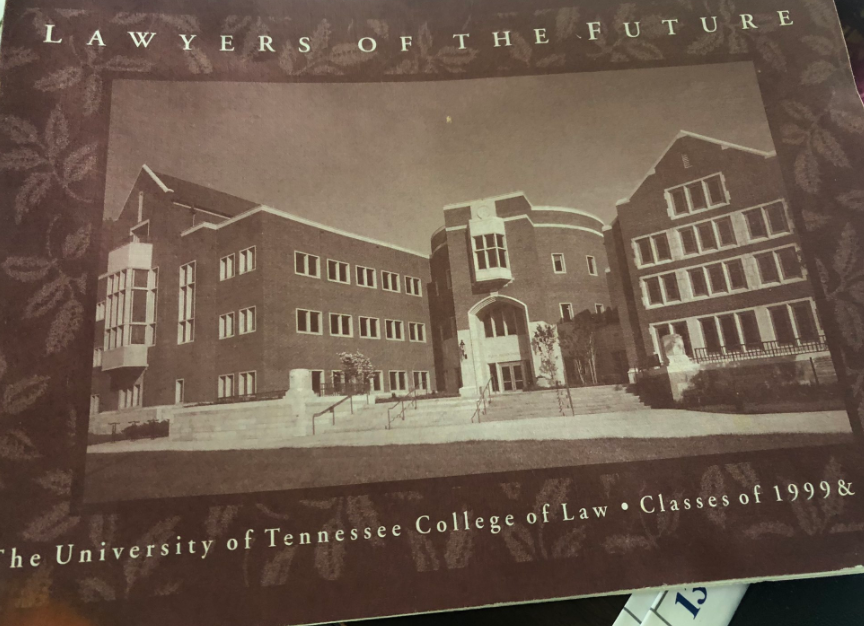
Over the long New Years holiday, I found my law school’s “Lawyers of the Future” picture book in a box while cleaning out my basement.

This was a booklet all University of Tennessee College of Law students were given at the start of a school year, with pictures and biographies of all the law students.

My plan had been to throw all of this stuff away, but I just couldn’t. Instead, I strolled down memory lane, looking at all the faces of the people who I’d assumed would be part of my professional life forever, as opposing counsel, judges, and law partners.

Twenty years ago, though, I looked at those faces with less sentimentality. Back then, I looked at those people and their prestigious backgrounds, mainly, as competition. Competition for grades. For law review. Moot Court. Summer Jobs. Clerkships. Associate positions.

Lawyers, do you remember how much you agonized over your first semester 1L law school grades? I mean, it felt like everything in your life depended on Criminal Law, Contracts, Civil Procedure, Legal Writing, and Torts.

Law school grades just absolutely consumed our lives.

Continue reading “Law Students: Law School Grades Will Not Define Your Career”

Unreliable 2021 Predictions for the Nashville Legal World

2020 wasn’t a great year for predictions for me.

Remember when I boldly predicted that June 2021 would see an all-time spike for consumer bankruptcy filings in Nashville? (Note: That time period actually saw local bankruptcies hit a 10 year low.)

Remember when I joined an out-of-town law firm with the express goal of creating the “perfect law firm”?

Remember when I bought a boat? (Note: Yes, I was quoted in USA Today calling it all a big hassle.)

So, with that grain of salt, here are my predictions for 2021:

Continue reading “Unreliable 2021 Predictions for the Nashville Legal World”

What I think about when I think about Nashville’s Second Avenue: My first law office. My first job. And the city I fell in love with.

My first job as a lawyer was on Second Avenue in Nashville.

This was in 1999, and my future boss had me come to the office to interview on a Saturday morning (partly to avoid the suspicion of the lawyer I would be replacing).

At the time, I didn’t know much about downtown Nashville, since most of my trips to Nashville were either to Opryland as a kid or driving on I-40 on the way to law school in Knoxville.

I had clerked one summer in Nashville at the Tennessee Attorney General’s office, but, back then, Second Avenue didn’t have much to attract folks in their mid-20s. In 1999, the vibe was Gatlinburg-esqe, with a Hooters, Mere Bulles, Graham Central Station (three stories of bars, each with a different theme), a palm reader, The Wild Horse, and other tourist-centric places that catered more to out-of-town grandparents.

I got the job, and I spent about 8 years on Second Avenue. A lot changed during that time.

Before Fan Fair moved downtown, the big show was Dancin’ in the District, which was set up in Riverfront Park. My office window was a perfect vantage for these shows; I saw Kanye West (with a then unknown John Legend on the piano), the Strokes, and many others, from about 500 feet away. It’s strange to think about all the big-time, national acts that performed at these free concerts to such relatively small audiences. Part of that, of course, was that, back then, hardly anybody wanted to go downtown.

Watching the 2007 July 4 celebration.

In fact, in the early 2000s, that lack of “busy-ness” was part of what I loved about downtown Nashville. On a Friday night, we’d hit 6-7 Broadway honky tonks (generally via the back doors in the Ryman alley) looking for any bars with a crowd, which we rarely found. Needless to say, there were no “all points” pedestrian crossings downtown in 2005.

Enjoying country music at our favorite, the Second Fiddle.

As a lawyer, there was always a bit of unease about being in a “Second Avenue” office, especially as that part of downtown started to take shape as an entertainment district. The tallest building on Second Avenue was 4 stories high, and no white collar firms would dare move in next to a karaoke bar.

Things really got bad in 2005 when Fan Fair became CMT Fest and moved downtown. During this all-day and all-night music festival, my very serious lawyer phone calls were always at risk of interruption by country music and–definitely worse–the pre-show sound checks at the “River Stage” in Riverfront Park (generally, 5 second snippets of Rod Stewart’s “Do Ya Think I’m Sexy,” played over and over and over in the days before the festival).

The CMT Fest move was a spark for downtown’s growth. Before that, people just didn’t go downtown at night. There was wasn’t much to do and not much interest in what there was. This single event showed 50,000 folks (and countless others watching on TV) how awesome the historic downtown venues were.

This process was accelerated in 2010, when the Nashville Flood hit, and the buildings on Second Avenue flooded and many were then sold and renovated for new uses. Nashville’s overall recovery from the Great Recession was far quicker than other cities, and the rebuilding (and, yes, the developer opportunities) resulting from the devastation of the flood caused a rapid growth in downtown property investment and in tourism.

And, out of nowhere, people saw downtown Nashville not just as a “night out” option, but as a vacation destination. Maybe it was the TV show, but, in 2014 or so, you couldn’t even get in the door (front or back) at the old honky tonks. And, where there’s a happy tourist, there will be no shortage of a honky tonks willing to sell them a $6.50 Coors Light. As a result, dozens of new bars took over any available spaces downtown. Tootsies even built a new Tootsies on top of the old Tootsies.

Soon, all the Second Avenue lunch places and the ground-level offices were turned into bars and gift shops, while the upstairs offices were converted into condos and, later, AirBnBs.

In fact, in 2015 or so, the new owners of my old office building converted it into a residential condo building with a tourist-centric snuff shop on the ground floor.

I moved to a different firm in 2008 on the “business” side of downtown, and, personally, got married and had kids and just stopped going downtown very much–if ever–at night. When I did go downtown, I was always amazed at the crowds. Just an oppressive amount of people that, frankly, made me wonder who all these people were and where they came from.

Locals began to avoid downtown, and local media had fun mocking the bachelorettes and references to the “It City.” It became a sort of estranged relationship, and that always made me sad to see.


The Nashville bombing on Christmas morning was a tragedy on all levels. A senseless, terrible act that risked many peoples’ lives and absolutely destroyed their homes and businesses. Some of the businesses destroyed–like Old Spaghetti Factory and The Melting Pot–had been there when I walked to that first job interview in 1999.

Both had held on through all of the ups and downs on Second Avenue and three different recessions, and then this happened.

As I watched the news coverage all day on Christmas, I’d see my old office building, with broken windows and blown open doors. It made me profoundly sad, as a human being and as a resident of Nashville. These buildings on Second Avenue are part of our city’s history, having made it through thousand-year floods, fires, and wars.

And, maybe this is just typical New Year’s Eve sentimentality talking, but I’m also sad on a personal level that the Second Avenue that I first visited 20 years ago is gone and most likely will never come back.

The entire city of Nashville has changed so much in the past 7-10 years, and it sometimes feels like, if you don’t drive down a certain street for a few months, that, when you do, you’re going to see something old gone and something new being built, whether it’s downtown, Music Row, or even far away places like Madison. There hasn’t been an end in sight, and the Nashville Post must be running out of ways to report that the old “price per square foot” real estate sale records get broken on a monthly basis.

Maybe my broader sadness for Second Avenue is a feeling of loss over the city that I first moved to, over that office I was sitting in when that jerk opposing counsel yelled at me, or the places Lena and I went when we were dating. (Cue the Dan Fogelberg music now.) Maybe it’s a bit of maudlin loss for that version of me who walked cautiously past the Lazer Tag place while rehearsing for that job interview. Maybe it’s sadness that we live in such a divisive world where somebody felt compelled to bomb a building for political reasons.

I’m hopeful that these old buildings can be saved. At the same time, I’m also a realist, and I remember all the day-to-day structural and mechanical issues that arose in that 150+ year old building that I worked in. In my old conference room, the floor was so un-level that, if you lifted your feet off the ground, your chair would roll to the side.

These buildings probably can’t be saved. (Well, my old building at 144 Second Avenue has been deemed structurally unsafe.)

If that’s the case, then, I hope this isn’t just another in a long line of disasters to hit Nashville and lead directly to investors’ property-prospecting and redevelopment. I hope our city leaders do what they can to protect the character. I’m hopeful that, instead, our state and federal governments will offer aid to the businesses and people affected.

I’m hopeful that, whatever happens on Second Avenue, that there aren’t a row of glass fronted condos and high rise offices there someday. I hope it’s never shiny or, worse, fancy.

I hope that Second Avenue comes back strong and serves as a vibrant rebuke to this despicable act. And, when it does, I hope that it preserves some of that unique charm that it’s had all these decades.

I hope it never becomes a place where big law firms want to move to.

Tennessee courts will not save a party from its own contract: Liquidated Damages provisions will usually be upheld

When a tenant under a long term lease defaults, you’ll remember that the landlord can’t automatically sue for the entire balance due over the remaining contract. Instead, the landlord has to mitigate its damages, generally by trying to find a replacement tenant to take over the empty space.

But, what about other types of long-term service contracts? Is the service-provider entitled to compensation for both past-due amounts and future contract payments coming due, regardless of whether they can find a “replacement” customer?

This exact issue is presented in three new lawsuits that were filed in mid-December in Davidson County. In the lawsuits, a commercial linen company (i.e. napkins, aprons, bar towels, mats, etc.) sued three Nashville restaurants for breach of the linen rental agreement. In all, the actual past due amount wasn’t that much–instead, the lions share of the requested judgment was for damages for the remaining months of the contract, which this particular agreement. Under this agreement, the provider could recover “60% of the weekly service charge for the unexpired term” as its future damages.

For instance, in the lawsuit against Woolworths on 5th, the restaurant had an actual overdue balance of just $1,430.11. But, after applying the damages clause, the rental company is asking for a total of $77,440.60, which includes 60% of the not-yet-due amounts owed over the 60 month service agreement.

This seems a bit unfair, right?

These types of damages are known as “liquidated damages.” When the actual amount of damages under a contract are uncertain and difficult to calculate, these provisions are agreed to by the parties at the time the contract is signed to provide certainty and establish a method for calculating those damages.

With real estate, it’s really easy to calculate damages —how long was the property vacant after the breach? With longer-term service contracts, it’s more difficult–what expenses and costs did the service provider not incur by not having to provide the linen?

In Tennessee, a liquidated damages clause will be generally be allowed unless the challenging party proves that the provision is really just a penalty and/or designed to punish the breaching party. Tennessee law does not favor penalties, and, if it’s a close call, Tennessee Courts will be inclined to disallow the penalty. Testerman v. Home Beneficial Life Insurance Co., 524 S.W.2d 664 (Tenn.App.1974). In short, a liquidated damages provision should be somewhat reasonable in relation to the possible injury suffered and not unconscionable or excessive.

More recent Tennessee cases tend to favor allowing parties to a contract the freedom to agree to whatever business deal they want, even it’s an awful deal with a fairly onerous damages provision. See Guiliano v. Cleo, Inc., 995 S.W.2d 88, 101 (Tenn.,1999). “‘The bargain may be an unfortunate one for the delinquent party, [but] it is not the duty of courts of common law to relieve parties from the consequences of their own improvidence.’” Id.

This will be interesting to watch. Sure, damages at 60% of the remaining term sounds really high, but maybe that’s representative of the expected profits in the linen rental industry. If it’s close, a Tennessee court will allow this.

341 Stories: PPP Money for local firms, Billable Hours, and the Tweet that Shut the Birch Building Down

Some people have told me that 2020 was a strange year to start my own law firm, and I tell them that I wished I’d done it sooner. Or, at the very least, while there was some Paycheck Protection Program money available…

Law Firm Financial Planning during COVID. This Nashville Business Journal story, The 20 Nashville law firms with the largest PPP loans, reported that local law firms received more than $48.8 million in COVID related loans.

I’ll steer clear of the optics of the city’s largest and most prestigious firms getting such large payouts. I mean, c’mon, it’s free-ish money and complicated paperwork. That’s sort of a lawyer’s super bowl, right?

All kidding aside, I am confident that all these law firms also instituted financial austerity measures, hiring freezes, and other cost-saving measures to account for the new economic reality and, further, many plan to return most, if not all, of the funds.

And it isn’t just Nashville firms dealing with all this. These are questions law firms all over the country are getting.

To the critics, I guess I’d remind them that law firms are businesses too, with actual employees and vendors and landlords. The fact that these are “big” law firms doesn’t mean that they don’t need financial assistance any less than a small or solo shop.

But, yes, it’s a very fine line to walk, especially with the @washingtonpost tweeting about how “More Americans are shoplifting food as aid runs out during the pandemic.” Hopefully, these biggest borrowers maxed out the program because they needed the cash to survive, not just because they could get it.

So, what happens next? The American Bar Association reports that cost-cutting measures drastically mitigated the impact of COVID on law firms’ profits. In short, it hasn’t been as bad for some firms or the smart financial decisions made in early 2021 are paying off.

And, per today’s news, Boies Schiller Flexner (the big New York firm that received $10MM in PPP funds) announced it was offering a $20,0000 “welcome” bonus for new associates.

Similarly, in today’s Nashville Post, I’m seeing that one of our local big firms at the top of the PPP list announced a bevy of new lawyer hires. So, maybe things are turning around, and the next story will be about how firms are paying it back.

Continue reading “341 Stories: PPP Money for local firms, Billable Hours, and the Tweet that Shut the Birch Building Down”

Tennessee Courts embrace Google Maps, AG sues Apple, and other technology updates

Some quick hits on this quiet Wednesday before Thanksgiving…

Tennessee Court of Appeals takes judicial notice of Google Maps. Yesterday, the Tennessee Court of Appeals expressly approved a trial court’s taking “judicial notice” of Google Maps to prove distance in trial proceedings.

(Note: Judicial notice is an evidentiary concept that means, basically, when a fact that is so well known and accepted that the court to accept the evidence as true without a full demonstration of proof of the underlying facts.)

The Court wrote: “Google Maps reflects the efforts by Google employees to provide an accurate representation of geography. The company’s business incentive to produce accurate maps is obvious. Furthermore, it is not as though Google Maps is a dubious new novelty. Google Maps has been relied upon by courts across jurisdictions for a number of years now, to say nothing of the general population.” The Total Garage Store, LLC v. Nicholas C. Moody, 2020 WL 6892012, at *11 (Tenn.Ct.App., 2020).

Some people claim that Tennessee Courts are, generally, reluctant to embrace new technology. Reasonable minds can differ, but this shows that courts will embrace technology when it makes obvious common sense.

It also doesn’t hurt that the opinion originated from one of the State’s “younger” and tech-savvy Chancellors…

Now, how are we doing with Zoom hearings?

I remain a little torn on this, and I’ll say that it depends on the Judge. With an active, engaged judge, you get 100% of the same focus, attention, and competency via a telephonic or video hearing. I’ll do a hearing via Zoom with those judges every time.

But, with a judge who is checked out and not paying attention, it’s easier for that judge to coast through, and it’s harder to get their focus and attention when you’re not personally in the same room. More judges than you’d think fall into this category.

Like so many other things in the law, the judge’s demeanor and interest (in the case, in the law, in where the lawyer is from, etc.) are the ultimate wild-card as to whether a client is going to get justice.

Tennessee sues Apple, Inc. over unfair and misleading information about iPhone updates and battery life. Last Friday, the Tennessee Attorney General filed a Complaint against Apple, Inc., alleging a violation of the Tennessee Consumer Protection Act over the iPhone’s “unexpected shutdowns” and “throttling” issues occurring in 2016 and 2017.

From the Complaint, it’s unclear how many Tennessee users are impacted and how much in damages are being sought. The full Complaint can be found here:

You’ll note that the final line of the Complaint contains a reference to “Ethicon’s unlawful trade practices,” which suggests that Attorney Generals are just like the rest of us, when it comes to recycling form pleadings.

Are lawyers more effective working from home?

Lots of parents (especially mothers) have talked about the struggle to effectively practice law from home with kids in the house. In my house, I spend the five minutes before a call or a Zoom hearing telling, bribing, begging my children to be quiet, stay in their room, etc.

But, who knew that the real time-wasters were our law partners?

If this report is to be believed, maybe the “heightened productivity” lawyers enjoy at home results from an unhealthy lack of separation between work and home…

Looking to help this season? Consider donating to the Window of Love.

You may have seen the Tennessean article last week that the State of Tennessee has amassed a historically high amount of surplus money in the Temporary Assistance for Needy Families fund, which is now at $741 million.

This is awesome, right? What perfect timing for this money in an economic crisis?

But, later, the article mentions that the state is just sitting on the money, with no clear plan in sight to use it to help people. In fact, the fund serves a smaller number of households in 2020 than it did in 2019. Some good news is that, maybe next year, the state will decide what to do with all this money.

Until then, though, I want to tell you about somebody who is doing something to help. She’s Samaria Leach, and she created the Window of Love.

It all started with a Facebook post on March 16, when she realized that the Metro school shut-down meant that there’d be no school lunches for the kids in her North Nashville neighborhood. That school lunch might be the only consistent source of food for some kids. So, from her own pantry, she put together food boxes, which she’d distribute out of her window a few days a week.

At first, she fed 25-35 hungry kids from her neighborhood with food from her own pantry.

Now, 8 months later, she’s still feeding hungry kids, but the number has tripled.

As you’re considering donations of time, money, or even food this holiday season, please consider donating to Windows Of Love. Her Facebook page frequently includes requests for grocery items that she needs for that week, including this post for Thanksgiving baskets for the families she serves.

If the state we live in isn’t going to help our kids, maybe we have to be like Samaria and recognize that we have to look out for each other sometimes.