Will collection on unpaid private school tuition bills be a big news story in 2021? Probably.

In late July, I noticed the television ads by the Nashville Catholic Schools during the morning news, confidently advertising that their schools would be open for in-person classes the 2020-21 school year.

The first few times, I wondered if it was a coincidence that the ads were being rolled out while public schools were struggling with the decision of whether to re-open for in-person classes during the COVID pandemic.

Then, the weekend after public schools started their online-only reopening, the private schools’ messaging got a lot less subtle:

Gone were the images of sweet kids in their school uniforms.

These new ads featured a frustrated mom, dealing with a pesky kid with a tablet in her little hands, bothering the mom for help with school work while the mom tried to work from home. But, as the ad showed, once the mom signed her kid up and sent her off to in-person school at the private school, however, all was good.

At the end of the day, a private school is a business, right? This is a marketing technique called “FUD,” which means “fear, uncertainty and doubt” and is evoked intentionally in order to put a competitor at a disadvantage. In short, the private schools knew that public school parents were terrified about the start of the new school year, had no idea what to do, and the ads were deployed the weekend after Metro re-opened to provide some answers.

The campaign has worked in my neighborhood. My local school’s Parent-Teacher Organization has been decimated by defections. Seriously, I might be the new PTO president by default and not even realize it. We’ve had so many kids and their parents opt out of our (awesome) school.

But, as colleges across the country all over America are realizing this week, promises of in-person learning can be hard to keep.

As a collections lawyer, I have to wonder if parents, who were enticed by the promise of in-person learning, will be unhappy with their decision (and the exorbitant monthly tuition costs) if in-person classes are suspended. Will this unhappiness result in defaults in tuition payments?

During the last recession, I represented a handful of Nashville’s private schools in collection matters. It was not an easy task, as I wrote about in this 2011 blog post, More Than Just Legal Expense: The Unexpected Hassles of Pursuing Collection of Unpaid Debt. In that post, I said:

I was reminded of this [difficulty] when I read this [then recent] Tennessean article about lawsuits filed by Nashville private schools to collect on unpaid tuition. I was doubly reminded about the “hassle” part when I scanned the comments, with the schools’ dirty laundry getting aired for the world to see.

The school is perfectly within its rights to seek payment of past due amounts, but collections can bring out the worst in people, especially in this economy.

In 2009 and 2010, I issued a number of demand letters to parents for unpaid tuition, and, wowza, the responses I got were not pretty. The parents complained about everything imaginable. I sent probably 50 letters, but I talked the school out of filing any lawsuits. Life was too short to have to have to deal with those sorts of fights in small claims court.

So, if the promises of in-person schooling end up not coming true during the global pandemic, will parents pull their kids out? Maybe. Does the standard annual contract have a provision that keeps the parents obligated to repay the full tuition? Probably.

Should the school sue? See my 2011 post about that.

This will be a developing issue in 2021. This is the first time that many of those parents are incurring the $2,000 to $4,000 a month fees, and they may not have anticipated the huge budget impact it will have. If the pandemic takes a harder turn–whether it results in online only classes or even a parent’s job loss–will those parents be willing (or able) to stay enrolled and current on tuition?

The Palm sues the Nashville Hilton over losses related to COVID

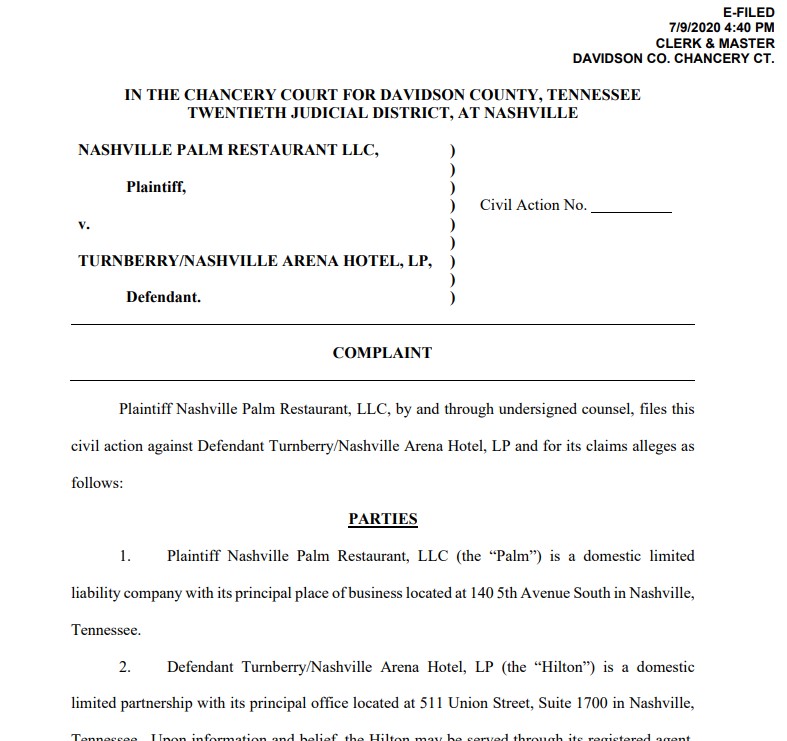
Late Thursday, the Palm Restaurant sued the Nashville Hilton, arguing it should not have to pay full rent during the pandemic and especially not for time periods when the Hilton hotel itself wasn’t open.

It’s an interesting argument, about issues that will be litigated throughout the country over the next few years.

Generally, in Nashville (and everywhere else), closures related to COVID-19 haven’t given tenants much factual or legal basis for avoid rent payments. That’s because most commercial leases–more than anything–make payment of rent such a supreme duty under the lease that anything short of total physical destruction of the premises doesn’t excuse payment.

The Palm’s Lease at the Hilton is no different.

The Complaint alleges that “[t]he Lease provides for a rent abatement in the event that the Premises is damaged as a result of casualty,” citing Section 23.1 of the Lease. Specifically, that provision requires that the Property “be damaged by fire or other casualty” and has the typical murky text that you’d expect in a landlord-drafted lease that assumes the premises were physically damaged.

(Side note: The Lease also has a “Force Majeure” provision that is so iron-clad that The Palm doesn’t even cite it in the Complaint.)

As in so many of these cases, the million dollar question is: Does the COVID-19 virus cause “physical damage”?

The Palm takes a novel approach, in part, arguing that the Hilton’s voluntary shut-down caused the losses at the restaurant, since The Palms’ decision to initially lease the space was so heavily dependent on the existence of a thriving Hilton hotel.

“Pursuant to the Lease, the Hilton was and is required to operate a first-class business hotel…[and] provide the Palm with access to Common Areas…” As part of the Lease, the Palm’s dependence on the Hilton is evidenced by the facts that: Palm allowed Hilton guests to charge meals to their rooms; the Hilton heavily advertised the Palm in the hotel and in the rooms; and the Palm agreed to identify the Hilton in its own marketing.

Then, COVID hit. On March 12, the SEC tournament was shut down. On March 20, Metro shut down in-person dining. On March 22, the State of Tennessee took similar action. In response, on March 22, the Palm closed to in-house dining.

But, the lawsuit alleges, “[a]t no point in time since March 1, 2020 has the Hilton been forced to cease operations due to a state or local governmental order. … Despite the fact that it was under no obligation to do so, the Hilton shut down on March 24, 2020. …Upon information and belief, despite its management company having cash on hand necessary to support ongoing operations, the Hilton remained closed during April, May, and part of June.”

The Palm re-opened to 50% capacity on May 11 (as allowed by local and state law), but the Hilton didn’t re-open until June 8, 2020. The Palm argues that it was denied the benefit of foot traffic from the Hilton, marketing and promotional benefits, and access to Common Areas.

When the lawsuit was filed, the Palm had not paid rent for April, May, June, or July 2020 (including CAM charges for space at the Hilton). The Hilton has refused to discount any of that rent, despite the Palm’s requests for a discount.

This lawsuit asks the Davidson Chancery County Chancery Court to provide “declaratory relief” and declare that The Palm is not in default and is not required to pay April, May, June, and July 2020 rent (as well as get back some of the rent paid in March).

This case raises nearly all of the issues the commercial landlord-tenant bar will be fighting in the near future. Plus, this one has the added awkwardness of two inter-dependent, adjacent businesses being involved in direct litigation.

This may be the first notable COVID-related landlord tenant lawsuit filed in Nashville, and it’ll be one to watch over the next few weeks, months, and, gulp, year.

TL;DR: The lawsuit asks whether the Hilton’s decision to shut its own operations down creates a factual or legal defense to some or all of the amounts due from The Palm under the Lease.

Second Lady A sues Original Lady A in Nashville: Interesting Legal Issues for Interesting Times.

I’ll start by saying this: Lady Antebellum’s heart seemed to be in the right place.

As you will recall, last month, the band announced that it was changing its name to “Lady A,” which was in recognition of the racially insensitive history of the term “Antebellum.”

The news was applauded, in light of the global outpouring of support for the Black Lives Matter movement and the growing awareness of how little so many of us understand about what it means to be a non-white member of American culture. It’s not cool for a white country music band to be walking around with Antebellum in their name.

But, then, you know what happened next. Anita White, an African American gospel and blues singer in Seattle–and who has long performed as “Lady A”–objected to the name-change.

Side-note: Did nobody do a google search on any of this?

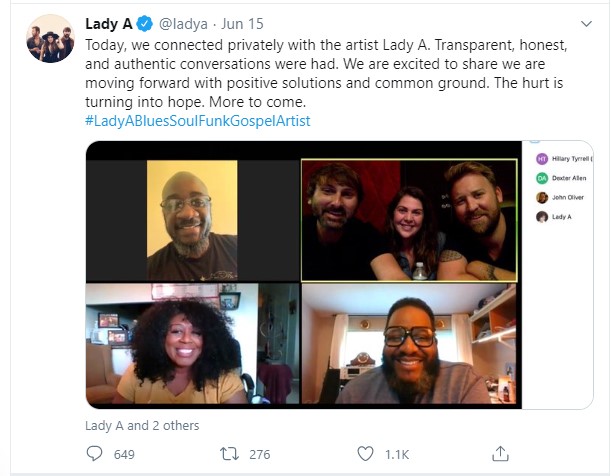
Per Second Lady A’s twitter, the parties had a number of conversations–all friendly (see above)–which became more complicated, as Original Lady A began to recognize that her interests may not be entirely at heart in the band’s move.

Then, well, I’ll let Second Lady A say it: “Today we are sad to share that our sincere hope to join together with Anita White in unity and common purpose has ended.”

To be clear, that date of the end was July 8, 2020, when Second Lady A filed a lawsuit in Nashville federal court, asking the District Court to grant them the right to use the trademark. The lawsuit says that it isn’t asking for money, but, still, it’s a fairly aggressive move. Apparently, Original Lady A asked for $10 million as part of the conversations.

This isn’t Trademark Rights 101 , but I follow really smart lawyers on twitter. Such as this twitter chain by Alexandra Roberts, an Intellectual Property law professor, who analyzes this situation top to bottom.

It’s a really fascinating view into the thought process that a court will consider, both on the facts and relevant law. Read the whole thing…you’ll be smarter by the end of it.

Another issue that I thought was interesting is this: Did Original Lady A submit herself to jurisdiction in Nashville by participating in phone and Zoom video calls, when Second Lady A were physically in Tennessee? Yikes, if that’s the law. Professor Roberts suggests that may be the alleged basis.

So, two quick-takeaways.

(1) This is a terrible look for Second Lady A. Maybe they’re correct as a matter of law, and I’ve just got more to learn about IP law. But, again, what a terrible look for Second Lady A. I tell my clients this all the time: You may be right here, but are there other factors to consider. Should we keep looking for a middle-ground resolution?

(2) I can’t wait for more information on the basis for jurisdiction in Nashville, Tennessee for this lawsuit.

Davidson County Chancery Court’s Zoom Trial Worked!

Last month, I told you Davidson County Chancellor Ellen Lyle had scheduled a business litigation trial to be conducted entirely via Zoom.

This was big news for laywers. After COVID-19 prevented most in-person court proceedings, many innovative courts began to conduct contested, non-evidentiary hearings via the phone or Zoom.

What was so interesting about this matter, however, was this was a full-blown trial, with witnesses and 61 exhibits. This required lots of advance planning, exchanging exhibits, and technical preparation (Does Zoom work? Can you share screens and jointly review exhibits?)

And, it worked. A link to the live-streams remains available at Part III’s YouTube channel. (What a crazy thing to type…”Part III’s YouTube channel.”)

It’s been an unprecedented time for our world, but it’s awesome to see our Tennessee Courts evolving to make sure matters get heard and also not being afraid to open up these news-worthy proceedings to the public.

Earlier this week, the Tennessee Supreme Court conducted a full day of hearings via Zoom, with the proceedings live-cast on the Court’s YouTube channel.

My office is just down the street from the Davidson County Courthouse and only a block or two from the Tennessee Supreme Court, so it’s no big deal for me to stop by and observe an interesting or newsworthy court proceeding.

But, for the average citizen, the barriers to seeing the justice system at work are staggeringly prohibitive. The average person probably doesn’t know where the courthouse is, how to get there, where to park, or whether they are even allowed to “pop in” and watch a proceeding.

Long story short, the Tennessee Courts have really done a great job during the pandemic; not only staying open, but expanding and innovating. Here’s hoping that the progress continues.

Time is On Your Side: 4 Tips for Collections in a Sinking Economy

Things are looking bad for the economy, and there doesn’t appear to be any end in sight. As we enter Month Two of the COVID pandemic, banks and others creditors are bracing themselves for a very long winter.

I’m telling my creditor clients to be patient. While this good news doesn’t put money into hands today, here are some things I said the last time around, i.e. in 2010, that any creditor should bear in mind while we wait to see what the economy does.

There’s time to be patient.  In Tennessee, the statute of limitations for collection on an unpaid debt is six (6) years, pursuant to Tenn. Code Ann. § 28-3-109. Then, once you sue and obtain a judgment (within six years from the date of the default), your judgment is valid for ten years, pursuant to Tenn. Code Ann. § 28-3-110.  Plus, if your judgment remains unpaid at the end of the ten years, Tennessee judgments can be renewed pursuant to § 28-3-110 for another ten year period.

Don’t wait to act.  In some instances, it may make sense to take no action on unpaid debt. Maybe the customer is a company that has gone out of business and has no remaining assets, or maybe they’ve filed a liquidation bankruptcy.  This is where you make the “don’t throw good money after bad” decision and possibly decide to write this debt off.

But, remember, the first creditor to obtain a judgment is the first in line to seize assets. Granted, you could be the first in line and discover there are no assets, but you should nevertheless record your judgment as lien in the real property records. For less than $25 in filing fees, a creditor can record a certified copy of its judgment in any and all Tennessee counties where the debtor owns real property, and that judgment becomes a lien on any real property owned by the debtor.

Even if they don’t have any equity in their property today, the situation could well be different in ten years (judgment liens remain valid as long as the underlying judgment is valid). What’s more, your lien’s reach will capture any real property they obtain during the life of the lien. In the end, sooner or later, your debtor will have to deal with you, whether it be as part of a purchase of new property, a sale, or a refinance.

Bend, don’t break. Sometimes, it’s important to recognize when a debtor truly lacks any assets to pay toward your debt. When this is the case, aggressive collections—whether it be seizing a work truck or all funds out of a bank account—may put that debtor out of business and, possibly, into a bankruptcy filing. A judgment creditor can take depositions and request financials from their debtor, and this information may assist you in determining whether they aren’t paying anybody…or just aren’t paying you.

Bankruptcy doesn’t mean the process is over.  If your debtor does file a bankruptcy case, there’s still a chance of monetary recovery. In addition to the benefits to the debtor, the secondary point of the bankruptcy process is to maximize return for creditors prior to granting the debtor a discharge of his or her debts. But, in most instances, a creditor in bankruptcy only receives pennies on the dollar in the process.

Keep in mind, however, the success rate in Chapter 13 bankruptcy cases (where debtors repay a percentage of their debts over 3 to 5 years) can be as low as 20%, meaning that most of those cases end with a dismissal. A dismissal is good for a creditor, because there is no discharge of the debt. Instead, the full amount remains due and owing. Debts are eliminated only when debtors receive a “discharge.” That’s an important distinction to know.

Finally, remember that a bankruptcy discharge only discharges “debts”—not “lien” rights. So, if you’ve already obtained a judgment and recorded it as a lien, then your lien on the debtor’s property survives the bankruptcy discharge. As a result, even though you can’t collect your debt, you can enforce your lien in the event of an attempted sale or refinance.

In the end, collection is a process that rewards the patient, especially in a struggling economy. But, a successful creditor must be prepared, and being prepared means having a valid judgment in place and exhausting all enforcement remedies before giving up. It may be a long road to recovery, but, if a creditor is smart and strategic now, the steps you take today will help make sure you’re paid in the future.

Davidson County Chancery Court has scheduled an actual trial that will be conducted via Zoom.

Mark your calendars: On April 28, 2020, Chancellor Lyle of the Davidson County Chancery Courts has scheduled a trial to be conducted via Zoom! (Full text: Lyle Order re Zoom trial).

For the past 5 weeks, Tennessee courts have been closed for most in-person proceedings, but, during that time, many courts have conducted telephonic or video “non-evidentiary” hearings. This is the first instance that I’m aware of that a civil court is conducting a real bench trial with witnesses and exhibits.

The underlying facts are interesting, from a creditor’s rights perspective.

The lawsuit seeks a declaration of the validity of a mechanic’s lien asserted on a Gulfstream GV  (a/k/a a “G5”) private jet, via both a recorded lien in the Davidson County Register of Deeds and with the Federal Aviation Administration Registry.  Per the Complaint, the plaintiff bought the jet from an actual Sheikh.

gulfstream g5(Note for the non-Sheikhs out there: Retail value for new G5s can be between $36MM and $48MM).

The Defendant / lien-claimant is a marketing firm in Kentucky that claimed a mechanic’s lien on the jet for sales marketing services provided to the Sheikh.

(I’ll reserve my thoughts on the validity of a mechanic’s lien when no actual physical improvements are provided, but I will note that, generally, the lien claimant has to show actual improvements to the property. Cases on aircraft liens have held that “gas for refueling” doesn’t even qualify, since gas doesn’t provide an actual improvement to the aircraft.)

This one will be really interesting, both substantively and procedurally.


Broadway Bar files first COVID-19 Insurance Coverage Lawsuit

What insurance companies do over the coming weeks in response to the COVID-19 pandemic is going to matter a lot to restaurants all across the country. Will insurance companies pay the claims, or will insurers use this this historically unprecedented situation as a way to poke holes in their customers’ coverage? (I’m betting on the latter.)

This question is of supreme importance to downtown Nashville, where the downtown honky tonks and restaurants stay jam packed 7 nights a week.

Except for, of course, the past 4 weeks.

undergroundToday, one of the downtown bars filed a lawsuit (full copy here: COVID Insurance lawsuit) against Nationwide Property and Casualty Insurance Company, challenging the denial of a coronavirus-related claim. The plaintiff is Nashville Undergound, described as “a seven-story restaurant, bar, nightclub and live music venue” and exactly the type of place that has never, ever practiced social distancing.

The lawsuit alleges that Nationwide denied the claim by citing policy “exclusions” for losses related to bacteria or virus and by arguing that there was no physical damage or physical loss to the restaurant. These are exactly the arguments that I told you they’d be making.

This will be interesting to watch, and, of course, this lawsuit will be the first of many just like it. (Another free prediction? This will nearly instantly be removed to federal court.)

For more background, this article, titled Opposite Sides of the Table: Restaurants Seek Recovery From Insurers for Business Interruption in the Wake of COVID-19,  has a really good and comprehensive recap of the insurance issues facing restaurants.

“According to restaurant.org, since March 1, the industry has lost more than 3 million jobs and $25 billion in sales, and roughly 50% of restaurant operators anticipate additional layoffs in April.  The National Restaurant Association has predicted that the industry will suffer $225 billion in losses in the next few months, forcing the elimination of as many as 7 million industry jobs.”


The CARES Act’s Exclusion of Debtor-in-Possession may be a death sentence to pending bankruptcy cases.

The Coronavirus Aid, Relief and Economic Security Act of 2020 is a great legislative response in helping thousands of struggling businesses navigate the financial disaster presented by the coronavirus pandemic.  The response to COVID-19’s spread has shut down thriving businesses, put people out of work, and is having ripples throughout the economy.

Despite the intent to provide wide and sweeping economic relief to affected businesses, Congress made an ill-advised exclusion when determining what businesses can be an eligible participant in the CARES Act loan program:

“(V) the recipient is not a debtor in a bankruptcy proceeding…” 

As the plain language indicates, any business that is a debtor-in-possession in an active Chapter 11 bankruptcy reorganization is ineligible for relief under the CARES Act.

This is a terrible oversight.

When a business files for relief under chapter 11 of the Bankruptcy Code, it then operates as a “debtor-in-possession,” continuing its pre-bankruptcy operations under the oversight and subject to the approval of the Bankruptcy Court.

The goal for the debtor-in-possession is to address, correct, and overcome whatever financial or operational issues that caused the bankruptcy and then reorganize its operations, finances, or governance structure in a way that a more successful business will result.

So, in short, a business operated by a debtor-in-possession operates like any other business. It has employees. It pays rent. It pays taxes. It buys goods and inventory.

If the DIP struggles and can’t pay employees, rent, taxes, and other operational costs, it fails.  Just like any other business.

And, just like any other business, a global pandemic has a catastrophic impact on its operations.

The exclusion of CARES Act financial relief to a debtor-in-possession in a chapter 11 reorganization is, in essence, a death sentence to that debtor’s ability to reorganize. It lays off employees. It can’t pay rent. It can’t pay taxes. It can’t confirm a plan of reorganization. It simply figures out a way to survive, without any help, or close.

Here, I’m guessing that Congress wanted to exclude the shutting down or liquidating bankruptcy debtor’s ability grab some cash. But, by including a broad exclusion, they’re hurting legitimate businesses that may already be on a path to survival.

With this exclusion, the Act forces the debtor to ponder a strange choice: Whether to voluntarily dismiss an otherwise viable bankruptcy proceeding in order to apply for federal relief.


The Coronavirus sheds new light on an overlooked paragraph: The Force Majeure Provision

On January 30, 2020, the World Health Organization declared a global health emergency in response to the rapid spread of novel coronavirus (2019-nCoV).

Since then, it seemed to slowly make its way to the United States–but, then, once it arrived, it hit us rapidly and in ways that have unexpectedly changed how we conduct our personal and professional lives.

And, yes, I say this as someone who was scheduled to depart tomorrow on a Disney Cruise. We (obviously) cancelled our trip, and, in the past week, I’ve seen a nearly nationwide cancellation of events, with unimaginable impact on businesses and employees.

So, what if you’re thinking about cancelling an event? Where do you start your analysis? Well, closely review your written agreement for the terms and conditions related to cancellation.

Is there a “force majeure” provision? Those provisions account for an unforeseen, unavoidable, and uncontrollable circumstance that prevents performance by one party to a contract and, more importantly, “excuses” that party for non-performance. The circumstances are intended to be so extraordinary that they are sometimes referred to as an “Act of God” provision.

The first time many of us dealt with these issues were related to September 11, 2001, and most modern contracts reflect this changed world-view (and the acknowledgement that something short of a natural catastrophe can trigger the defense).

Force majeure provisions are valid and enforceable under Tennessee law. The question frequently becomes a matter of contractual interpretation: Is the [event that occurred] truly a force majeure that prevents performance/excuses non-performance?

This is where the lawyers make their money, and it comes down to how clear and detailed the contract’s definition of a force majeure is. Tennessee law doesn’t define it, so it’s up to the parties to negotiate the definition, scope, and application.

I’ve prepared marketing agreements that are currently being used by the Big 12 Athletic Conference, with Fortune 50 businesses as the counter-parties. Needless to say, these were really big deals. In working on those documents, we spent hours on all sorts of negotiations, but rarely–maybe never–talking about the definition of a force majeure.

So, if you are a business that is shut down–either by choice or by necessity–and it’s preventing you from performing under an agreement, look at your contract and see what it says about cancellation (and damages for cancellation). And, skip to the end, and see if there’s a force majeure provision.

If there’s not one, make sure that your future agreements have them.

With the 2020 Legislature in full swing, here are three bills to watch.

The Tennessee Legislature is considering three new laws for 2020 that impact debtor-creditor lawyers and that you should know about. Here’s a quick recap:

Increased homestead exemptions. This is at Senate Bill 2235 and House Bill 2682. This bill increases the individual Tennessee homestead exemption to $35,000, increases the joint exemption to $52,500, and eliminates the enhanced exemptions based on age and parental status.

My thoughts? Current law provides for a $5,000 exemption for individuals and a joint $7,500 exemption for married couples. While a jump to $35,000 seems pretty steep, keep in mind that the homebuilder lobby is asking for an increase that ranges from “unlimited” to one million dollars to $250,000. Based on my conversations with the Tennessee Bar Association and Tennessee Bankers Association, the $35,000 is designed to both acknowledge that Tennessee currently has one of the lowest exemptions and to head off a greater increase.

This amount is going up, so why not participate in that process and have it go up to an amount everybody dislikes (but not enough to try to get it higher)?

Decrease in number of days to appeal a Detainer Judgment. This is Senate Bill 2563/House Bill 2372. Current law provides a tenant ten days to appeal an eviction judgment, which means that they have ten days to remain the property before the property owner can file a writ of possession to have them removed. This bill reduces that time period from ten days to two.

My thoughts? I don’t support this. This is too creditor friendly. The ten day appeal period gives a tenant time to either prepare an appeal (and the associated possessory bond) and also time to voluntarily move out. The current time period, frankly, feels like a reasonable amount of time. Two days feels inadequate and onerous.

I mean, if the guy who writes Creditor Rights 101 says something is too creditor-friendly…yikes.

The “Medical Debt Protection Act.” This is Senate Bill 2700/House Bill 2346. This proposed law proposes a number of protections onto the medical bill debtor, and it imposes a number of pre-lawsuit and filing requirements onto the medical bill collection agency/attorney, including a shortened statute of limitations. Further, once a judgment is entered, there are limitations on collection, limits on adverse credit reporting, and restrictions on post-judgment interest.

My thoughts? This is clearly in response to the crisis in our country’s healthcare system that impacts the poorest people, and we’ve seen this in Memphis over the past year. While I don’t agree with all the details of this proposed legislation, I see that it’s coming from a legitimate place. We need to do something.

But, according to insiders at the Capitol, it’s a moot issue. I’ve been told that this bill was taken off notice by Rep. John Ray Clemmons after the Tennessee Hospitals Association promised to create a task force to address this issue (and after the Tennessee Bar Association had already expressed concern with this bill).