The changes to Tennessee’s foreclosure laws went into effect on July 1, 2025, and, as you can imagine, Tennessee banks and foreclosure lawyers have had lots of questions on how to navigate them.
Today, let’s discuss one specific issue that keeps coming up: Now that new Tenn. Code Ann. § 35-5-101(a)(1) only requires publication “two (2) times in a newspaper,” does that preempt what my deed of trust says?
Many deeds of trust don’t have specific requirements; they just make a passing reference to “applicable law.” With those, you follow the statute and (now) do two publications.
Be careful, though: Lots of deeds of trust contain more specific requirements.
A few weeks ago (and after July 1), I prepared to foreclose under a $57,000,000 deed of trust. Naturally, I read every word of that deed of trust. (Many, many, many times.)
That deed of trust required the trustee to “advertise the time, place, and terms of sale at least three (3) different times in some newspaper published in the county where the Land is located…”
Remember, Tennessee is a “two track” foreclosure state, meaning that a foreclosing lender must satisfy the requirements of both the Tennessee foreclosure statutes and the requirements agreed to by the parties in the Deed of Trust.
So, in short: Yay, they have reduced the number of times a foreclosing lender must publish the foreclosure sale notice in the newspaper! Also, be sure to check your deed of trust to make sure you haven’t agreed otherwise.
In that case, the Chancery Court allowed the lien to stand, drawing the mechanical distinction between the processes of recording a judgment and enforcing that lien via execution sale. The answer didn’t end the debate, since the reasoning wasn’t fleshed out in a memorandum opinion and never considered at an appellate level.
As a creditor lawyer who knows the immense value of getting a judgment lien recorded as soon as possible, I saw the case as a good first step, but have been eager to see an appellate court discuss this issue.
There, the Judgment Debtor posted a supersedeas / appeal bond after entry of the judgment, but the Judgment Creditor nevertheless recorded the judgment as a lien. Debtor demanded that the lien be removed as a “wrongful execution” because it was recorded while a bond was in place, and Creditor refused.
The Court of Appeals found in favor of the creditor, in fairly short order. “[F]iling a judgment lien does not constitute execution of a judgment.” Id. at *11. “Recordation of a judgment lien precedes execution.” Id.
Similar to the Davidson County Chancery Court’s reasoning, the appellate court drew a distinction between the processes of recording a lien and enforcing a lien, citing with approval the creditor’s analogy that “recording a judgment is ‘no more an execution than recording a deed of trust is a foreclosure’.” Id.
Recording a judgment as a lien is one of the most powerful collection tools in a creditor’s arsenal. It gives the creditor a lien on all property owned by the debtor in that county. The debtor can’t then transfer, refinance, or otherwise do anything with the property, unless the lien is paid or the creditor consents.
In considering whether the judgment debtor’s appeal was “baseless,” the Court notes the debtor “cites no Tennessee law to explain why it is a debatable question.” Id. at *11. The Court then cites text from ATS, Inc. v. Kent, 27 S.W.3d 923, 924 (Tenn. Ct. App. 1998), to support its conclusion, but that case didn’t consider this exact issue (the judgment in ATS was recorded about 46 days after entry).
With all due respect, I’ve practiced creditor rights law for more than 25 years, and lawyers ask me this exact question more than any other. That ATS decision offers hardly any guidance on this issue. In short, the creditor lawyer in me supports the outcome, but I’m disappointed with the reasoning.
Having said all that, there’s the answer: You absolutely can record your judgment as soon possible after entry.
We’re one step closer to answering one of Tennessee collection law’s greatest mysteries: Can a judgment creditor record a copy of its judgment as soon as it is signed by the Judge, or must the creditor wait 30 days?
The question arises under Tenn. R. Civ. P. 62.01, which says that “…no execution shall issue upon a judgment, nor shall proceedings be taken for its enforcement until the expiration of 30 days after its entry…”
For starters, what’s the statutory authority for recording a judgment lien? I look at Tennessee Rule of Civil Procedure 69, which is titled “Execution on Judgments,” and includes all the different ways you can “execute” on judgments (garnishments, levies, sheriff’s sales, liens). This list includes Tenn. R. Civ. P. 69.07(2), “Execution on Realty,” which provides the exact process to record a judgment lien against the judgment debtor’s realty.
And let’s be honest; why would you record a judgment in the first place? Under Tennessee law, the recording of a judgment with the register’s office creates a lien on real property, meaning that the debtor can’t sell, refinance, or transfer the property without dealing with the judgment. It’s a pretty powerful tool to get paid. That’s why you’d record it, and as fast as possible.
If the point is to get paid–and as soon as possible–that looks a lot like enforcement, right? But is that “execution”? Should we also throw around terms like “collection” or “attachment” too?
It’s been a mess because the statutes and rules all seem to use these different terms interchangeably, except when they aren’tinterchangeable.
Faced with this exact issue, the Davidson County Chancery Court had to make sense of these competing terms and concepts. In an Order from February 2, 2024, the Court found the mere act of recording a judgment during the Rule 62.01 stay period “was not premature ….because the filing of judgment lien is not an act of enforcement.”
In doing so, the Court referenced the pleadings filed in the matter, which drew reasoning from Tenn. Code Ann. § 25-5-101(b)(1) and the competing concepts of “final” judgments found in Tenn. R. Civ. P. 54 and 62.01. Further, given the Court’s brief, but specific, factual finding, the Court seems to agree with the opposing brief’s distinction between the acts of recording a lien versus enforcing a lien, arguing that only the latter would violate Rule 62.01. The full Order is attached below.
It’s an important issue that has long vexed creditor rights lawyers, debtor’s counsel, and even court clerks. I’ve had court clerks only begrudgingly provide me with a certified copy of a judgment on the day of entry (and reminding me that I “can’t do anything with it for 30 days”).
This Order and the related reasoning may provide a roadmap for future arguments on this issue, which comes up far more frequently than you’d think.
I watched these trial court proceedings pretty closely, and I’m glad to see a creditor-friendly result. The underlying initial pleadings are also attached below.
It looks very exciting on TV, but success in the legal profession is often a matter of being really good at paperwork.
Proof-reading and getting the details right are essential….
But what makes great lawyers really great is the knowledge and foresight to know which details to include.
On TV, cases tend to end after a passionate closing argument, and the lawyer and client walk out of the courthouse victorious. In reality, most of my cases end with me pouring over the details of a single document–the Order that the Judge will sign–and victoriously e-filing it with the Court Clerk.
When I prepare an order for a Judge’s signature, I try to think through every possible scenario where I’d enforce the terms. When I type the judgment debtor’s name, I make sure I’ve spelled the name the same way it’s spelled on the debtor’s old checks or property deed. If there’s some special request or relief I’ve asked for in my motion, I make sure to recite that in the order and have the order expressly grant it.
A trend I’m noticing lately is that lawyers leave out critical details in their orders, and the omissions hurt their cases.
A good example relates to post-judgment sheriff sales. Sheriff’s sales confuse courts, clerks, lawyers, and sheriffs. The law is tricky and draws on 2-3 separate statutory bases (Tenn. R. Civ. P. 69.07 ; Tenn. Code Ann. § 26-5-101, Tenn. Code Ann. § 35-5-101). County sheriffs are good at a lot of things, but they really dislike having to navigate confusing Tennessee statutes on their own.
A good creditor attorney will think through the entire process, starting at the end (i.e. what will the title company need to insure title on this sale), anticipate all the questions, and have the Order address any possible question that could arise.
Who owns the real property? (Look at the Order.)
What are the liens that are impacted by this Sheriff’s Sale? (Look at the Order.)
Who will prepare and publish the Notice of Sheriff’s Sale? (Look at the Order.)
What’s the minimum price pursuant to Tenn. Code Ann. § 26-5-115? (Id.)
Will there be a deposit? What happens after the sale? When does the buyer get a deed?Will there be a sale contract? What happens with the redemption rights? And so on…
I recently saw an Order Authorizing Sheriff’s Sale that said, basically, “the relief granted in the Motion is GRANTED.”
And that was it. The Order had no specific reference to relief described in the Motion and provided no guidance to the sheriff. Instead, to enforce the Order, the lawyer had to also send a copy of the Motion and hope that the sheriff would connect the dots between the two pleadings.
The lawyer’s job is make the process run as smooth as possible, and that includes anticipating issues and preventing them. One strategy to make the process work is to think through all the issues in advance and, before the Judge signs the order, include it all in the document the Judge signs.
One of the greatest current failures of Tennessee law is the lack of a penalty for fraudulent lien filings. In December, I wrote: “if somebody records a piece of paper with ‘Notice of Lien’ written somewhere on it (and includes the owner name and property address), they’ve got a totally un-lawful, but also practically-effective, lien.”
Last year, a hand-written, three sentence recorded “lien” brought a pending commercial property sale to a halt. When I politely explained to the lien claimant that there was no basis under Tennessee law to assert lien rights, she said “If that were true, then, why are you even calling me?“
What she was really saying was: Yeah, but what are you going to do about it?
So easy, in fact, that the group filed more than a hundred UCC-1s without legal or factual basis against a variety of folks who they had grievances with. The police officer who gave one a speeding ticket. An ex-wife. The local Chancery Court Clerk and Master. In all there were about 30 victims.
After one took his complaints to a lawyer, and was rebuffed, he attended the local meetings of this group, who taught him how to assert liens under the Uniform Commercial Code. By the UCC-1 filers’ logic, those “debtors” had done something that resulted in inconvenience to them and the UCC-1 filing was designed to obtain compensation (ranging, in this case, from 4 and 12 million dollars). The victims testified about the resulting failed home closings, the denied credit applications, and dings on credit reports.
The defendants were ultimately convicted of fraud and forgery, per Tenn. Code Ann. §§ 39-14-105(a)(6), 39-14-114, 39-17-117. This type of scheme is often referred to as “paper terrorism.”
The Supreme Court then analyzed the various actions against the requirements of Tennessee’s criminal statutes, and the Court upheld all criminal convictions.
In a footnote, the Court alluded to civil penalties, including at Tenn. Code Ann. § 47-9-625, and the ways that private citizens can protect themselves against these schemes.
Spoiler-alert: It’s far easier to file these bogus liens than it is to remove them.
Tenn. Code Ann. § 47-9-625 isn’t much help. It requires a party to seek court intervention (i.e. file a lawsuit), but the damages don’t include attorney fees. Per § 47-9-625(b), the party can only recover damages resulting from “the debtor’s inability to obtain, or increased costs of, alternate financing” (all very difficult to prove in court). There’s nothing in the statute setting a minimum penalty or, more importantly, allowing for the recovery of attorney fees.
Sure, these defendants made the headlines because of the breadth and shamelessness of their scheme, but the opinion and authorities cited in it do nothing to help the individual homeowner, who has a meritless lien recorded against her house and has a closing being held hostage. File a lawsuit and, then, simply recover the increased cost of her more expensive loan?
In short, there are no effective and efficient remedies under Tennessee law for this.
There are no internal fail-safes to protect against the schemes perpetrated by the defendants in this case. The Secretary of State isn’t watching these. Instead, the purported remedies (under Tenn. Code Ann. §§ 47-9-518 and 47-9-625) put the burden on the consumer to discover and challenge invalid liens, but with no effective remedy or deterrent for fraudulent liens.
The facts of this opinion should scare you, but I’d say that that the law in this opinion is the most terrifying aspect.
When a mortgage or judgment gets paid off, the creditor has to release its lien. It’s not only common sense, but it’s a duty imposed by Tennessee statute (seeTenn. Code Ann. § 66-25-101).
It’s an easy process to prepare a Release of Lien and record it with the register of deeds. Also, it’s not particularly expensive. Depending on how many pages the release is, the fee can be as little as $12.00.
Not too onerous for a lender who just got paid in full, right?
Well, not so fast. Ask any of my creditor clients, and they’ll tell you that “paid in full” means “fully paid, including that release fee.” When I get a payoff request on a deed of trust or judgment lien, I generally include a line for the $12.00 release costs.
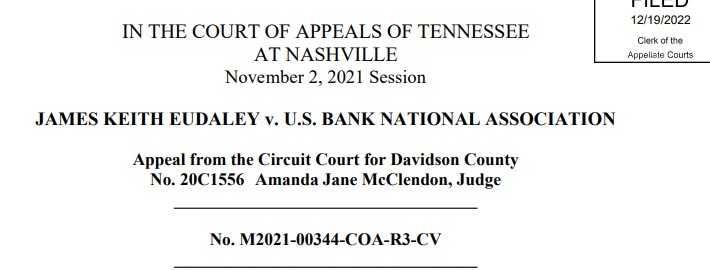
Not anymore, in light of a December 2022 Tennessee Court of Appeals opinion, Eudaley v. U.S. Bank Nat’l Ass’n, No. M202100344COAR3CV, 2022 WL 17751378 (Tenn. Ct. App. Dec. 19, 2022). In that case, the mortgage lender got paid in full, recorded the release, and sent a bill to the borrower for $12.00. In response, the borrower filed a class action lawsuit in Davidson County Circuit Court, arguing that, per Tenn. Code Ann. § 66-25-106, “[a]ll costs … for registering a formal release[ ] shall be paid by the holder of the debt secured by the … deed of trust.”
Despite the very clear statutory text, the trial court dismissed the case after finding that federal law allows such fees and preempts the state law. The Court of Appeals affirmed, but not before providing some useful guidance to other lienholders (who may not have a federal banking regulation to hide behind).
Specifically, the Court wrote that “§ 66-25-106 prohibits holders of debt from seeking reimbursement of costs associated with recording a release of a deed of trust” because “[t]he debt holder’s obligation to record a release only arises if the debt has been paid in full or satisfied, indicating that nothing further is owed to the debt holder.” In affirming the trial court’s dismissal, the opinion makes clear that the lienholder bears those costs and can’t seek reimbursement, but, nevertheless, “that prohibition is preempted by federal law when the debt holder seeking reimbursement is a national bank.”
So, what if you’re not a national bank? Tenn. Code Ann. § 66-25-106 applies, and the creditor must chalk up $12.00 as the cost of getting paid.
What about other sorts of liens, like judgment liens or mechanic’s liens? § 66-25-106 seems to apply to any lienholder, but the judgment creditor may nevertheless have an argument that the release fees are “costs of collection” or allowed court costs/discretionary costs.
Either way, this December 2022 opinion provides pretty compelling authority to support a lender’s decision to simply record the release and write off the $12.00. In a very creditor-friendly state like Tennessee, Tenn. Code Ann. § 66-25-106 is an outlier, but this case is a very good reminder that it exists.
I need to pay more attention to this blog. (And not just posting to it.)
A few weeks ago, I had a pretty deep legal discussion with a lawyer for a nearby county on a complex creditor rights question. And, after a few days of comparing research, she sent me a link to my own blog post on the exact same topic.
The bad news is that I spent many hours re-researching the issue. The good news is that I came to the same conclusion.
The issue was whether a Chancery Court in County A can issue an order and a levy to the Sheriff in County B to sell real property located in County B. And this wasn’t just a theoretical discussion–this was my own levy seeking to collect on a judgment.
The issue doesn’t come up much, and my concern was a lingering recollection that, in fact, some actions related to real property *are* limited to the county where the real property is located. That’s the “local action rule,” which requires those actions with a direct and undeniable connection to the land to be brought in that county (examples: title dispute / quiet title actions; detainer actions affecting possession of land; actions seeking money damages for trespass or injury to land). The way that Tennessee cases apply it, however, the local action rule speaks more to a “cause of action” that relates to the specific land at issue, not a general execution against the land.
In the end, here’s why Sheriff B can do it:
(1) Execution Sales of Realty are governed by Rule 69.07 and Tenn. Code Ann. § 26-5-101, and neither contains any county limitations. My review of Tenn. Code Ann. § 26-1-101 (and all around those statutes) did not reveal any limitation of the Sheriff’s ability to sell real property. We know that a local sheriff can enforce an out-of-county judgment on all other assets (wages/personal property like cars/bank accounts)—if there were a distinction as to real property, wouldn’t it be in those same statutes?
In fact, not only does Rule 69 not contain any exclusions, but it lumps real property in there with the other categories. For instance, in setting what can be levied against, Rule 69.05(1) says that “Property includes a judgment debtor’s realty, personalty, money, wages, corporate stock, choses in action (whether due or not), and court judgments.” (Note that there’s no distinction between the different types of assets.)
For personal property (which we know an out of county Sheriff can do), Rule 69.06 makes no distinction or exception as to the sheriff’s powers (or identification of which county’s sheriff can act).
For real property, Rule 69.07 (the separate rule for “Execution on Realty”) makes no distinction or exception related to which sheriff can take action. Instead, that Rule creates a system by which the creditor “may move” for an order of sale and then, “the sheriff” conducts the sale.
(2) The Jones v. Helms I wrote about last year remains valid.
In Jones, the creditor held a judgment from Gibson County and filed a Rule 69.07 motion in Gibson County for a sale order, and the Gibson County Court granted the request and ordered the Weakley County Sheriff to sell the land to pay the Sessions judgment. Rather than recite all the opinion, I’ll just direct you to last year’s post. (And, also, check out: Jones v. Helms, 2020 Tenn. App. LEXIS 517, *8-12, 2020 WL 6806372.)
One of the reasons that I maintain this blog to curate a list of useful opinions for my own practice. Next time, I’ll be sure to check in here first.
The Tennessee Legislature is, again, considering debtor-friendly changes to the homestead exemption statute.
The one most likely to pass is House Bill 1185, which seeks to increase Tennessee’s homestead exemption from the existing $5,000 to $35,000 for single homeowners and from $7,500 to $52,500 for jointly owned property.
Before you complain too much about that proposal, consider Senate Bill 566, which provides an unlimited exemption for a judgment debtor’s residential real property (and, after the debtor’s death, it passes to the heirs).
Back in 2019, I talked about the importance of exemptions for debtors, since exemptions can preserve and protect a basic necessity level of assets for debtors (picture the clothes on their back, a few thousand dollars in the bank, a car, tools).
As I wrote in 2019, though, “if this new law passes, the downfallen debtor can keep 100% of the equity in his $750,000 house entirely out of the reach of creditors.” I then said:
Wait a second. Is this law designed to protect downtrodden debtors seeking a fresh start in life (who very probably do not have high value real property at all) or, maybe, is it designed to protect high income individuals whose businesses fail?
Because that’s all this proposed law does. It grants fairly absolute protection to the high value real property owned by judgment debtors in Tennessee, and all the garnishments, levies, liens, and bankruptcies will never touch a penny of that equity.
I feel the same way about these new proposals. If we’re talking about protecting the working poor and preserving the necessities of life from garnishment, let’s start somewhere other than $750k of equity in a mansion. Let’s talk about debt relief measures, eviction support, access to justice, etc.
But, these new laws aren’t about basic necessities of life for poor people. Most poor people don’t live in lien-free mansions. Instead, these new measures are being lobbied for by the construction industry.
These are bad proposals. Unless you’re a debtors with big, lien-free McMansion. Then, sure, it’s a great new law.
Yesterday, the Tennessee Court of Appeals answered another longstanding creditor question: Whether a Court can order an execution sale on a debtor’s real property in a different county.
I get asked that all the time, and I’ve generally said you can. Now, I can cite the new opinion from the Court of Appeals in Ronald L. Jones v. Louise Helms, No. W2019-00864-COA-R3-CV, 2020 WL 6806372 (Tenn. Ct. App. Nov. 19, 2020).
The legal issue is whether the first county court has “subject matter jurisdiction” to order the sale of real property in another county. The Court looked first to Tenn. R. Civ. P. 69.07, which gives the judgment creditor a lien (per Rule 69.07(2) and provides that a creditor “may move for an order of sale. (per Rule 69.07(3)).” But, Rule 69.07 doesn’t provide any guidance on the process, procedure, or venue.
So, the question remains: In which county does the creditor make this request?
The Court wrote:
Rule 69.07(3) does not mandate which court or county a judgment creditor must file the motion in for the order of sale. Furthermore, circuit courts are courts of general jurisdiction, meaning that they have broad, rather than limited jurisdiction. Tenn. Code Ann. § 16-10-101 (“The circuit court is a court of general jurisdiction, and the judge of the circuit court shall administer right and justice according to law, in all cases where the jurisdiction is not conferred upon another tribunal.”). Therefore, it would appear that under the terms of the rule and the broad nature of the jurisdiction conferred upon circuit courts, Appellee was entitled to move for the order of sale in the circuit court for Gibson County. Indeed, it appears to be an accepted practice to file Rule 69.07 motions in circuit courts…. Moreover, Tennessee law generally provides that, with regard to sale of land for the payment of debts by decedents, courts of record “may decree a sale of lands lying in any part of the state.” Tenn. Code Ann. § 16-1-107.
The opinion makes fairly short order of this long-standing legal issue, and the certainty and procedure is good for creditors.
In the past, after my review of the chancery court statutes, I’d often wondered whether a court had jurisdiction to order and approve a sale of real property in a different county. I still have some lingering doubts whether a better challenge and legal argument in response could cast some doubt on this issue, particularly under the chancery jurisdiction statutes.
But, until then, save this opinion. It may save you having to file a Petition for Sheriff’s Sale in a different county to enforce your judgment.
Is a judgment creditor required to exhaust its collection efforts against personal property before executing on real property?
If you asked 100 lawyers over the age of 60 this question, 80 of them would get the answer wrong. And every single one of them would be absolutely positive that they were right.
I’d guess that I have a argument with opposing counsel on this legal issue at least once a month, and it usually ends with them being absolutely certain that I am wrong.
What’s crazy is the answer is simple:
Execution against personalty need not precede execution against realty.
Tenn. R. Civ. P. 69.02
So, there you have it.
If you’re wondering, however, whether you should ever start the collection process with efforts to sell real property…well, that’s another blog post entirely.




 Creditors Rights 101