In the nearly 5 years after leaving my old law firm, I’ve opened 807 new matters.
That is a lot of files.
In fact, it’s so many that I was reluctant to mention it. For many lawyers, opening a lot of files is a negative thing, an indication that you run a high volume, “small” matter firm. The true honor, some would argue, is working on a very small number of very large, complex cases.
I won’t debate the different philosophies. After taking a leap of faith and leaving a big law firm to start a brand new, solo-focused firm, I’m just grateful that there have been at least 807 times that a client has said “I need David Anthony’s help on this” and called me.
And, sure, I’ve handled a lot of small files, like the dozens of times I’ve sent a demand letter and nothing else. Many have been big: File No. 797 was to foreclose on a notable Nashville commercial property valued at $120 million. File Nos. 227 to 274 were when a big bank client found out I had left and told my old firm to send me every open case I had touched while working there.
In retrospect, I should have left earlier. Some of my hesitation was, candidly, fear. Fear of whether I needed to be at a big firm to be taken seriously. Of whether I needed all the bells and whistles of a big firm. Whether clients would trust me if I started my own firm. Whether my phone would ring.
I was way off, but I’ve got mouths to feed and needed to be careful. You never know what the future holds. Some lawyers leave a big firm with a few boxes of files, but no plan on how to get more.
When younger lawyers ask me for advice, I tell them that there are things you can do early in your career that prepare you for long term success. That client development and professional development go hand-in-hand. Being a very good lawyer is the baseline expectation, but what really builds a career is the ability to connect with your clients, to understand their business and needs, to inspire trust, and to care enough to deserve that trust.
I tell clients too often: “You don’t have to worry about this any more. Your problems are now my problems.” That is absolutely not the most healthy approach to work/life balance (see the part in that post about my late night ER visit). Having said that, your clients can tell if you are just pushing paper around to satisfy your law firm’s billable hour requirements.
You have to practice law with a purpose. Be the attorney who goes the extra mile, who communicates more, and who makes the client look good. Impress the clients when you send the simple demand letter, and then they’ll call you on the big foreclosure.
Lawyer (and lawyer business coach) Lee Rosen has a great post about this, “Associates: You are Going to Leave.” In short, prepare to leave, long before you would ever leave.
After I left the old firm, I never looked back. I never needed to. I was lucky, but I also think we can create our own luck, with preparation and being bold when presented with opportunities.
Around this time of year, I always promise that I’ll share stories and advice about starting your own firm. I invariably get busy with work and then don’t post as much as I intended (this post was actually scheduled for about 2 weeks ago, when I opened File No. 800).
Oh well, maybe this year will be different. A disclaimer: While writing this, my paralegal opened File No. 808, and a client emailed me File Nos. 809 and 810.
The Tennessee Legislature has made some significant changes to the foreclosure process in Tennessee, and those changes to Tenn. Code Ann. § 35-5-101 take effect on July 1, 2025.
By my analysis, the new statute doesn’t apply to foreclosures initiated before July 1 and, for those of you who aren’t ready or willing to learn a new law, I tell you this: Issue your foreclosure sale notices now.
Here’s my analysis. Tenn. Code Ann. § 1-3-101 says “[t]he repeal of a statute does not affect any right which accrued, any duty imposed, any penalty incurred, nor any proceeding commenced, under or by virtue of the statute repealed.”
The Tennessee Supreme Court has considered a similar question and wrote “[t]hough ‘procedural’ changes in the law generally apply retrospectively to causes of action arising before such changes become law,… where the pending action has gone beyond the procedural stage to which the amendment pertains, an amendment will not apply.” See Smallwood v. Mann, 205 S.W.3d 358, 365 (Tenn. 2006).
In short, even though procedural legislation generally applies retroactively, this general concept doesn’t apply when the case has progressed beyond the procedural stage impacted by the new law.
By my own analysis (disclaimer: I could be wrong), if a foreclosure was already in its publication stage before July 1, 2025, the new law doesn’t apply.
After more than 25 years, I’ve practiced through many changes in the law. In that time, I’ve learned that there are always growing pains, confusion, and a little bit of chaos in the days, weeks, and months after a big change.
What I’m saying is: Call your bankers and ask them if you have any foreclosures on their desks.
In an apparent rush to be as unfriendly to tenants as possible, the Tennessee Legislature has upset lawyers for both tenants and landlords.
I’m talking about the new Tenn. Code Ann. § 27-5-108 (d), which became effective July 1, 2023.
The prior version said:
(d) If no appeal is taken within the time provided, then execution may issue.
The new version says:
(d)(1) Except as provided in subdivision (d)(2), if no appeal is taken within the time provided, then execution may issue.
(2) For a writ of possession, if no appeal is taken within the time provided, then execution shall issue by operation of law.
Do you see the difference? Under the new (d)(2), a writ of restitution “shall” automatically issue after an eviction judgment.
Some quick background: A “detainer /eviction judgment” is the court order that says a landlord is entitled to possession of the property, usually due to lack of payment of rent or some other breach under a lease. A “writ of restitution” is the subsequent legal paperwork that directs the Sheriff to physically remove a person (and all their stuff) from the property.
To be clear, the entry of the former one does not necessarily require the issuance of the latter.
In most cases, no Writ is ever needed. Most tenants act fast in response to the mere threat of having the Sheriff show up, unannounced, with hired labor to physically remove them and move all their possessions to the street.
Most landlords reach out to the tenant and do everything in their power to accommodate a reasonable and peaceable move-out, to avoid the cost and mess of having the Sheriff throw out all of a tenant’s stuff.
And, sure, not all evictions are the same, and there will always be a few–the “worst of the worst”–where the Sheriff’s help is needed. But those are a rare exception.
As a landlord-tenant lawyer, of the 500 eviction judgments I’ve won, I’d guess that I’ve issued less than 10 writs of restitution.
Why on earth did the 2023 Tennessee Legislature decide that each and every eviction judgment needs this immediate and atomic action? This makes no sense, as a matter of policy or practical application.
Tenant lawyers hate it. Landlord lawyers hate it. I’m guessing the Sheriff’s Office hates it (or will hate it).
Just today, I filed an eviction judgment with the Court and, as part of the filing process, I was forced to also to pay the $67.00 Writ of Restitution fee. Neither I nor my client want that process to issue.
The only people who think this is a good idea is the Tennessee Legislature.
One of the greatest current failures of Tennessee law is the lack of a penalty for fraudulent lien filings. In December, I wrote: “if somebody records a piece of paper with ‘Notice of Lien’ written somewhere on it (and includes the owner name and property address), they’ve got a totally un-lawful, but also practically-effective, lien.”
Last year, a hand-written, three sentence recorded “lien” brought a pending commercial property sale to a halt. When I politely explained to the lien claimant that there was no basis under Tennessee law to assert lien rights, she said “If that were true, then, why are you even calling me?“
What she was really saying was: Yeah, but what are you going to do about it?
So easy, in fact, that the group filed more than a hundred UCC-1s without legal or factual basis against a variety of folks who they had grievances with. The police officer who gave one a speeding ticket. An ex-wife. The local Chancery Court Clerk and Master. In all there were about 30 victims.
After one took his complaints to a lawyer, and was rebuffed, he attended the local meetings of this group, who taught him how to assert liens under the Uniform Commercial Code. By the UCC-1 filers’ logic, those “debtors” had done something that resulted in inconvenience to them and the UCC-1 filing was designed to obtain compensation (ranging, in this case, from 4 and 12 million dollars). The victims testified about the resulting failed home closings, the denied credit applications, and dings on credit reports.
The defendants were ultimately convicted of fraud and forgery, per Tenn. Code Ann. §§ 39-14-105(a)(6), 39-14-114, 39-17-117. This type of scheme is often referred to as “paper terrorism.”
The Supreme Court then analyzed the various actions against the requirements of Tennessee’s criminal statutes, and the Court upheld all criminal convictions.
In a footnote, the Court alluded to civil penalties, including at Tenn. Code Ann. § 47-9-625, and the ways that private citizens can protect themselves against these schemes.
Spoiler-alert: It’s far easier to file these bogus liens than it is to remove them.
Tenn. Code Ann. § 47-9-625 isn’t much help. It requires a party to seek court intervention (i.e. file a lawsuit), but the damages don’t include attorney fees. Per § 47-9-625(b), the party can only recover damages resulting from “the debtor’s inability to obtain, or increased costs of, alternate financing” (all very difficult to prove in court). There’s nothing in the statute setting a minimum penalty or, more importantly, allowing for the recovery of attorney fees.
Sure, these defendants made the headlines because of the breadth and shamelessness of their scheme, but the opinion and authorities cited in it do nothing to help the individual homeowner, who has a meritless lien recorded against her house and has a closing being held hostage. File a lawsuit and, then, simply recover the increased cost of her more expensive loan?
In short, there are no effective and efficient remedies under Tennessee law for this.
There are no internal fail-safes to protect against the schemes perpetrated by the defendants in this case. The Secretary of State isn’t watching these. Instead, the purported remedies (under Tenn. Code Ann. §§ 47-9-518 and 47-9-625) put the burden on the consumer to discover and challenge invalid liens, but with no effective remedy or deterrent for fraudulent liens.
The facts of this opinion should scare you, but I’d say that that the law in this opinion is the most terrifying aspect.
Much to my former law partners and book-keepers’ chagrin, I often apply courtesy discounts to my clients’ legal invoices.
It’s counter-productive to my business model. But, as a kid raised by a mom who worked at the local Piggly Wiggly and a dad who worked on an assembly line, sometimes I look at a bill, am reminded of how expensive lawyers are, and apply a small discount.
Don’t get me wrong: All my billable entries are wonderful and worth every penny. In fact, I tend to win many of my cases, including an award of attorney fees, and, when I do, I sometimes wonder whether the defendant have to pay the full amount (and not the discounted amount)?
A recent Tennessee Court of Appeals says that a court can only award what the prevailing party actually pays (or is obligated to pay). It’s at St. Paul Cmty. Ltd. P’ship v. St. Paul Cmty. Church, No. M202101548COAR3CV, 2023 WL 1860692(Tenn. Ct. App. Feb. 9, 2023).
In the case, the trial court originally awarded the Church $343,535.07 in attorney fees and expenses, which were computed at the rate of $295.00 per hour. In later proceedings (after an earlier remand), the Church attorneys asked for $515,655 in attorney fees, which appeared to retroactively calculate all entries at $450 per hour.
Why? The attorney and client had a unique “side” agreement to the engagement letter, that, even though the hourly rate was $295, if they won, the attorney would ask the Court to reimburse the fees “at a higher rate than the $295/hour I’m billing the church.” There was no agreement that the Church would ever actually have to pay that higher rate.
In light of the Tennessee’s application of the “American Rule” on attorney fees, the Court of Appeals focused on the text of the underlying agreement, which required the reimbursement of attorneys fees “incurred” by the Church. “Incur,” the Court noted, means “to become liable for” or “to be legally obligated to pay.”
Here, the lawyer’s engagement letter clearly said that the Church would never be expected to actually pay that higher rate. The trial court, then, was correct in awarding the attorney fees at the $295 rate, “which were charged and paid at the $295 rate pursuant to the written engagement letter” and denying any requests that the higher rate. Id. *6.
It’s an interesting opinion, with some fairly unique facts that would never come up in most cases.
But, in the context of long-standing litigation, a few $300 or $500 “courtesy discounts” here and there over the course of a case could add up to a few thousand (or more) dollars. After a long fought legal battle, it’d be natural to have your billing software show your cumulative legal fees for your Affidavit (which would naturally output only logged time entries and not paid bills) and forget to give your adversary the benefit of those discounts.
Under this new opinion, you may be legally obliged to. So, maybe my book-keeper is right.
I promised a follow-up to my “Best of List,” but, since complaining is more fun, I am writing about some things I disliked in 2022.
The courts system’s quick return to pre-COVID practices. You remember my rant when I caught COVID on a 5 hour docket in July. I think courts were too quick to abandon the pandemic innovations and return “to the way law was practiced when people rode horses to court.” Sure, a court might let you call-in for a hearing, but there is always a risk the technology won’t be up to speed, the judge won’t realize you’re on the line, or she won’t be able to hear you on the invariably staticky line. Having seen the trouble other lawyers had with call-in appearances, I decided to never risk my client’s case on a remote appearance. When in doubt and given the option, lawyers will generally appear in person. How about–for some hearings–there’s a process that allows for no other option other than to call-in?
There’s no state-wide, uniform e-filing system. My law practice has a fairly small foot-print. (My marketing materials call it a “curated practice.”) In the 3-4 counties where I do most of my work, I have separate log-ins for the different courts in each of those counties. Each e-filing system has its own set of rules, exclusions, and peculiarities. E-filing is awesome, so I’ll take a bad system over no system. But, having said that, why can’t the State of Tennessee establish a uniform system?
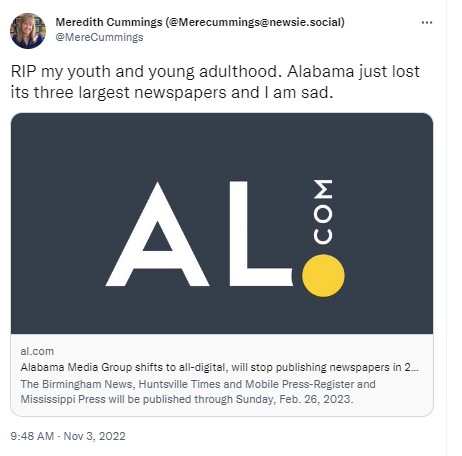
Our Tennessee foreclosure system is entirely based on physical newspapers. Until recently, I had a newspaper subscription, even though: (a) for the past 20 years, I’ve gotten 99% of my news online; (b) my local newspaper had shrunk to about 10 pages (total); and (c) my newspaper carrier generally delivered my morning paper either 8 hours late, the next day, or not at all. Physical newspapers are possibly the worst way to convey information in our modern age, but, nevertheless, Tennessee’s entire foreclosure and UCC sale system is tied directly to published notices in physical copies of newspapers. All over the country, newspapers are going to an online-only model (followed, most likely, by going out of business). But our foreclosure laws haven’t been updated. We’re headed for trouble unless we change these laws.
There’s no penalty for bogus lien filings in Tennessee. Sure, there’s the toothless “exaggeration of lien” statute (Tenn. Code Ann. § 66-11-139) or the confusing “slander of title” cause of action, but, by and large, if somebody records a piece of paper with “Notice of Lien” written somewhere on it (and includes the owner name and property address), they’ve got a totally un-lawful, but also practically-effective, lien. A few years ago, the Tennessee Legislature passed Tenn. Code Ann. § 66-21-108, which gave property owners a nuclear bomb to deal with invalid lien claims, but it was repealed within a year. As it stands now, there’s no useful remedy, other than to pay the invalid lien or to cancel your transaction.
Big Mortgage Lenders refuse to provide payoffs on their debts with impunity. One of the weirdest sub-plots throughout my 2022 was how near-impossible it was to get a payoff from mortgage lenders. In December, I had to sue a mortgage lender to get a payoff (and to stop an immediately pending foreclosure sale). It might have been the dumbest lawsuit I’ve ever filed (dumb as in the other side was dumb to make me go to the trouble): Within 24 hours of my getting a foreclosure injunction, the lender provided the payoff and, within a few hours of that, it was paid off in full. A win, except it cost more than $5,000 in unrecouped legal fees to address an unnecessary situation. There needs to be a law that imposes penalties, including attorney fees, in these situations.
I spent the entire year in a sales funnel. In 2022, after a full year as a small business owner, I took some time to evaluate my existing legal technology and services and what needed to be upgraded. On legal tech websites, I’d enter my email in order to download some awesome “Free Guide To _____” that promised a magical solution or explanation for some common problem or process. Having downloaded a number of those (none of which solved any problem), my phone rang all year long, over and over, with sales calls. It’s not “free,” if I end up in a Sales Funnel. My advice to service providers: How about sharing your expertise, impressing me with your vast knowledge, and leaving me alone, confident that I’ll return to you for my buying needs?
Phone calls from Tom James Company custom clothiers were the worst. If I ever find out who sold my name and phone number to Tom James Company, I will immediately sever ties with that organization (I suspect one of the bar associations did it). Tom James representatives were relentless in 2022. They called me so many times that I remembered the caller’s name (from the prior week’s call), could recite their opening line back to them, and remind them that I was the person who wasn’t interested because I buy all my suits from South Korea, just like BTS (not true, but why not go big, right?). After maybe 25 calls in 2022, I reached out to Tom James corporate, and asked if I could pay them something to be added to a no-call list.
Dealing with global, multi-state law firms. All of Nashville’s medium to big law firms are slowly selling out to mega-law firms. For the most part, I still deal with local folks on my litigation matters, but, on matters where a Tennessee law license may not be required, I have to deal with out-of-towners, and it’s rarely a pleasant, easy relationship. It’s a trend I’m dreading, as these firms bring their billable rates, minimum hourly requirements, other customs into the work they do in the local market. In short, their weirdness makes my job harder.
I miss old twitter. Many years ago, while waiting at a docket call in Montgomery County, I tweeted that I forgot to bring a pen for court. Within a minute, a local lawyer who follows me on twitter introduced himself and handed me a pen. Over the past decade plus of very-regular twitter use, I have found a vibrant and diverse lawyer community who post updates, victories, and advice. It’s awesome. Over the last few months, it’s gotten less active. If twitter as we once knew it goes away, we will have truly lost something.
The Lawyer-Industrial-Complex has gotten out of hand. Have you tried to hire a lawyer lately? If so, you were probably shocked by their hourly rates. The Clio 2022 Legal Trend Report (warning, you have to enter your email to access it) says that, in fact, lawyer rates are too low and haven’t risen with the general rate of inflation. I don’t know about that, but, holy smokes, lawyers and all the law adjacent services are so expensive right now. I’m using a Westlaw Rules of Civil Procedure book from 2020 because a new set (that will be obsolete in a month) is nearly $1,000. Some lawyers say that this isn’t a problem (more money in my own pocket, right?), but, frankly, it’s a trend that I don’t like. Prices are going up, but the quality of service is staying the same.
Having said that, where are all the good, reasonably priced Nashville lawyers? As noted above, I keep a small footprint for my law practice, and I refer out about 2/3 of the “new client” calls I get. My biggest problem with referrals has been “To whom”? I only refer cases to lawyers who will make me look good and will do an awesome job. Everybody on my existing list is swamped right now. What Nashville lawyer does good, competent, cost-efficient work? And, also, is looking for more work? I can’t find him or her. But I’m looking.
“Every day” would be exaggeration. But, “every other day” isn’t.
Every other day, I’m reading in the Nashville Post about some out of town Big Law firm buying a Nashville law firm or practice group (or, as Rex Hammock says “acquihire“). Or poaching a bunch of lawyers (or a few). Or just local firms shuffling lawyers like a deck of cards.
It’s absolutely nuts, and I love it. It’s like the NBA trade-deadline, but far more boring–unless you’re a lawyer, and you like gossip (two things that will be on my gravestone).
A few weeks ago, I had a pre-trial lunch with a lawyer from Jones Day in Atlanta, and I asked him if the Atlanta legal market is this crazy with attorney movement. He said, yes, but for associate attorneys.
There was a bit of condescension involved, but implicit in his response was the suggestion that, maybe, this suggests that Nashville is joining the big leagues. Part of becoming one of the “big cities” is being taken over by the “big” law firms.
For years, the Big Law firms never paid any attention to Nashville. Nashville’s legal market was ruled, largely, by home-grown, home-managed law firms whose footprint generally extended a few counties in any direction, but rarely beyond the state lines. Small firms, with big personalities.
If a Big Law firm had a Big Client who needed help in Nashville, they’d call one of the 3-4 big(-ish) Nashville law firms to serve as local counsel. But, in general, the Big Law Firms didn’t think they needed to be actually in Nashville.
That’s what has changed. The national/global law firms now realize they need to be here and are having to catch up by “buying” into the Nashville market. Atlanta isn’t seeing this constant shuffling, because, frankly, all the Big Firms are already in Atlanta.
And what a boon it’s been in Nashville. You know those random calls you get asking if you’d sell your house? That’s what’s happening. But with lawyers.
I’m curious about what the next 4-5 years holds in store in the Nashville market. Part of what has made Nashville’s legal world special is the eccentric independence of so many firms here in town. Sure, there are local folks you dislike having cases with, but at least you know them.
After a bunch of out-of-towners start buying up your neighbors’ houses, your property increases in value. But you don’t know your neighbors anymore.
Recently, I dealt with Arizona lawyers on a hipster donut store lease in “southern Davidson County,” but they had no idea what I was talking about when I said “Brentioch.”
For a while, I was afraid to even mention all the local moves, worrying that this group or that group would think this post was about them. But that was probably 50 acquihires ago. This post is, literally, about the entire market (since we’ve all seemed to switch firms since 2019).
As long-time readers know, when I get busy with work, this blog suffers. As I’m nearing my anniversary of my firm’s current incarnation, I’ll be posting more, mainly as a way to share and discuss this solo- and small practice adventure over the last few years.
It’s news-worthy because it seems like such a jerk thing to do, especially given the public persona of Sudeikis, who is famous for playing the nicest character on modern TV and, generally, regarded as a nice person in real life.
Seriously, Ted Lasso isn’t just nice, but inspirationally nice. I can’t count the number of showy LinkedIn posts talking about life lessons people have learned from Ted. One review called the show a “warm hug of nice.”
Personally, in trying serve an evasive defendant, I’ve researched social media, court dockets, or anything else that will help me locate where and when the defendant may be. My process server has shown up holding a bouquet of flowers, an empty cardboard box, and waited at the end of a bike race, looking for Racer # 3433 at the finish line.
So, did Sudeikis do something wrong? It depends. Was Olivia Wilde evading service, requiring them to go to this extra mile to “catch” her? We don’t know that.
But, we do know this: This move is inflammatory and is going to make this litigation more difficult. As lawyers, we are faced with all sorts of “allowed” procedural tactics that sound great on paper, but that can also skew litigation into scorched earth territories in real life. Part of a good lawyer’s job is to talk clients out of those tactics and focus on the bigger picture.
But, looking at the big picture, the damage may already be done. This custody battle just got a lot more contentious. And, honestly, it’s going to be weird watching Ted Lasso manage his own divorce and custody issues knowing what I know about this messy real-life drama.
A few of you asked if there was a corresponding drop in Chancery, Circuit, and General Sessions filings. Maybe that’s why people weren’t running to file bankruptcy.
Given the numbers in Bankruptcy Court, it’d make sense that state court litigation might have also slowed down, but I was a bit surprised by the answer.
Davidson County Chancery Court lawsuits have been surprisingly consistent.The final Chancery lawsuit of 2021 was filed at 11:59AM on December 30. It was case number 21-1324-I, which means that it was the 1,324th case filed last year. It’s an unpaid commercial debt lawsuit.
For comparison, here are the last few years’ numbers on new case filings: 1,299 cases filed in 2020; 1,569 in 2019; 1,413 in 2018; and 1,386 in 2017.
In short, there was no real drop in chancery court litigation, which surprised me. 2021 felt like a slow litigation year for Nashville.
Of the ten stories featured in the Nashville Post’s 2021 “Top Reads: Legal” article, six of them were just about law firm personnel moves not, you know, actual news-worthy litigation.
In general, you’d expect to see the business-minded Chancery Court have cases on this list, but, frankly, it’s a bit boring (no offense, toilet fire lawsuit).
What about General Sessions Cases? This is where it gets more interesting.
As of the end of November, there were 6,551 detainer / eviction warrants filed in 2021, along with 15,404 small claims lawsuits filed. For that same period (end of November) in 2019, there were 10,694 eviction lawsuits and 24,508 small claims lawsuits filed. Long story short, that’s about a 40% drop in filings.
Circuit Court? By the end of November, there had been 1,736 new civil lawsuits filed in 2021. At the end of November 2019, there had been 2,590 civil lawsuits filed, representing a 33% drop.
I’m not entirely sure what to make of this data. A 40% drop in evictions and credit card/debt collection cases would certainly be expected to result in a slower pace of new bankruptcy filings, but, nevertheless, this also shows that the common perception that “courts are closed” and “evictions aren’t happening” is incorrect.
Some credit has to be given to the LEGACY Housing Resource Diversionary Court run by Davidson County Judge Rachel Bell. This program can’t stop the new eviction filings, but it has helped many pending cases get resolved. As of September 20, 2021, $18,799,705.71 had been paid to landlords via this program and, most likely, kept those tenants out of the bankruptcy lawyers’ offices.
In the end, my take is that Middle Tennessee bankruptcy filing numbers are far more impacted by lawsuits filed in Davidson County General Sessions Courts than by the business-litigation dockets in Chancery Court. These numbers offer some part of an explanation.
When COVID first hit, lawyers talked about how future contracts would evolve to anticipate the special challenges presented by a global pandemic.
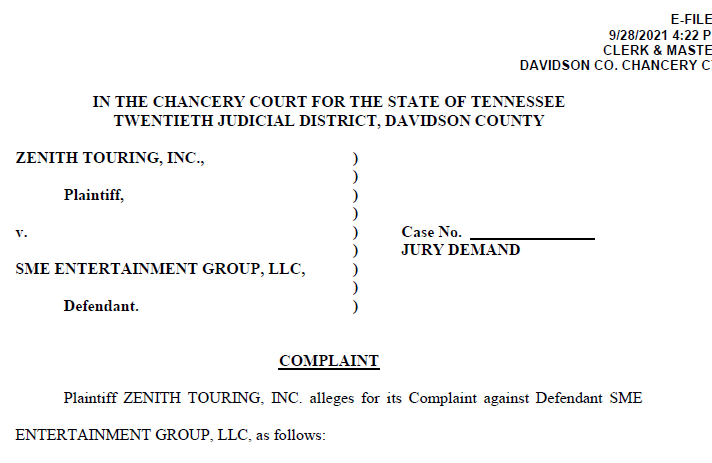
Now, 19 months in, a new Davidson County Chancery lawsuit filed on behalf of the Foo Fighters shows that–even with all the planning in the world–COVID is still disrupting the best laid plans.
The plaintiff (the touring company that books gigs for the band) alleges that defendant hired the Foo Fighters to perform at an August 13, 2021 corporate event for payroll processing company ADP. The parties entered entered into a April 5, 2021 written agreement. Per the contract, the band would receive $3,000,000 for the performance, with half paid when the contract was signed, and the other half paid at (or before) the event.
But this contract was updated to take into account all the lessons learned during a global pandemic.
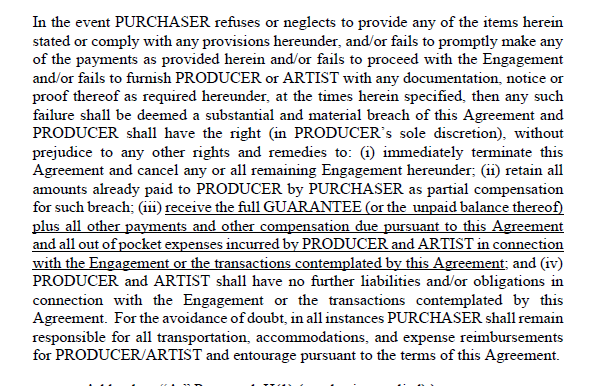
Per Paragraph 10 of the Complaint, if the defendant defaults or cancels the performance for any reason, the band would receive the full performance payment (regardless of whether the band actually plays the show).
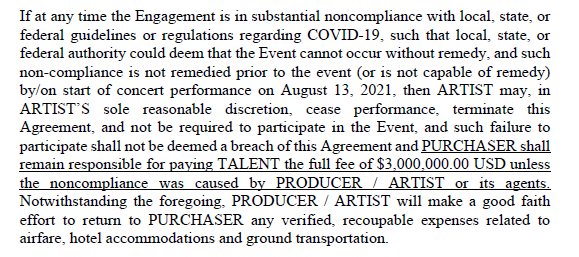
Based on the allegations of the Complaint, it’s clear that concerns about COVID played a large role in the negotiations. In fact, the parties included a section called “COVID CANCELLATION,” which–as you’d guess–allocated the risk of a forced cancellation due to the pandemic.
And, boy-oh-boy, was that risk apportioned squarely onto the plaintiff:
In short, if the contracted for event were to be deemed unsafe and impossible due to the resurgence of COVID, this provision says that it does not matter. The band, in their “sole reasonable discretion,” can terminate the obligation and refuse to perform…and still get paid.
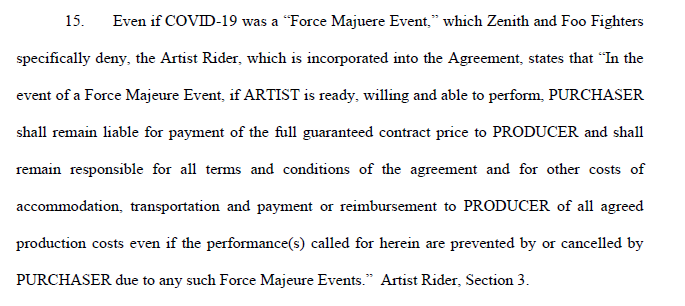
Was COVID a “force majuere” event? The band says that they expressly removed the reference to COVID in that paragraph, and further allege this:
There’s a bit more to the story, but, in short, COVID didn’t go away, and this August 2021 event at Mile High Stadium in Denver became less and less of a good idea for the ADP corporate event.
They discussed limited capacity, the band offered to do an exclusive live-stream concert, but, on August 4, 2021 (9 days before the event), the defendant decided to cancel the event. The lawsuit points out that “there was no local, state, or other governmental restriction that required the cancellation of the Event” and, helpfully, points out a number of other large concerts and events that happened that weekend in or near Denver.
The Foo Fighters have sued for the $1,500,000 owed under the Agreement. (And I tend to agree with their analysis of the contract.)
It’s an interesting case. On the most superficial level, it shows that, no matter how hard you try, it’s hard to contract around the unexpected.
In April 2021, my own family was so exuberant about the vaccines and a COVID-free summer (and fall) that we surprised our kids with shockingly expensive Jonas Brothers tickets to celebrate the end of the pandemic. In April, my wife and I believed we had weathered the storm and that a sold out concert in September 2021 was a totally safe and reasonable reward for our kids. We went, but we were terrified taking our vaccinated kids to the show.
I have to wonder if the defendants, here, suffered from a similar bit of vaccine optimism.
Nevertheless, the Foo Fighters’ lawyers did not share that optimism; or, if they did, they included sufficient terms in the contract to assign the burden of any risk squarely on the other party.
From what I’ve seen of it, it’s a good contract. Who knew we’d be learning some lessons about contract law from the Foo Fighters?





 Creditors Rights 101