Many collections lawyers handle cases on a contingency basis. They don’t bill by the hour, but, instead, they keep some percentage (usually 33%) of the money they actually collect for the clients. Sounds fair, right?
A recent study showed that a Nashville lawyer’s average rate exceeds $500 per hour, and that adds up pretty quick. With lawyers being so expensive, it makes sense that some clients would ask their attorney to share in the success (or, maybe, frustration) of the collection process.
(As a quick disclaimer, I rarely take collections cases on a contingency and, when I do, I’ve done my advance homework and am confident that, candidly, we’re all going to make a lot of money.)
Because the contingency fee attorney is not sending bills that track every minute of his time, a down-side is that he may not have a clear measure of how much in fees he has expended on a case. This is important in breach of contract cases, when the lawyer asks the judge to add an award of attorney fees to the creditor’s judgment. Under Tennessee law, a trial court must consider whether the fees requested are “reasonable,” using very specific guidelines established by the Tennessee Supreme Court.
If the lawyer hasn’t kept track of her work, then what amount does the attorney ask for? Generally, contingency-fee lawyers simply ask for their contingency-fee amount to be added to the judgment. That is generally allowed.
In that case, after they were awarded $50,000 on their breach of contract claim, the plaintiffs asked for attorney’s fees “in the amount of one-third of the total Judgment, or sixteen thousand six hundred and sixty-six dollars and sixty-six cents ($16,666.66).” See Fulmer v. SARCO, GP, No. M202201479COAR3CV, 2023 WL 5787082, at *2 (Tenn. Ct. App. Sept. 7, 2023).
In questioning the attorney fees, the Court of Appeals wrote that “[w]hile a one-third fee may have been what [plaintiffs] agreed to pay their counsel, it is not what [defendants] agreed to pay in the Note” (which only referenced “reasonable attorney fees”). Id. The defendants were not party to the contingency fee agreement, and “what [plaintiffs] agreed to pay their own attorney is not dispositive of what constitutes a reasonable fee under the circumstances of this case.” Id.
Instead, the trial court must have some proof substantiating the fees and services provided, consistent with the factors listed in Tennessee Supreme Court Rule 8, RPC 1.5. Id.
I understand the reasoning here, but I disagree with the general premise that a contingency fee is, per se, not reasonable.
As an example, consider my practice. If I accept one of my no-brainer, “we’re all going to make a lot of money” contingency fee cases mentioned above (and my homework is correct), I could possibly make a $333,333.33 fee on a lawsuit that lasts two months. Does that the fact that I got the matter resolved quickly and efficiently necessarily mean that my fee violates the Tennessee standards for reasonableness? This opinion suggests it might.
In my limited contingency practice, I lean really heavily on my skills, expertise, and homework (i.e. the “novelty and difficulty” referenced in the Rule) in picking my cases. In short, on those cases where I hit a grand slam, it can occasionally look easy, but a lot goes into that. It’s like the ship repairman, who charged $2.00 for tapping the engine with a hammer one time and $9,998.00 for knowing where to tap. He is worth every penny.
In the end, the Court of Appeals remanded the question back to the trial court, and there’s some chance that the plaintiffs make these same arguments in defense of their contingency fee.
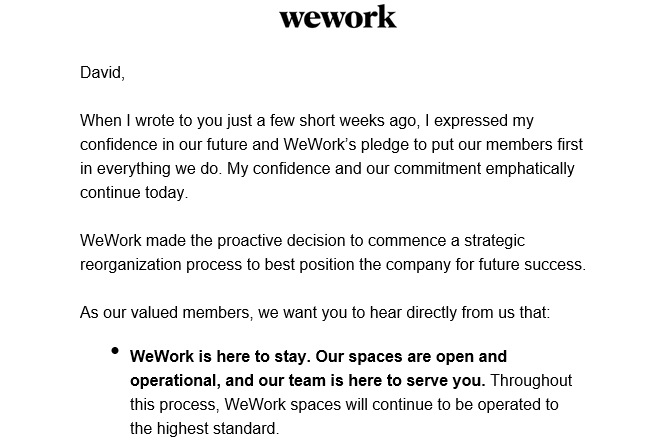
In fairness, since I wrote that post in 2021, my love for WeWork has waxed and waned in stretches.
When I started my firm and wasn’t sure how much office I needed (and for how long), flexible space and term options saved me tens of thousands of dollars. When my family took a 3 week trip to the other side of the world, WeWork Euljiro in Seoul kept my firm running. Plus, as a solo, being around noise and people can be a good thing.
On the other hand, “noise and people” can be bad when it’s mostly “22 year tech bros in shorts and flip flops making loud sales calls.” Don’t get me started about the constant battle to get squatters out of the conference rooms. And, despite what you might think, a dedicated office in a WeWork is surprisingly small and very expensive.
Instead, it’s probably an indication that all those leases signed by WeWork at pre-COVID lease rates (back when the company had a $47 Billion valuation and a “money ain’t no thing” vibe) were simply unsustainable in our new post-COVID reality.
The Bankruptcy Code has a unique tool available for commercial debtors to fix this exact issue. Under 11 U.S.C. § 365, a debtor has the ability to “assume” or “reject” any of its leases. In layman terms, the debtor gets to keep the leases that are useful to keep and cancel the leases that aren’t useful and it doesn’t want to keep. The mere threat of rejection often spurs a conversation between a debtor and a landlord about modifications to the lease to reflect a more realistic rate of rent.
WeWork’s messaging has been clear. They call this a “strategic reorganization process.” That’s a fancy way of saying “bankruptcy” but without saying “bankruptcy.”
That’s surely intentional. The term “bankruptcy” suggests failure or that the company is shutting down.
In reality, a corporate bankruptcy of this magnitude isn’t really a bankruptcy in the traditional sense–it’s a restructuring process that, incidentally, favors the debtor and incentivizes negotiation and cooperation and, as a result, reorganization. I suspect that, when the business people took over from WeWork’s founder in 2020, the first item on their “to do” list was what to do with so many of these terrible leases. Bankruptcy was always a viable option to fix the company’s troubles.
In short, this is a good thing, and this process will probably allow WeWork to shed some of the mistakes of the past and emerge a more viable company going forward.
As a tenant, I’m hoping they succeed. To that end, I’ll vote in favor of any Chapter 11 Plan on the following condition: They have to create some penalty for the squatters in the conference rooms and phone booths. Every single time I book a conference room, when I open the door for my meeting, it’s filled to capacity, with people in shorts and flip flops. We have to fix this next.
It looks very exciting on TV, but success in the legal profession is often a matter of being really good at paperwork.
Proof-reading and getting the details right are essential….
But what makes great lawyers really great is the knowledge and foresight to know which details to include.
On TV, cases tend to end after a passionate closing argument, and the lawyer and client walk out of the courthouse victorious. In reality, most of my cases end with me pouring over the details of a single document–the Order that the Judge will sign–and victoriously e-filing it with the Court Clerk.
When I prepare an order for a Judge’s signature, I try to think through every possible scenario where I’d enforce the terms. When I type the judgment debtor’s name, I make sure I’ve spelled the name the same way it’s spelled on the debtor’s old checks or property deed. If there’s some special request or relief I’ve asked for in my motion, I make sure to recite that in the order and have the order expressly grant it.
A trend I’m noticing lately is that lawyers leave out critical details in their orders, and the omissions hurt their cases.
A good example relates to post-judgment sheriff sales. Sheriff’s sales confuse courts, clerks, lawyers, and sheriffs. The law is tricky and draws on 2-3 separate statutory bases (Tenn. R. Civ. P. 69.07 ; Tenn. Code Ann. § 26-5-101, Tenn. Code Ann. § 35-5-101). County sheriffs are good at a lot of things, but they really dislike having to navigate confusing Tennessee statutes on their own.
A good creditor attorney will think through the entire process, starting at the end (i.e. what will the title company need to insure title on this sale), anticipate all the questions, and have the Order address any possible question that could arise.
Who owns the real property? (Look at the Order.)
What are the liens that are impacted by this Sheriff’s Sale? (Look at the Order.)
Who will prepare and publish the Notice of Sheriff’s Sale? (Look at the Order.)
What’s the minimum price pursuant to Tenn. Code Ann. § 26-5-115? (Id.)
Will there be a deposit? What happens after the sale? When does the buyer get a deed?Will there be a sale contract? What happens with the redemption rights? And so on…
I recently saw an Order Authorizing Sheriff’s Sale that said, basically, “the relief granted in the Motion is GRANTED.”
And that was it. The Order had no specific reference to relief described in the Motion and provided no guidance to the sheriff. Instead, to enforce the Order, the lawyer had to also send a copy of the Motion and hope that the sheriff would connect the dots between the two pleadings.
The lawyer’s job is make the process run as smooth as possible, and that includes anticipating issues and preventing them. One strategy to make the process work is to think through all the issues in advance and, before the Judge signs the order, include it all in the document the Judge signs.
If I know where a judgment debtor banks, I’m half-way to collecting on my judgment. That is, of course, until the bank responds “Account Closed” to my bank levy.
What then?
You have to make some lemonade with the lemons, I guess. “Account Closed” suggests that, at some point, the debtor had an account there. If I can’t capture money, maybe I can figure out where it all went.
One way to do that is to subpoena the bank’s records for the time periods that the account was active. To do that, a Tennessee creditor has to comply with the Tennessee Financial Records Privacy Act, found at Tenn. Code Ann. § 45-10-101 et. seq.
The purpose of the Act is to protect a bank customer’s privacy, and the Act prevents Tennessee banks from arbitrarily releasing customer records (where the customer hasn’t authorized the release).
This sounds complicated, but compliance isn’t particularly difficult. The basic requirements are spelled out in the Act: (i) the customer must get notice of the subpoena and an opportunity to object (Tenn. Code Ann. T.C.A. § 45-10-106 ); and (ii) the requesting party must satisfy a number of technical requirements, spelled out at § 45-10-106 (15 days minimum to respond; sufficient identifying information must be provided; a bond).
In response, the bank will provide signature cards and account statements for the time periods requested. The records will show how much came in, how much went out, and where it all went.
Having looked at 100s of responses from Banks, I will tell you: Bank records don’t lie, and they always tell a story. Some involve luxury purchases, vacations, and restaurants I’ve never heard of (and couldn’t afford). Some confirm that maybe the debtor has, in fact, gone broke. Some will lead to other banks and other records to be subpoenaed.
In short, knowing how to subpoena records under the Financial Records Privacy Act is a powerful tool and not particularly hard to get right.
Honestly, the hardest part is knowing what bank to send the subpoena to.
Today (August 8) is my birthday, and it’s also the three-year anniversary of when I started my own firm (well, August 7). With this post, I’ll ask you to indulge me a bit.
It’s a happy birthday toast to my law firm.
It hasn’t been a straight line, but it’s always been onward and upward. I cringe a little bit re-reading my August 2020 post announcing the move. My mission statement still rings true, but, in retrospect, I hadn’t quite run my “big plans” past the other firm (or the other other firm). I was just so excited to be building something new:
I tend to wake up, involuntarily, at 4:45 a.m. or so, to worry about whether it was the right choice and about all the work to be done to build something. Opening bank accounts. Picking office space. Hiring staff. Hiring lawyers. And, of course, doing the legal work for all the clients. And by “wake up, involuntarily,” I really mean “freak out” about what’s next.
My mistake was that I had no idea what I was looking for, until I happened to find it. It’s crazy that, 3 years ago, I typed out the above words, but it never once crossed my mind to actually start my own firm. Instead, I had spent the prior 3 years looking for, simply, a different Big Law Firm. /s/ Because everybody knows that the best way to have a voice in the big firm decisions and autonomy in your law practice is to move to a Big Law Firm./end sarcastic voice/
Fail fast. So, I had all these big plans for an innovative way to run a law firm, and then somehow decided that I should definitely open an office for a 100 year old law firm based in a city 300 miles away. Reading that last sentence, I totally see the red flag. In reality, it took about 2 weeks. One more (brief) false start later, I decided to go Solo.
Trial and Error is sometimes the best teacher. I won’t recount the mistakes I made in the first 15 months running my own firm, but I’ll tell you that, by November 2021, I was annoyed, fed up, and ready to find the biggest law firm that needed a creditor rights expert. To that end, I met with a legal recruiter, Tara Boosey (who had an office in my building), and told her that I was sick of it, described what my dream job looked like, and told her to find it for me. Her advice? “It sounds like you already have the perfect job for you.” Not what I wanted to hear at that moment, but such great advice.
Just focus on the firm I have.Then it clicked. The work and referrals had always been there, but the unlikely encouragement really focused me on my path. A past obstacle was that clients tend to call me whenever something comes up, and I fretted about the client who maybe calls once a year for an IP referral or the other who sends me 1-2 complex commercial transactions that are way over my head. How could I help them, if I wasn’t at a huge law firm? Simple: I wouldn’t. I’d focus on exactly what I do (and do best), I’d build a network of small-law experts who I trusted, and the smart clients would appreciate a thoughtful referral to another awesome attorney.
And, then, focus even more. Even though the phone never stops ringing, I bill less hours than I used to at the big law firm. That’s because I also spend so much more doing everything else: marketing, IT, accounting, you name it. There are only so many hours in the day. If I couldn’t accept every new case, then I’d have to decide which of the clients I could help. I began to ask things like: Which clients are jerks? Which ones take forever to pay? Which ones are unreasonable? Which ones don’t listen to me? Those were the first ones to go. I call it the Client Decision Tree.
The good clients sustained the firm. Three years ago, when I announced that I was leaving my old firm, one client lost his mind, thinking he didn’t have the option to go with me. In a frantic email, he wrote “Wherever you are, that’s where I want my cases.” Needless to say, that client made the cut and has followed me through every step, through 4 different email addresses (ugh). Since August 7, 2020, I’ve opened 517 new client matters1. Maybe I’m not as low volume as I thought; that number is surprisingly high. A large part of that (maybe 200) were old matters that followed me when my bank clients said “take everything.” (It turns out that my fears that I wouldn’t have any clients unless I stayed in a Big Law Firm were incorrect.)
Working less is a good thing. Once upon a time, no matter what the old firm’s billable minimum was, I exceeded it. Obsessively. It was unhealthy, and maybe bad lawyering. The law should be thoughtful, strategic work, and “high volume” anything does not create the best product. I had a crushing workload. Billable hour mandates are driven by expenses and overhead, and, if those could be kept in check, I believed that my new model could produce high quality work, balanced with a healthy lifestyle. So far, so good: Last year, my hours hit an all-time low, but my net income hit an all-career high.
The mission statement wasn’t entirely crazy, either. Since opening my own firm, I’ve been recognized as an Attorney for Justice by the Tennessee Supreme Court every year. I have helped a Nashville group distribute more than a million dollars in property tax protection and racial justice reparation funds. I’ve started a charitable program, Lawyers Give Back, that has supported 17 different area charities. And, yes, the firm works really hard in service of our clients. I still lose sleep worrying about my cases–there are just intentionally less of those cases to worry about.
In the end, I discovered that I had my dream job. At the old firm, I took my kids to school maybe 10 times over the course of 5 years. In the last 3 years, I bet I’ve done 300 drop-offs and pick-ups. I’m a better lawyer, and I’m also a more engaged husband and father. (After a “law firm divorce,” I can assure you that your law partners don’t actually love you like family.)
Byeonhosa Noraebang! I never took real vacations; instead, I’d tack a few extra days onto 3 day weekends here and there. This year, my family took a dream vacation, spending 3 weeks in South Korea. Our trip culminated with a great dinner with two Korean banking lawyers (and friends), who took our family to noraebang afterwards (on the 10th anniversary of BTS’s debut).
If you’ve made it this far, you may be wondering what my point is, other than a bit of bragging. That’s fair, but we should be able to authentically celebrate all sorts of successes and not just brag on LinkedIn about being a Super Lawyer.
There’s a stigma attached to being a solo lawyer, which isn’t fair. A lawyer doesn’t have to work at a big law firm to be successful or to produce sophisticated work. Three years ago, I couldn’t comprehend that, a result of years of false messaging from law schools and bar associations. Even 20 years into my own legal career, I fell for that BS, and my ignorance wasted a lot of my time.
Don’t get me wrong. Running a small firm is hard and can be a complete pain in the neck (feel free to read some of my other blog posts on that topic). I often tell people “It’s the best job on earth, and it’s the worst job on earth, but it’s never in the middle. I used to spend a lot of time in the middle.”
I also used to tell my kids that they were forbidden from ever becoming lawyers, because it was such an awful job. Not anymore. Now, for the first time, I can picture a day when one of my kids might take over the little firm.
What a three years it’s been. I’ll conclude this post with a celebratory link to BTS’s Mic Drop (a song in which South Korea’s greatest boy band encourages you to relish your successes and also to tell your haters to annyeonghi gaseyo).
Now, I’ll turn off the work email early and go enjoy a birthday dinner with my family.
A prior version of this post said 549, which is what my billing software shows and sounded bizarrely high. On further research, that included a few adminstrative / pro bono / conflict type file assignments, so I reduced the number. ↩︎
I totally agree with the outcome, but I also feel weird about the Clerk’s Office simply deciding that we’re not going to follow a very clear (yet really dumb) statute. I didn’t realize we had a choice.
Last year, I was making small talk with a Medium Firm lawyer at a fancy lawyer dinner, and I was complaining about all the phone calls.
The conversation hit an abrupt stop….
Him: Wait a second. You don’t answer your own phone calls, do you?
Me, after an awkward 5 second pause: HA! No way, of course not, are you kidding? (said, literally, while my phone was vibrating in my pocket with a new call)
One of my favorite parts of having my own firm also relates to the least fun part of it: I make every administrative decision and also pay for every decision.
When the cost of every subscription, new technology, and sponsorship comes directly out of your own pocket, you develop a critical eye when making decisions.
With every one, I always ask: Will this help me serve my clients and/or make their experience working with me better? If yes, I then ask: Is it absolutely necessary?
At my old firm, every fall, a brand new stack of the Thomson Reuters “Rules of Court” books would show up on my desk. It was great. I’m a litigator, and, back then, I’d have stretches where I went to court every day of the week. Those books are useful.
Even back then, I’d get so worked up when I’d see that cart full of the new versions being delivered to every lawyer at the firm. About half of the lawyers never went to court and most likely never touched the books. At 40 lawyers, the $600 price tag turned into real money fast.
Because the $25,000 invoice didn’t come out of any one person’s pocket, nobody ever questioned the expense. We were a big firm, and buying a set for every lawyer was just something you did.
Over time, I saw dozens of budget items that had accumulated over time, which simply became legacy institutional costs that nobody questioned.
Just like paying somebody to answer your phone.
A disclaimer: I’ve always been a “direct line” lawyer, but my clients generally learn to email me for best results. (I mean, post-COVID, who is making “surprise” calls and expecting the other person to have a substantive conversation with you on the spot?)
And, yes, my old firm had people who intercepted unanswered calls and then flipped them to my voicemail. Nowadays, I use a third-party answering service, Abby Connect, to do the same thing, but for about $300 per month. As long as the client hears back promptly, they haven’t cared at all.
There’s really no right or wrong way to run a law practice. What works for one firm might not work for somebody else.
Having said that, though, there’s a direct correlation between how expensive it is to run a law firm and how many hours lawyers are forced to bill. Everything you read about lawyer burnout and stress suggests that an oppressively heavy workload isn’t ideal.
Sure, frisbees with your law firm logo on them are fun, but, somewhere, there’s an associate attorney billing an hour to pay for that.
When I make a decision for my own firm, I also know that any added cost means added billable hours. Some costs are necessary; others simply aren’t worth the extra burden on my schedule.
Today, I’m lucky that I’m the one who gets to make that choice.
My advice for other lawyers thinking about switching firms? Consider whether your values align with the people who will be making those types of decisions. It’ll be you paying for them.
Also, law firm clients, this same warning applies to you. I mean, you’re the ones who pay for all of it.
If I won the billion dollar Powerball, I’d live a life free of interrogatories and argumentative lawyers. As a billionaire, I’d only employ lawyers who tell me “yes.”
The legal industry is different. Most law firms–big, medium, small, and tiny–follow the same general business model: billable hours. A lawyer’s salary usually comes down to: (1) How many hours are you billing? and (2) How much are you charging for that hour?
There’s a little bit of discretion this way or that way, but, in the end, a lawyer’s salary is a matter of math.
When a new firm offers a raise, a lawyer will probably be expected to “earn it back” (by multiples) by billing more hours and charging higher rates. Law firms don’t give money away.
It’s not a terrible list. The “big picture” concepts are fine, but there are about 5 items of specific advice that make me cringe.
My own list would add: (4) Are you growing as an attorney, either via general learning (Are they mentoring you?) or developing a niche practice (Are they exposing you to a practice area or client base that you can grow into and develop?) (5) Do you like the people there and their working style (i.e. the vibe)? (6) Does your law firm value your contributions to the firm? (7) What are the future prospects for growth (i.e is the firm managed by old white guys on their way out, without any transition plan) and how could you fit into that future (i.e. is the leadership team inclusive, a small clique, or, worse, located 2-3 states away)? (8) What level of autonomy do (or would) they allow for you to grow your practice?
As you consider all of these questions, always ask yourself: Ignoring the potential raise, would things be better if I just stayed put?
Before I left my old law firm in 2020, I had spent about 2 years seriously listening to recruiters’ and law firms’ offers, and I realized that every law firm was basically the same. A little bit more money, but more hours and my rate would increase to a level that would chase off most of my clients. I’d be a stranger, though, who didn’t know how the document management system worked or where the snacks were hidden. The money wasn’t worth the hassle and couldn’t overcome my other concerns.
I declined all offers, mainly because I cherished my “F You Capital,” hard earned after nearly 13 years of high performance at the same firm. Even though I didn’t agree with the firm on many administrative things, my past success and client base had earned me a level of autonomy that was valuable to me. I had very little interest in being the “new lawyer.”
I understand that some lawyers are drastically underpaid, and many people don’t have the luxury of turning down a raise. What I’m recommending, though, is that money shouldn’t serve as a wildcard, to solve the red flag answers to the other questions.
You’ll have lots of jobs and will make good money as a lawyer, but you only have one career. Be deliberate when making the jump.
At the time, Tennessee creditor rights attorneys complained both about the decrease in the interest rate (at the time, it dropped from 10% to 5.25%) and also the confusion related to tracking a variable rate (it changes every 6 months). Back then, none of us envisioned a world where the rate would exceed Tennessee’s old rate.
When the Legislature made these changes during the Great Recession, it was designed to provide relief to judgment debtors. That the rate has reached an all-time high is good for creditors, of course, but also indicative that interest rates are pushing the economy toward a tipping point.
In an apparent rush to be as unfriendly to tenants as possible, the Tennessee Legislature has upset lawyers for both tenants and landlords.
I’m talking about the new Tenn. Code Ann. § 27-5-108 (d), which became effective July 1, 2023.
The prior version said:
(d) If no appeal is taken within the time provided, then execution may issue.
The new version says:
(d)(1) Except as provided in subdivision (d)(2), if no appeal is taken within the time provided, then execution may issue.
(2) For a writ of possession, if no appeal is taken within the time provided, then execution shall issue by operation of law.
Do you see the difference? Under the new (d)(2), a writ of restitution “shall” automatically issue after an eviction judgment.
Some quick background: A “detainer /eviction judgment” is the court order that says a landlord is entitled to possession of the property, usually due to lack of payment of rent or some other breach under a lease. A “writ of restitution” is the subsequent legal paperwork that directs the Sheriff to physically remove a person (and all their stuff) from the property.
To be clear, the entry of the former one does not necessarily require the issuance of the latter.
In most cases, no Writ is ever needed. Most tenants act fast in response to the mere threat of having the Sheriff show up, unannounced, with hired labor to physically remove them and move all their possessions to the street.
Most landlords reach out to the tenant and do everything in their power to accommodate a reasonable and peaceable move-out, to avoid the cost and mess of having the Sheriff throw out all of a tenant’s stuff.
And, sure, not all evictions are the same, and there will always be a few–the “worst of the worst”–where the Sheriff’s help is needed. But those are a rare exception.
As a landlord-tenant lawyer, of the 500 eviction judgments I’ve won, I’d guess that I’ve issued less than 10 writs of restitution.
Why on earth did the 2023 Tennessee Legislature decide that each and every eviction judgment needs this immediate and atomic action? This makes no sense, as a matter of policy or practical application.
Tenant lawyers hate it. Landlord lawyers hate it. I’m guessing the Sheriff’s Office hates it (or will hate it).
Just today, I filed an eviction judgment with the Court and, as part of the filing process, I was forced to also to pay the $67.00 Writ of Restitution fee. Neither I nor my client want that process to issue.
The only people who think this is a good idea is the Tennessee Legislature.






 Creditors Rights 101