I looked the firm up. It was a reputable firm. It’s not like it’s some solo or something like that.
If you could have seen my face when I heard that, sitting in the front row at the Tennessee Bar Association 2026 Creditors Practice Forum, you’d have known I was annoyed.
The speaker was a Miami lawyer, flown in from a mega-firm, and he was presenting on “AI and the Self-Represented Litigant.”
To a room of 40 solo and small firm lawyers.
The implication was, of course, that one would not expect a well-trained, properly educated lawyer to misunderstand legal technology, but you’d sort of understand if the party being sanctioned for misuse of AI was one of those ambulance-chasing, strip-mall type solo attorneys.
Ok, ok, I get. Don’t be so sensitive, and it probably says more about his own insecurities and BS than it does about small firms.
But, still, I was annoyed that he’d come into this room and feel the need to blow a dog whistle of big firm superiority at us, to tell us how to deal with pro se litigants.
In the end, though, I was annoyed that he gave air to a played out stereotype and got it so wrong.
One of the joys of leaving a big firm and starting my own practice is the freedom to explore new technologies, without running the concepts through a corporate decision maze, with each turn being guarded by people who, frankly, cared less and less about the value of the tech and more about their own personal bottom-line.
The way my practice goes, I constantly hear about some awesome technology that can make my work better(!), more efficient(!), and faster(!), and, within days, I’m doing the demo. A few days after that, I’ve either signed up (it’s great!) or cancelled (magic beans!). At my old firm, we wasted so much time and money on bad technology, sometimes enduring a 6-9 month approval process, only to realize it was garbage, but we kept it, to justify the time spent approving it.
I’ve said it for years: Solo and small lawyers are the ones who benefit the most from new legal technology, and they are often the canaries in the coal mine for innovation. We are the first adopters and the proofs of concept.
Cloud computing? Paperless offices? Remote work? Virtual assistants? Online research? VOIP and video conferencing? AI? (Yes, that too)
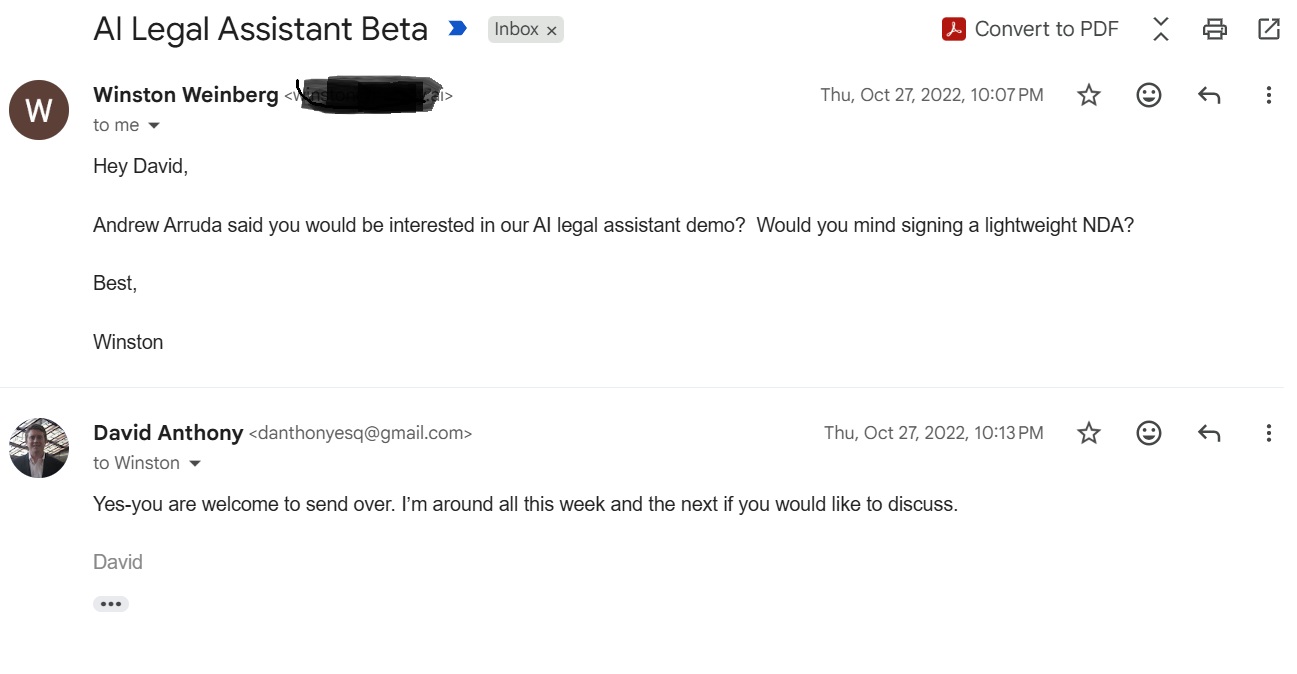
I came across this email a few weeks ago. It was after ClioCon 2022, and people at this legal tech conference (for small firm lawyers) were talking about artificial intelligence, but nobody had any idea how it’d be used. As with any trip to ClioCon, I left in about 10 active technology sales funnels.
Within days, I was emailing with a guy who had an idea (the Big Guy, later named a Top 100 mind in AI tech) for a concept called Harvey AI, and he needed lawyers to beta test it.
TL;DR: Harvey AI is a HUGE deal, and, coincidentally, it’s the AI vendor serving our speaker’s mega firm.
But I bet they weren’t on it in 2022.
Ok, maybe I’m letting my own “small firm lawyer in a big firm world” insecurities do the blog posting now, but I still think the guy was wrong.
Last week, I volunteered at a local Legal Aid Clinic, where 32 community members showed up, all needing help. 7 lawyers came. 4 of them were from a local office of that same mega firm. None of the 4 did collections, evictions, or bankruptcy law.
But they brought their laptops, all logged in to Harvey.
Armed with that, they competently and confidently answered questions about domestic orders of protection and eviction, and all sorts of things they probably had never dealt with before.
It was awesome. (And don’t get me wrong, I came with my laptop and AI squad as well.)
AI is phenomenal technology, that creates new pathways for access to justice across the spectrum. A small business can hire a solo attorney, and, with AI, they can navigate 10,000 pages of document production. A pro se litigant can get answers to help them save their house. A Big Law Firm can reduce a task that used to take 80 hours to 15 minutes.
It’s useful technology, no matter how big your firm is. F that guy.


